
Introducing The Spring Street Passive House: A Healthy Home Project By Kristof & Diane Irwin
For two decades, our work at Positive Energy has been driven by a single, powerful question: why aren’t buildings created to better support the people inside them? We’ve dedicated our careers to answering that question, moving from hands-on custom home building to the forefront of building science and MEP engineering. Now, we’re bringing that journey full circle by taking on our most personal project yet: our own family home, the Spring Street Passive House.
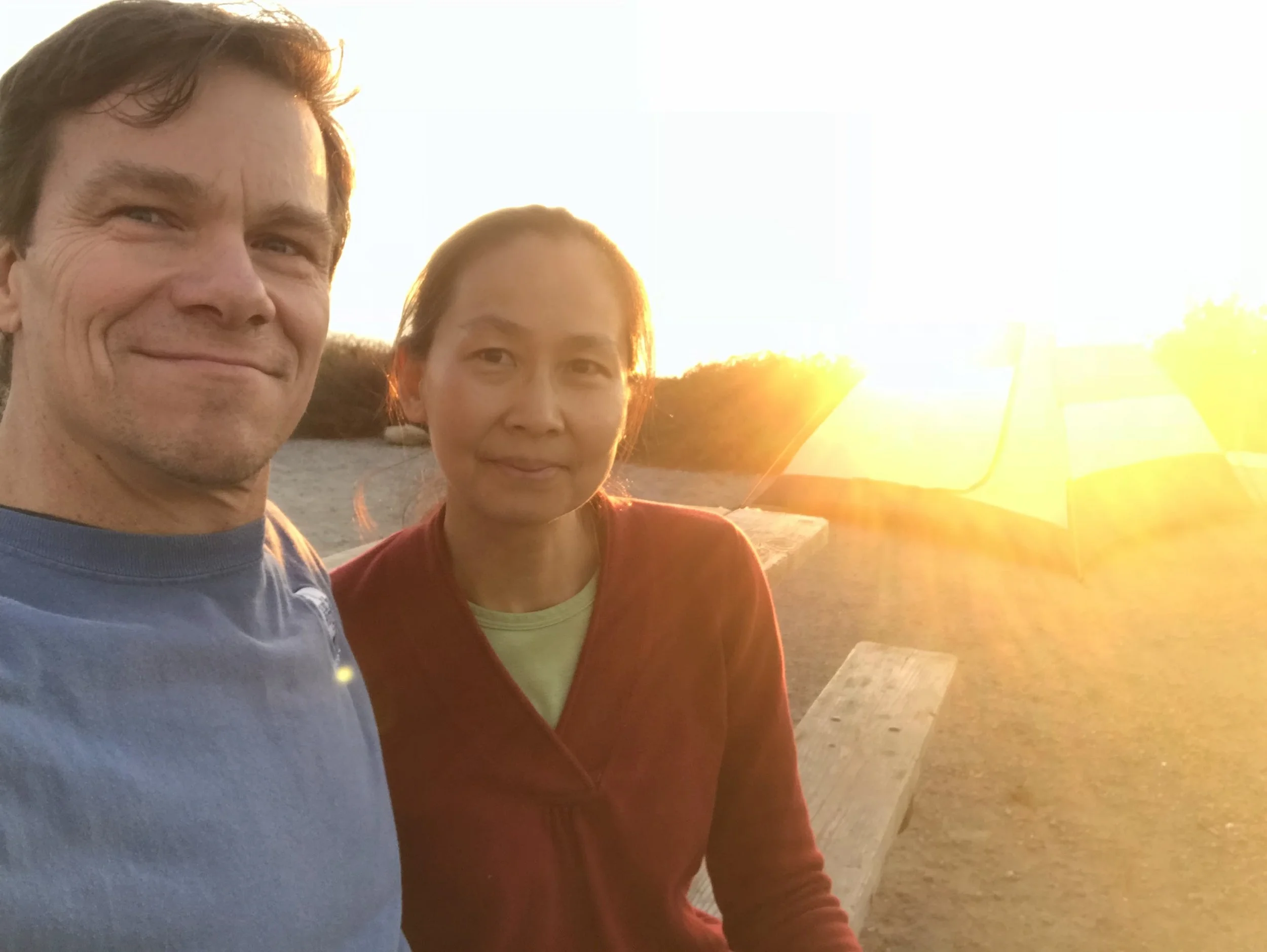
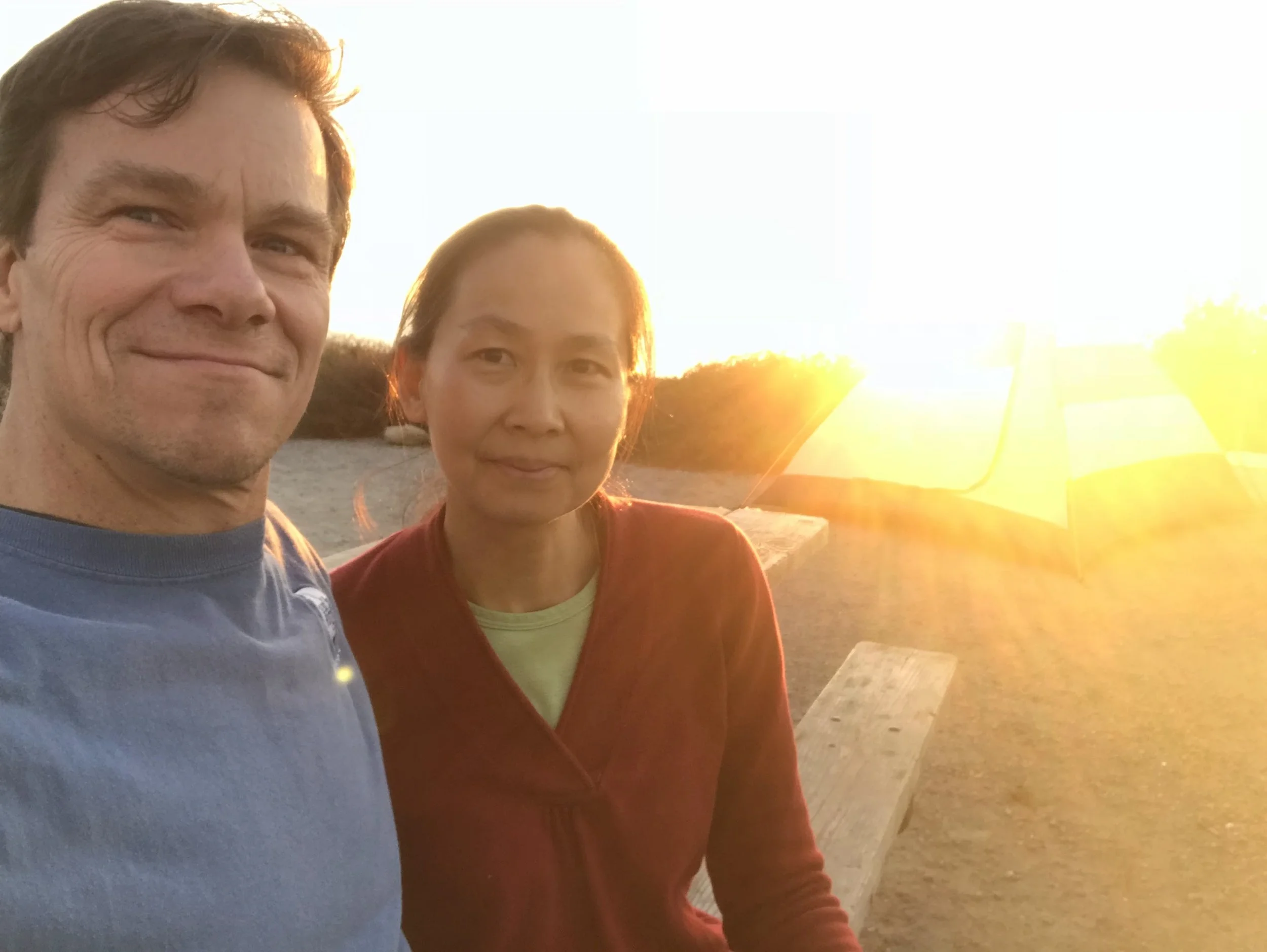
Kristof and Diane Irwin, Co-Founders of the niche building science and MEP firm, Positive Energy.
For two decades, our work at Positive Energy has been driven by a single, powerful question: why aren’t buildings created to better support the people inside them? We’ve dedicated our careers to answering that question, moving from hands-on custom home building to the forefront of building science and MEP engineering. Now, we’re bringing that journey full circle by taking on our most personal project yet: our own family home, the Spring Street Passive House.
This project is more than just a structure of wood and glass; it's a physical manifesto. It’s our chance to apply everything we’ve learned about creating healthy, comfortable, resilient, and durable buildings to the place we will raise our family and welcome our community.
A Dream Site with a Challenge
Our story begins in the dramatic landscape of the Columbia River Gorge, a place we’ve dreamed of calling home for decades. When a steep, rocky, and seemingly unbuildable lot became available, we saw not obstacles, but potential. The site’s defining feature is its dramatic slope, a constraint that has fundamentally shaped the home’s design. Instead of fighting gravity, we are working with it, designing a multi-level home that nests into the hillside and culminates in a surprise, panoramic view of Wy’east (Mt. Hood).
Walking the Walk with Passive House (Phius)
From the start, we knew this home had to align with our professional values. That's why the decision to pursue Phius (Passive House Institute US) certification was an easy one. For us, Passive House represents the fruition of the building science perspective, a holistic, performance-based approach that guarantees exceptional results.
So, what does this mean in practice? It means we are prioritizing the "fabric" of the home first:
Airtight Construction: Creating a meticulously sealed building envelope to eliminate drafts, save energy, and block out wildfire smoke, a critical resilience feature in the Gorge.
Continuous Insulation: Wrapping the home in a thick thermal blanket, free of weak spots, to ensure stable, comfortable indoor temperatures year-round, no matter the weather outside.
High-Performance Windows: Using triple-glazed windows that prevent heat loss and eliminate the feeling of radiant cold, allowing us to frame the stunning landscape without compromising comfort.
Filtered Fresh Air: Employing an Energy Recovery Ventilator (ERV) to act as the "lungs of the house," continuously supplying fresh, filtered air while exhausting pollutants and stale air.
By investing in a superior envelope, we drastically reduce the energy needed for heating and cooling, paving a clear path for our all-electric home to become net-zero with the future addition of solar panels.
A Place for Community
While the technical details are exciting, our ultimate goal is human-centered. We are designing this house to be a sanctuary of health, quiet, and comfort. Above all, we envision it as a welcoming hub for friends and family, with a kitchen at its heart and a seamless connection to the outdoors.
This project is an opportunity for us to live our values and share the process. It’s a chance to answer the tough questions about cost, materials, and complexity we’ve helped so many of our clients navigate. We invite you to follow along as we build not just a house, but a home that embodies the future of resilient, human-centered design.
The Invisible Force Holding Our Buildings Back
Why aren't we building as well as we could be? The answer does not lie in a lack of technical knowledge, but in our deeply held beliefs about our place in the world. As the brilliant systems thinker from the MIT Systems Dynamics group, Donella Meadows, teaches us, our "paradigms" or worldviews are our most powerful levers for change.
by Kristof Irwin
We all want better, healthier places to live and work. Building science is the key to understanding how our homes and offices function as interconnected systems, with the ultimate goal of improving our well-being. The understanding and abilities we have gained from building science is tremendous. Yet, despite knowing so much, we often fall short of making decisions and taking actions that produce the indoor environment we want.
Why aren't we building as well as we could be? The answer does not lie in a lack of technical knowledge, but in our deeply held beliefs about our place in the world. As the brilliant systems thinker from the MIT Systems Dynamics group, Donella Meadows, teaches us, our "paradigms" or worldviews are our most powerful levers for change.
Let's explore the dominant worldview that has shaped how we interact with our homes and our home planet.

The Great Divide: Humanity vs. Nature
We have come to believe that humans, because of their perceived unique capacity for thought and reason, are separate from and superior to the natural world. Through this lens, nature isn't seen as a living system with its own intrinsic value, but rather as a passive backdrop or a collection of resources waiting to be used.

This mindset leads to a drive for control and commodification. If nature is just inert matter, then its purpose is to serve our needs. Land, water, minerals, and living organisms become "resources" to be extracted, bought, sold, and consumed. This utilitarian view makes exploiting nature seem not just acceptable, but a sign of progress and human ingenuity - comparable to our “manifest destiny”. We live in a time where capitalism, consumerism, and materialism dominate to such an extent that enterprises for private profit are consuming and destroying our resources of clean air, clean water and arable land upon which all public welfare depends. The fact that this is currently happening with overt support from the government highlights the power of dominant paradigms.
Our Homes: A Reflection of This Worldview
This ingrained way of thinking is visible in how we design and build our homes today. Our buildings are, in many ways, an ultimate attempt to control the natural world. We do not just seek shelter, we seek security and sanctuary indoors. To do so, we extract vast amounts of materials and energy from the planet and emit vast amounts of waste and pollutants as by-products of the way we choose to construct our shelters, often overlooking, or trying our best to overlook, the environmental consequences.
Once built, our homes become highly controlled environments that exist as separate from nature. Within these spaces we attempt to control every detail of our indoor experience. From the architectural design and layout to the choice of finishes and furnishings, to the layers of engineering decisions impacting temperature, humidity, indoor air quality, sound, vibration, and lighting - all of these efforts reflect a sense of separation from and control of nature. We ironically prioritize our visual connection to nature* while generally failing to recognize outdoor air and the outdoor microbiome as more directly related to our overall health and well-being.
*Strictly speaking, the visual connection to nature is indirect at many levels. First it’s mediated by light and optics that create electrical signals serving bundles of nerve fibers stimulating our optical cortex; these are then further processed by our culturally influenced value-preference systems.
Beyond Our Limited Perception
But here's the thing: our physical and mental perceptions are inherently limited - we experience only a subjective fraction of reality. For example, we don't naturally perceive that our own bodies are a complex ecosystem of trillions of living beings, and that our health is intimately tied to the dynamic relationship of a human microbiome. Similarly, every indoor surface is teeming with microbial life. Our well-being depends on a positive relationship with this invisible world we live within.
We have decided it makes sense to want to look at nature while we live surrounded by synthetic materials. The petrochemical based boxes filter for indoor microbial communities that can live on synthetic materials at temperatures and humidities that we find appealing. In so doing we’ve created a physical separation from nature that mirrors the deeper philosophical schism. Failing to recognize the artificial separation we've created between ourselves and the planet's ecosystems, as well as the microbial world we inhabit, is at this point perhaps the biggest risk to humanity's future.
Bridging the Gap: Expanding Building Science
We know how to create architecturally stunning indoor environments that support our health, comfort and well being. These same spaces can last hundreds of years and have a regenerative impact on planetary ecosystems. Does this sound familiar? Is that what we do in practice? Ask anyone who’s familiar with both what’s possible and what’s actually occurring and the reality of the "know-do gap" in the AEC becomes clear. Though we know how, we do not do what’s needed to achieve the full positive potential of our knowledge and effort.
The core of building science is about applying systems thinking to create healthier, more harmonious environments. However, the dominant worldview which sees humanity as separate from nature profoundly influences our approach. It fosters a mindset of control and exploitation. Our buildings, with their vast resource consumption and attempts at total environmental control, are prime examples of this.
To truly unlock the power of building science and close the "know-do" gap, we must recognize and challenge these underlying paradigms. As previously noted, our worldviews are the most powerful points of leverage for transforming our world. It’s like being lost in a daydream and then coming back to the room you’re in - we can snap out of the trance that nature is “out there” and we are separate from it. By becoming aware of the distorting power of these deeply ingrained beliefs,we can begin to make better decisions and create truly healthier, more harmonious living and working environments to promote human thriving.

A Path for California Architects to Easily Achieve Title 24 and Achieve Beyond-Code Performance
California has long been at the forefront of energy efficiency in the United States compared to its 49 counterparts, with its pioneering Building Energy Efficiency Standards, commonly known as Title 24, Part 6, first adopted in 1976. These standards are not static. They undergo rigorous updates every three years, serving as a dynamic benchmark for building energy performance and a critical mechanism for reducing greenhouse gas emissions during construction and operation. This continuous evolution is a deliberate policy strategy by the California Energy Commission (CEC) to systematically integrate the latest energy-saving technologies and construction practices into the built environment.
Designing for a Resilient California Future
The Evolving Mandate for Energy Efficiency in California Homes
California has long been at the forefront of energy efficiency in the United States compared to its 49 counterparts, with its pioneering Building Energy Efficiency Standards, commonly known as Title 24, Part 6, first adopted in 1976.[1] These standards are not static. They undergo rigorous updates every three years, serving as a dynamic benchmark for building energy performance and a critical mechanism for reducing greenhouse gas emissions during construction and operation.[1] This continuous evolution is a deliberate policy strategy by the California Energy Commission (CEC) to systematically integrate the latest energy-saving technologies and construction practices into the built environment.[2]
The state's ambitious climate objectives, including the goal of achieving net-zero buildings by 2030 and net-zero carbon pollution by 2045, underscore the profound importance and strategic direction of these regulations.[3] The 2022 Energy Code, which became effective on January 1, 2023, represents a significant leap forward in this trajectory. New single-family homes constructed under these standards are projected to consume approximately 7% less energy due to enhanced efficiency measures compared to those built under the 2019 code. When the impact of mandatory rooftop solar electricity generation is factored in, homes built to the 2019 standards are estimated to use about 53% less energy than those from 2016, illustrating the accelerating pace of energy reduction.2 This consistent and increasingly stringent progression of Title 24 updates signifies California's strategic commitment to driving the building sector toward its ambitious decarbonization targets. For architects, this means that compliance is not a fixed target but a moving one, necessitating continuous engagement with the latest code cycles. Proactive understanding and integration of advanced building science principles are therefore fundamental requirements for maintaining a competitive edge and ensuring designs are future-proof and aligned with state mandates for sustainability and reduced operational costs.
Bridging Design Vision with Technical Excellence
Architects, as the primary visionaries shaping California's built environment, hold a unique and powerful position to integrate these stringent energy standards into designs that are both aesthetically compelling and functionally superior. However, translating grand design concepts into the intricate technical realities of building science and mechanical, electrical, and plumbing (MEP) engineering can often present a formidable challenge. Many architects possess a strong general knowledge of construction but may lack the specialized technical depth required to confidently navigate the complexities of advanced building performance.
This blog post is crafted to bridge that very gap. It aims to demystify the technical intricacies of Title 24 compliance and beyond-code performance, offering practical strategies and evidence-based insights. By offering an understanding of the fundamental principles of building science and the pivotal role of robust MEP engineering, we hope to empower architects, enhancing their confidence and enabling them to create truly high-performance custom homes that not only meet but demonstrably exceed regulatory demands, contributing to a more resilient and sustainable future for California.
Decoding California's Title 24 Energy Code
Understanding the 2022/2023/2025 Updates: A Framework for Compliance
California's Title 24, Part 6, formally known as the Building Energy Efficiency Standards, is a comprehensive set of regulations that govern energy use in new residential construction across the state. These standards apply broadly to single-family homes, accessory dwelling units (ADUs), duplexes, and townhomes, as well as to significant renovations and additions.[2] The code is regularly updated to incorporate the latest energy-saving technologies and construction practices, reflecting California's aggressive climate goals.
The 2022 Energy Code, which took effect on January 1, 2023, introduced several pivotal advancements that architects must understand:
Heat Pumps: The code strongly encourages the use of efficient electric heat pumps for both space heating and water heating, marking a definitive policy shift away from reliance on fossil fuels in buildings.[1] This prioritization aligns with the state's broader decarbonization efforts.
Electric-Ready Requirements: New homes are now mandated to be "electric-ready," meaning they must be wired and plumbed in a way that facilitates the future installation of all-electric appliances and systems, even if gas appliances are initially installed.[5] This foresight minimizes future retrofit costs and accelerates the transition to an all-electric grid.
Solar PV and Battery Storage: Requirements for solar photovoltaic (PV) systems have been expanded, making them mandatory for most new homes to achieve net-zero electricity goals. There are, however, specific exemptions for solar PV based on factors such as significant shading, small building size (under 500 square feet), or conversions from existing structures like garages.[3] The 2023 Title 24 updates place increased emphasis on integrating battery storage systems, recognizing their role in enhancing demand flexibility and grid resilience by allowing excess solar generation to be stored and used during peak demand periods.[3]
Ventilation Standards: The 2022 code also strengthened ventilation requirements, a crucial step for improving indoor air quality in increasingly airtight homes.[5]
Looking ahead, the upcoming 2025 Title 24 updates are poised to introduce even higher performance margins for single-family homes, with specific targets varying by California's 16 climate zones.[6] This continuous and increasingly stringent progression of Title 24, particularly the consistent push towards all-electric homes and mandatory solar with encouraged battery storage, is in clear relationship with California's strategic direction towards grid-interactive, decarbonized buildings. This trajectory means architects must design not just for energy efficiency within the building's confines, but for how the building actively participates in the broader energy grid. This requires anticipating a future where homes are dynamic participants in energy management, optimizing for "demand flexibility" and "time-dependent valuation" (TDV) to support grid stability and reduce peak loads.[1] The shift to all-electric design also inherently improves indoor air quality by eliminating on-site combustion byproducts.[10]
Compliance Pathways: Mandatory Measures, Prescriptive, and Performance Approaches
Title 24 provides architects with distinct pathways to demonstrate compliance, offering a degree of flexibility while ensuring all projects meet fundamental energy efficiency benchmarks. Regardless of the chosen approach, a core set of mandatory measures must always be met.[1]
Mandatory Measures: These are foundational, non-negotiable requirements that apply to specific building features and systems across all projects. Examples include minimum insulation standards tailored to climate zones, the use of high-performance windows and doors equipped with adequate weather stripping to prevent air leakage, the installation of efficient HVAC systems paired with smart, programmable, or remotely controllable thermostats, and the exclusive use of LED lighting with automatic controls.[3] These measures form the baseline for energy-efficient construction.
Prescriptive Approach: This pathway offers the most straightforward route to compliance, functioning as a "recipe" or checklist. Architects can demonstrate compliance by ensuring each building component meets or exceeds predefined performance levels. This includes adhering to specific R-values for insulation (e.g., R-30 to R-49 for roofs/attics depending on climate zone) and U-factors for windows (e.g., between 0.3 and 0.4, with a prescriptive maximum of 0.30 for all fenestration).[1] While this approach simplifies the design and permitting process by providing clear, fixed targets, it inherently offers less design flexibility and may not allow for optimal performance tailoring to unique project conditions.
Performance Approach: This method provides significantly greater design freedom and encourages innovation. Instead of adhering to a rigid checklist, architects demonstrate compliance by proving that the proposed building achieves the same or better overall energy efficiency than an equivalent "standard design" building. This is accomplished through sophisticated energy modeling, which calculates Energy Design Ratings (EDR) based on source energy and time-dependent valuation (TDV) energy.[1] The EDR system allows for strategic trade-offs between different building components; for instance, a highly efficient envelope might offset less efficient HVAC components, provided the total energy budget is met or exceeded. Approved compliance software, such as EnergyPro, CBECC, or EnergyPlus, is used to simulate the building's energy performance and compare the proposed design's EDR against the standard design's budget.[3] This approach is particularly beneficial for complex custom homes, where unique architectural visions can be realized while still achieving high energy performance.
The availability of both prescriptive and performance compliance pathways presents a strategic choice for architects, allowing them to select an approach that best suits their project's complexity and design ambition. While the prescriptive path offers simplicity and predictability for straightforward projects, the performance path, though demanding advanced energy modeling expertise, unlocks greater design flexibility. This flexibility can lead to optimization for specific project goals beyond minimum compliance, potentially resulting in more cost-effective and innovative solutions in the long run. However, it is important to note that the performance path requires accurate modeling and the involvement of skilled MEP engineers and energy modelers to ensure compliance is robustly demonstrated and potential issues are mitigated early in the design process.[3]
This table offers a concise overview of typical prescriptive requirements for single-family homes under the 2022 Title 24 Energy Code. It provides a quick reference for architects to understand baseline energy efficiency targets for various California climate zones, facilitating early design decisions and material specifications. The variations across zones underscore the climate-specific nature of Title 24, guiding architects to tailor their designs to local environmental conditions.
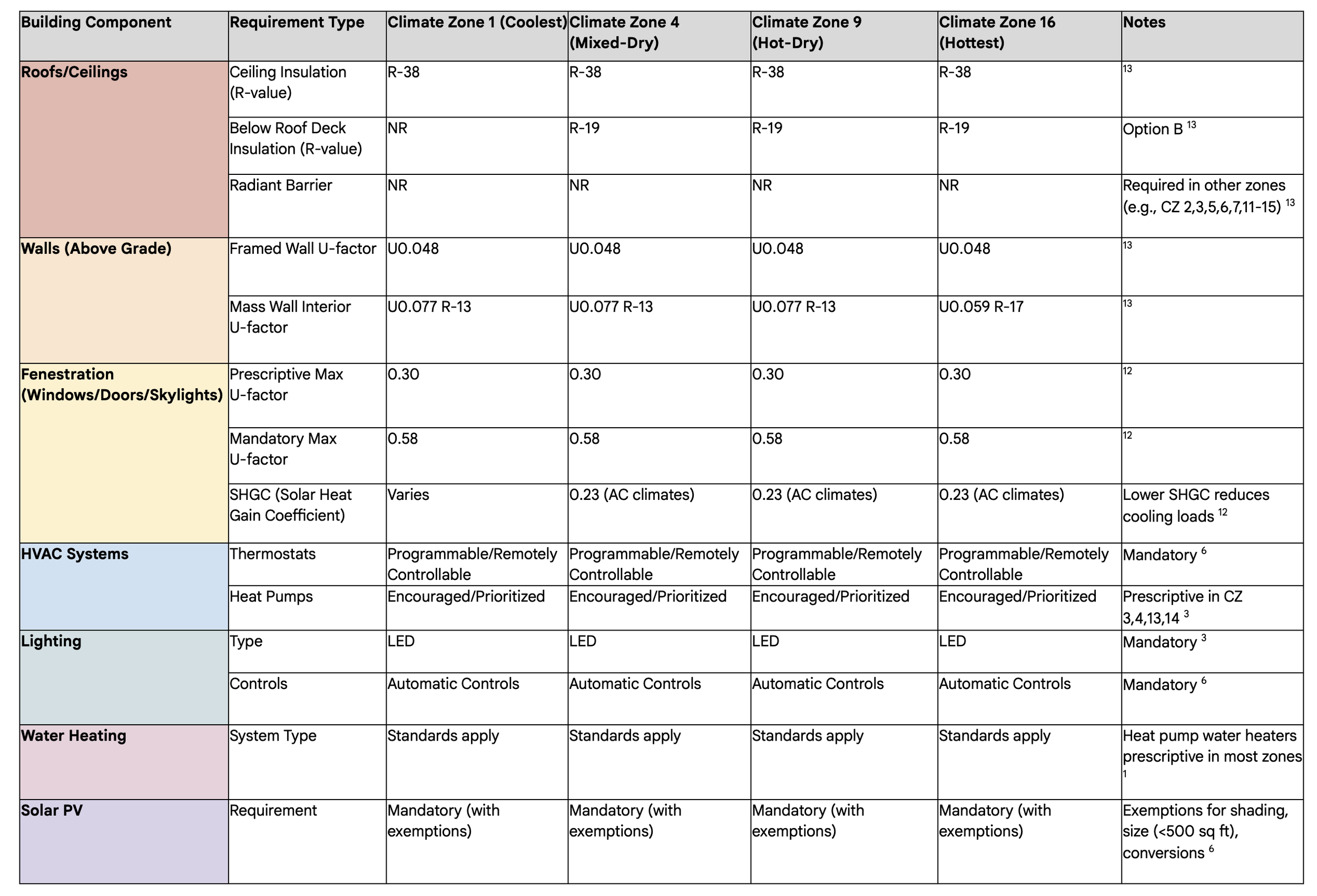
Table: Snapshot of Key Prescriptive Requirements for Single-Family Homes by Climate Zone (2022 Title 24, Part 6) Note: This table provides general prescriptive values. Actual requirements depend on the specific climate zone and project details. Architects should consult the full 2022 Single-Family Residential Compliance Manual and local Authority Having Jurisdiction for precise requirements.7
Architectural Design Strategies for Title 24 Compliance
Achieving Title 24 compliance and moving towards high-performance building begins with fundamental architectural design choices. These decisions, made early in the process, profoundly influence a home's energy consumption, occupant comfort, and long-term durability.
Optimizing the Building Envelope: Insulation, Fenestration, and Air Sealing
The building envelope—comprising walls, roofs, floors, windows, and doors—acts as the primary environmental separator between the conditioned interior and the external climate.[12] Its design is critical for managing heat transfer and overall energy performance.
Insulation: Strategic use of insulation materials with high R-values minimizes the energy required for heating and cooling.[6] Title 24 provides specific R-value requirements that vary significantly based on California's 16 climate zones and the particular building component. For instance, roof and attic insulation requirements can range from R-30 to R-49, while walls in some zones may require R-15 or R-30.[6] Architects must select insulation types and thicknesses appropriate for their project's climate zone to ensure optimal thermal resistance.
Fenestration: Windows, glazed doors, and skylights can account for up to 50% of a home's heating and cooling loads (and even more so in some heavily glazed homes).[12] High-performance fenestration is critical. This involves specifying products with low U-factors, which measure the rate of heat transfer—a lower U-factor indicates better insulation.[6] Equally important is the Solar Heat Gain Coefficient (SHGC), which quantifies how much solar radiation passes through the glass. In California's air-conditioning-dominated climates, a lower SHGC (e.g., below 0.23) is beneficial for reducing cooling loads.[12] Modern fenestration often incorporates double or triple glazing, low-emissivity (low-e) coatings, and inert gas fills (like argon or krypton) between panes to significantly enhance thermal performance.[12]
Air Sealing: A continuous and robust air barrier is fundamental to high-performance building. This barrier prevents uncontrolled air leakage, known as infiltration and exfiltration, which can significantly compromise the effectiveness of insulation and lead to substantial energy loss.[18] Beyond energy savings, effective air sealing improves occupant comfort by eliminating drafts and plays a critical role in moisture control and maintaining healthy indoor air quality.[17] Key areas for meticulous air sealing include penetrations through the building envelope such as attic hatches, electrical boxes, plumbing stacks, and the junctions between walls and ceilings.[25]
Moisture Management: A comprehensive moisture management strategy is essential for the long-term durability of the building and the health of its occupants. Moisture is a leading cause of building degradation and can lead to serious health issues.[27] This strategy involves a multi-pronged approach: controlling moisture entry (from rainwater, groundwater, air transport, and vapor diffusion), preventing its accumulation within building assemblies, and facilitating its removal.[27] Practical strategies include designing effective drainage planes, installing proper flashing at all openings and transitions, and making thoughtful decisions about vapor retarders based on climate conditions. For instance, in air-conditioned climates, avoiding interior vapor barriers is often recommended to allow building assemblies to dry inward, preventing moisture entrapment that could lead to mold and rot.[19]
The building envelope is not merely a collection of independent components but an integrated system where insulation, fenestration, air sealing, and moisture management work synergistically. A deficiency in one area, particularly air sealing, can undermine the performance of others and lead to significant durability and health issues, such as moisture accumulation and mold, even if individual R-values or U-factors meet code minimums. This highlights that "compliance" represents a baseline, and true "high-performance" demands a holistic, systems-thinking approach to the envelope, prioritizing the long-term health and resilience of the structure and its inhabitants.
Integrating Solar Photovoltaic (PV) Systems
Solar PV systems are a cornerstone of California's energy policy, now mandated for most new residential construction to help achieve the state's net-zero electricity goals.[3] For architects, this mandate translates into specific design considerations. It is essential to assess roof strength to support the weight of the panels, optimize roof orientation and pitch for maximum solar access throughout the year, and adhere to strict fire and safety codes regarding panel placement and spacing.[32]
Beyond simply generating electricity, the integration of battery storage systems is increasingly encouraged, particularly with the advancements in the 2023 Title 24 updates. This integration enhances demand flexibility and grid resilience by allowing excess solar generation produced during the day to be stored and then discharged during evening peak demand periods, or even during grid outages.[3] The mandate for solar PV, coupled with the strong encouragement for battery storage, signifies a shift in building performance expectations: homes are moving beyond merely generating renewable energy to actively managing it for grid stability. This implies that architects should design homes that are not just "solar-ready" but "grid-interactive." This involves considering how the home's energy profile can adapt to time-of-use electricity rates and contribute to the overall health and stability of the electrical grid. This is a higher-order consideration than simply sizing a PV array; it involves designing for demand flexibility and understanding the time-dependent valuation (TDV) of energy, anticipating a future where homes are active participants in energy management, optimizing for both homeowner cost savings and broader grid support.[1]
The Critical Role of MEP Engineering in Title 24 Compliance
MEP (Mechanical, Electrical, and Plumbing) engineering forms the functional backbone of any building, directly influencing its energy efficiency, occupant comfort, and safety.[18] For high-performance homes, the early and continuous involvement of MEP engineers in the design process is not merely beneficial but crucial. Their expertise allows for the optimization of building systems from the outset, identifying significant energy-saving opportunities and ensuring seamless integration with architectural plans. This proactive collaboration helps prevent costly redesigns, delays, and performance compromises that can arise from a fragmented design approach.[3]
High-Efficiency HVAC Systems: The Shift to Heat Pumps and Smart Controls
HVAC systems typically represent the largest energy consumers within a home.[18] Title 24 mandates increasingly higher efficiency ratings for HVAC equipment, driving innovation and adoption of appropriate technologies.[3]
Heat Pumps: California's energy policy explicitly prioritizes heat pumps over traditional gas heating systems, with the 2022 Energy Code actively encouraging their widespread adoption for both space heating and water heating.[1] Heat pumps are remarkably efficient because they operate by transferring heat rather than generating it through combustion, making them capable of providing both heating and cooling from a single system.[34] This technology offers substantial energy bill savings for homeowners, with average annual savings of $370 compared to gas heating, and potentially up to $3,260 when replacing propane or oil systems (mileage may vary).[10] Beyond economic benefits, heat pumps significantly reduce greenhouse gas emissions, aligning with California's decarbonization goals and improving indoor air quality by eliminating combustion byproducts.[10] Various types of heat pumps are available, including ground source heat pumps (GSHP), which are conventionally called “geothermal” systems, variable speed air source heat pumps (VRF), and air to water heat pumps (A2WHP), each offering different configurations and appraoches.[34]
Smart Controls: The integration of smart controls is a mandatory aspect of Title 24 compliance. Programmable or remotely controllable thermostats are required, enabling precise temperature management and significant energy reductions by optimizing heating and cooling schedules.[6] These smart thermostats and automated controls are essential tools for comprehensive HVAC system optimization, allowing homeowners and building management systems to fine-tune energy use based on occupancy patterns and external conditions.[18]
Ventilation: In the context of increasingly airtight, high-performance homes, mechanical ventilation systems become indispensable for maintaining healthy indoor air quality. Energy Recovery Ventilators (ERVs) and Heat Recovery Ventilators (HRVs) are designed to exchange stale indoor air with fresh outdoor air while simultaneously recovering a significant portion of the energy from the exhaust air.[20] HRVs primarily transfer heat, while ERVs transfer both heat and moisture. These systems are crucial for ensuring continuous fresh air supply without compromising the thermal performance of the building envelope.
Advanced Water Heating and Lighting Solutions
Beyond space conditioning, Title 24 also addresses other major energy consumers in residential buildings.
Water Heating: The code outlines specific standards for water heating systems, with the 2022 code introducing prescriptive requirements for heat pump water heaters in most climate zones.[1] This further reinforces the state's push towards all-electric solutions.
Lighting: Energy-efficient lighting, predominantly LED technology, is mandatory for new residential construction.[3] This is coupled with requirements for automatic controls, such as occupancy sensors and timers, to prevent energy waste in unoccupied spaces.[6] Architects also play a vital role in maximizing natural daylighting through thoughtful building orientation and fenestration design, which not only reduces reliance on artificial lighting but also contributes to lower HVAC loads.[18]
MEP engineering is not just about selecting efficient equipment; it is about orchestrating a cohesive system that interacts dynamically with the building envelope and occupant behavior. The widespread adoption of all-electric heat pumps, coupled with sophisticated smart controls and balanced ventilation systems, represents a fundamental re-thinking of how comfort and energy use are achieved in a home. Achieving "beyond-code" performance means leveraging MEP systems not just for minimum compliance, but for delivering superior occupant comfort, health, and long-term operational efficiency. This proactive approach addresses issues like indoor air quality, which are often secondary considerations in minimum code compliance, ensuring a truly high-performance living environment.
The Beyond-Code, Transformative Potential of Phius
What is Phius? A Performance-Based Standard for Optimal Living
While Title 24 establishes a robust foundation for energy efficiency, pushing California homes towards significant decarbonization, architects can aim higher. Simply meeting compliance ensures a baseline level of performance, but true innovation lies in exceeding it. If architects are already deeply engaged in the complex processes of adhering to stringent Title 24 requirements, it is a strategic next step to explore standards like Phius. These offer not just incremental improvements, but a transformative shift towards ultra-low energy use, superior indoor air quality, and enhanced resilience. Considering the effort already invested in achieving Title 24 compliance, delving into Phius represents an opportunity to leverage existing expertise and investment, ensuring that California's homes are not just code-compliant, but models of sustainable, high-performance living that set a new benchmark for the future.
Phius (Passive House Institute US) offers a robust, climate-specific passive building standard that guides the design and construction of buildings to achieve superior energy performance, exceptional indoor air quality, and enduring quality.[38] It provides a "quality-and-conservation-first framework for net zero building," emphasizing deep energy conservation measures as the primary strategy for achieving ultra-low energy consumption.[38]
Phius standards are globally applicable and are firmly rooted in rigorous building science principles and best practices, supported by comprehensive quality assurance protocols.[38] The core philosophy of Phius is to identify the "sweet spot where aggressive energy and carbon reduction overlap with cost effectiveness," taking into account a full range of variables including climate zone, source energy, building size, and construction costs.[38] This approach ensures that high performance is not only achievable but also economically viable over the building's lifecycle. Phius certification has emerged as the leading passive building certification program in North America, with thousands of certified units across numerous states, demonstrating its growing adoption and proven efficacy.[39]
Phius is not merely a set of energy efficiency targets; it is a holistic building science framework that optimizes for performance, occupant health, and long-term durability from the outset. Its rigorous third-party verification and design review processes serve as a powerful risk management tool. These comprehensive reviews identify potential design and construction issues early in the design stage, which is crucial for complex high-performance buildings. This proactive identification and resolution of potential problems significantly reduces the likelihood of post-occupancy performance gaps and costly rectifications, providing architects with a higher degree of certainty that the building will perform as intended. This shifts the focus from simply "meeting code" to actively verifying performance.
The Five Pillars of Passive Building
Phius standards are fundamentally built upon five interconnected design principles, which, when integrated holistically, enable the construction of ultra-low energy buildings [40]:
Continuous Insulation and Thermal Bridge-Free Design: This principle calls for an uninterrupted layer of insulation that completely envelops the building, minimizing heat transfer through the building shell. Crucially, it also requires the elimination of "thermal bridges"—points in the building envelope (such as framing members or connections) where heat can easily escape or enter due to breaks in the insulation layer or the use of highly conductive materials. Advanced framing techniques and the use of low-conductivity structural materials are employed to prevent these thermal bypasses.[40] This is a significant departure from conventional framed construction, where thermal bridging can substantially degrade overall thermal performance.
Achieving Exceptional Airtightness: This pillar mandates the creation of an extremely tight building envelope, designed to achieve very low air infiltration rates (e.g., a maximum of 0.6 air changes per hour at 50 Pascals pressure, as measured by a blower door test).[21] This level of airtightness is far more stringent than typical code requirements and is critical for several reasons: it dramatically reduces energy loss due to uncontrolled air leakage, eliminates drafts for superior occupant comfort, and provides precise control over moisture movement within the building assemblies. Achieving this requires meticulous attention to detail in sealing all penetrations and junctions in the building envelope using appropriate tapes, sealants, and caulks.[21]
High-Performance Windows and Doors: Glazed openings are inherently the weakest thermal points in conventional building envelopes.[21] Phius addresses this by requiring windows and doors with exceptionally low U-factors (indicating minimal heat transfer) and appropriate Solar Heat Gain Coefficients (SHGC). This typically involves the use of triple-glazed windows, often with advanced low-emissivity (low-e) coatings and inert gas fills between panes, combined with highly insulated frames.[12] These components are designed to prevent air leakage, minimize heat gain in summer, and retain heat in winter, contributing significantly to thermal comfort and energy efficiency. Beyond thermal performance, high-performance windows also offer superior acoustic insulation.[21]
Balanced Ventilation with Energy Recovery (HRV/ERV): In an exceptionally airtight building, a dedicated mechanical ventilation system is essential to ensure a continuous supply of fresh, filtered outdoor air while exhausting stale indoor air. This is achieved through Heat Recovery Ventilators (HRVs) or Energy Recovery Ventilators (ERVs).[21] HRVs primarily recover heat from the outgoing air and transfer it to the incoming fresh air. ERVs, on the other hand, transfer both heat and moisture. These systems are highly efficient, with some models capable of retaining over 80% of the heat energy during the air exchange process.[21]
Optimized Passive Solar Design & Internal Heat Gains: While not always explicitly listed as a standalone "pillar" in every Phius summary, the standard implicitly relies on intelligent architectural design to minimize active heating and cooling needs. This involves optimizing the building's orientation on the site to maximize beneficial passive solar gains during colder months, while strategically incorporating shading elements (such as overhangs, fins, or landscaping) to control unwanted solar heat gain during warmer periods.[40] The design accounts for internal heat gains generated by occupants, appliances, and lighting, leveraging these sources to further reduce the demand for supplemental heating.[40]
The five pillars of Phius are not independent features to be simply added to a design; rather, they are interconnected design principles that must be integrated from the earliest conceptual stages of a project. This integrated approach directly addresses the "performance gap" often observed in conventionally built "green" homes, where theoretical energy savings fail to materialize in practice due to poor execution of individual components or a lack of systemic thinking. The inherent interdependency of these principles means that exceptional airtightness, for instance, necessitates balanced mechanical ventilation for healthy indoor air quality, preventing issues like stuffiness or moisture accumulation.21 Similarly, continuous insulation and thermal bridge-free design are foundational to minimizing heat loads, which then allows for much smaller, more efficient HVAC systems. This holistic design methodology is precisely what enables Phius-certified buildings to consistently achieve their ambitious performance targets, delivering on promised energy savings and comfort levels.
The Phius Advantage: Unparalleled Comfort, Health, and Durability
Phius-certified buildings offer a comprehensive suite of benefits that extend far beyond mere energy savings, delivering a superior living environment and long-term value [38]:
Unparalleled Comfort: Due to superinsulation, high-performance windows, and precisely engineered mechanical systems, Phius homes maintain a remarkably consistent and comfortable indoor temperature throughout the year. This eliminates common issues like cold spots, drafts, and significant temperature fluctuations.[21] The robust building envelope also provides exceptional acoustic insulation, creating a quiet and peaceful indoor sanctuary, shielded from external noise.[44]
Superior Indoor Air Quality (IAQ): A hallmark of Phius design is its commitment to healthy indoor environments. The controlled ventilation systems (HRV/ERV) continuously supply fresh, filtered outdoor air while exhausting stale indoor air, significantly reducing the concentration of indoor pollutants, allergens, dust, and pollen.[36] By actively managing humidity levels, these systems also mitigate the risk of mold growth, contributing to a healthier living environment, particularly beneficial for individuals with allergies or respiratory sensitivities.[36]
Enhanced Durability and Resilience: The holistic design approach and meticulous attention to detail in constructing the Phius building enclosure result in structures that are uniquely built for the long haul. This inherent durability translates into reduced maintenance and repair costs over the building's lifespan.[38] Furthermore, Phius buildings have demonstrated enhanced resilience in the face of extreme weather events and natural disasters, including wildfires. Their exceptional airtightness, combined with the use of fire-resistant materials and robust envelope construction, provides a significant protective barrier against external threats.[26]
Long-Term Financial Value: While the initial construction costs for a Phius-certified home may be slightly higher than a traditional build (typically ranging from 3.5% to 8% more), the long-term financial benefits are substantial and compelling.[21] Phius homes achieve dramatic reductions in energy consumption—often 80-90% less for heating and cooling compared to conventional buildings, and approximately 30% less than typical new builds.[21] This translates directly into significantly lower utility bills and provides a hedge against future energy price increases, ensuring long-term operational cost savings.[44] Phius certification often automatically qualifies homes for other prestigious designations, including the U.S. Department of Energy (DOE) Zero Energy Ready Home status and the U.S. Environmental Protection Agency (EPA) Indoor airPLUS and ENERGY STAR certifications.[39] These additional certifications further enhance the marketability and resale value of Phius homes, appealing to an increasingly environmentally conscious buyer demographic.[46]
The comprehensive benefits of Phius certification extend beyond energy efficiency to encompass occupant well-being, building longevity, and enhanced market value. This broader value proposition shifts the conversation for architects from merely "meeting code" to delivering a superior, future-proof product that offers tangible, multi-faceted benefits to homeowners. The emphasis on comfort, health, and resilience, coupled with verified energy savings and recognized certifications, provides architects with a powerful narrative to articulate the advantages of investing in beyond-code performance.
This table quantifies the tangible improvements offered by Phius certification over standard Title 24 compliance, providing compelling evidence for architects to present to clients. It directly illustrates the concept of "beyond-code performance" by highlighting the significant differences in key metrics.
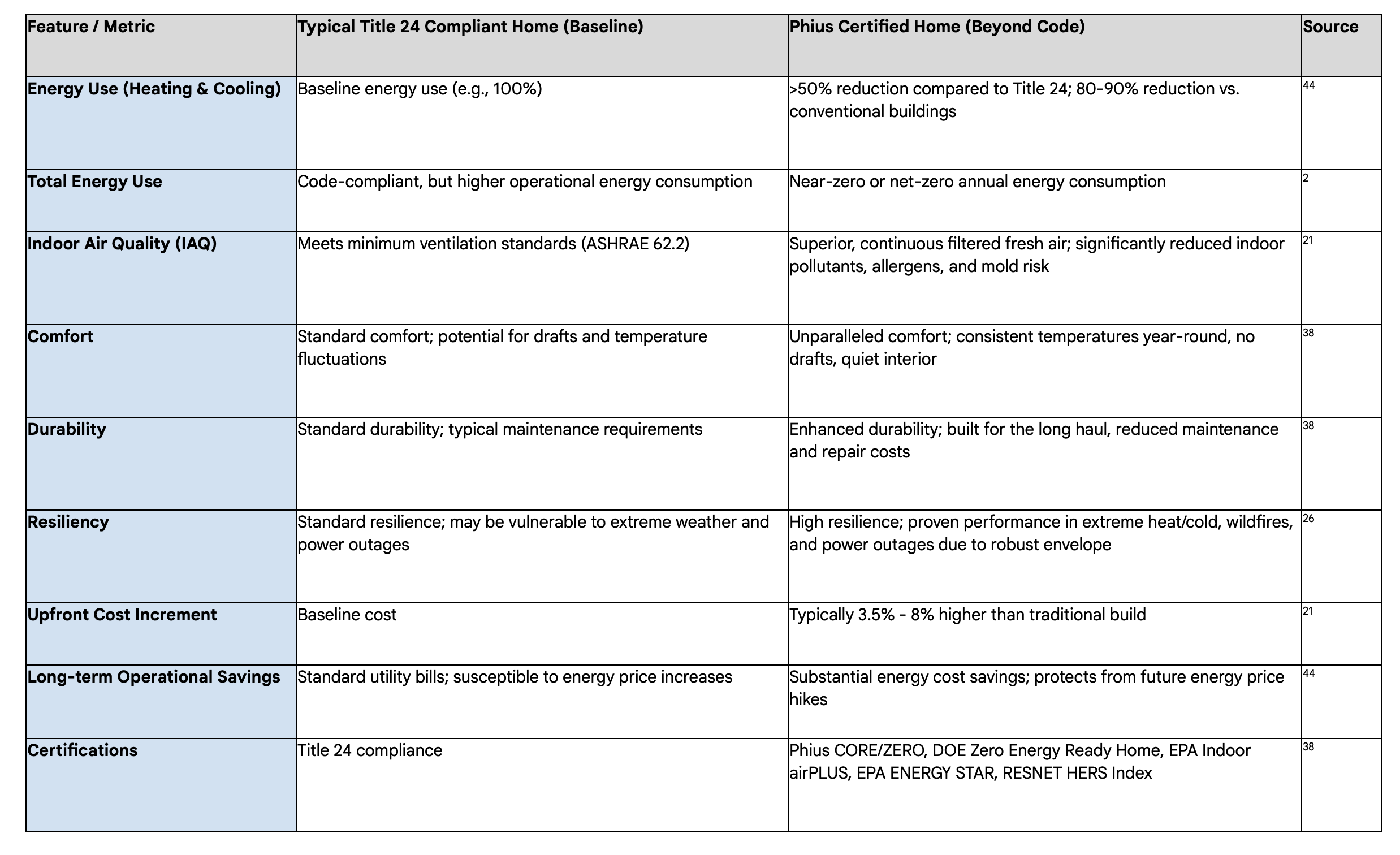
Table: Comparative Performance: Title 24 Compliant vs. Phius Certified Homes
Phius Certification Pathways: CORE and ZERO
Phius offers a structured approach to high-performance building through distinct certification levels, allowing architects and clients to select the ambition level that best aligns with their project goals and sustainability aspirations.[38]
Phius CORE: This is Phius's foundational or "legacy" certification. It focuses on meticulously optimizing both passive and active conservation strategies to achieve a superior level of performance and construction quality.[38] Phius CORE targets performance metrics that are challenging yet achievable primarily through robust conservation measures, such as superinsulation, airtightness, and high-performance windows. It offers a flexible performance path applicable to all building types, as well as a more streamlined, limited-scope prescriptive path specifically designed for single-family homes and townhomes, facilitating broader adoption.[38]
Phius ZERO: Building upon the rigorous framework of Phius CORE, the Phius ZERO standard elevates the ambition to achieve net-zero energy consumption. This certification sets the net source energy target at absolute zero, meaning the building is designed to produce as much energy as it consumes on an annual basis.[38] A key distinguishing feature of Phius ZERO is its strict prohibition of fossil-fueled combustion on site. To achieve the net-zero target, the standard provides options for integrating both on-site renewable energy generation (e.g., solar PV) and, where necessary, off-site renewable energy solutions.[38]
The existence of these tiered Phius certifications (CORE and ZERO) allows architects and clients to incrementally increase their sustainability ambition, providing a clear roadmap for achieving deeper decarbonization and energy independence. This structured approach not only makes high-performance building more accessible but also serves as a clear market signal for the direction of advanced building practices. It establishes recognized benchmarks for what "net-zero" truly means in a verified, performance-based context, distinguishing it from less rigorous "green" labels and guiding the industry towards increasingly sustainable and resilient construction.
The Synergy of Building Science and MEP Engineering
Fostering Collaboration from Concept to Completion
Achieving high-performance, beyond-code homes in California necessitates a fundamental shift from traditional linear design processes to a more collaborative and iterative approach. The Integrated Design Process serves as this essential framework, bringing together architects, MEP engineers, contractors, energy modelers, and other key stakeholders from the earliest conceptual stages of a project.[18]
The core elements of IDP include effective communication, integrated project management, shared goals, and cross-disciplinary knowledge exchange.[52] This holistic approach ensures that sustainability and high performance are embedded at the core of every design decision. By fostering early collaboration, the IDP allows the project team to identify synergies among different building components, leading to optimized performance, reduced lifecycle costs, and a significant minimization of costly change orders during construction.[18] An early-appointed design facilitator, ideally with expertise in energy and emissions reduction, is crucial to guide this interdisciplinary team through the complex decision-making process.[54]
The IDP is more than just a methodology; it represents a fundamental paradigm shift in architectural practice for high-performance buildings. It moves away from siloed disciplines where each consultant works independently, often leading to missed opportunities for optimization or, worse, conflicts that compromise performance. Instead, it promotes a unified vision where, for example, an architect's passive solar design choices directly inform the MEP engineer's sizing of heating and cooling systems, and the structural engineer's material choices consider thermal bridging. This collaborative environment ensures that the building operates as a cohesive, high-performing system, rather than a collection of disparate components. This integrated approach is what allows projects to consistently achieve their performance targets and avoid the "performance gap" often seen in conventionally built "green" homes, where theoretical energy savings do not materialize in practice due to poor integration or execution.
Overcoming Challenges in High-Performance Home Construction in California
While the benefits of high-performance homes are clear, their construction in California presents unique challenges that require strategic foresight and collaborative solutions.
Cost and Complexity: Building to standards like Phius often entails higher upfront costs (3.5-8% more than traditional builds) due to advanced materials, increased insulation, high-performance windows, and sophisticated ventilation systems.[21] The design process itself can be more complex, requiring specialized energy modeling tools (which may not be approved for Title 24 compliance, necessitating dual modeling) and meticulous detailing to achieve extreme airtightness and eliminate thermal bridges.[26] This complexity demands a higher level of expertise from architects, engineers, and contractors.[57]
Labor and Expertise Gaps: A significant barrier is the limited awareness, knowledge, and training within the broader building industry regarding high-performance principles.[57] Many new construction professionals, including custom builders, are reportedly reluctant to construct extremely airtight building envelopes due to past issues with mold and moisture problems, stemming from a lack of understanding of building science principles.[57] California also faces broader construction challenges, including labor shortages (exacerbated by wildfire rebuilding efforts and immigration policies) and rising material costs, which can impact the feasibility and timeline of high-performance projects.[58]
Permitting and Regulatory Hurdles: While California has streamlined permitting for solar PV and ADUs, navigating the permitting process for highly innovative, beyond-code homes can still be complex. Local jurisdictions may have varying interpretations or additional requirements, and the need for specialized energy modeling tools (like PHPP for Passive House) that are not currently approved for Title 24 compliance can add time and cost by requiring multiple energy models.[32] Legislative proposals to pause state building code changes, while intended to reduce costs, could also hinder the adoption of advanced energy-efficient practices.[61]
Contractor Resistance and Adoption: Overcoming contractor resistance to new building practices, particularly those that deviate significantly from long-standing methods, is a persistent challenge.[57] The "learning curve" associated with implementing Phius principles, though straightforward once understood, can be a deterrent.[21]
To overcome these challenges, several strategies are proving effective:
Early and Continuous Collaboration: The integrated design process is the best way to got through the learning curve, ensuring all stakeholders are aligned from the project's inception and have opportunity to learn along the way. This proactive approach identifies and resolves potential issues early, reducing costly changes and delays.[18]
Specialized Expertise: Engaging building science consultants and MEP engineers with deep expertise in high-performance standards (like Phius) is critical. These experts can guide architects through complex detailing, energy modeling, and system integration, ensuring optimal performance and compliance.[3]
Education and Training: Increased investment in workforce development and training programs for builders and tradespeople can close knowledge gaps and foster greater familiarity with high-performance construction techniques.[57]
Policy and Incentives: Advocating for legislative changes that streamline alternative compliance pathways (e.g., directly recognizing Passive House models for Title 24 compliance) and offering incentives for high-performance construction can accelerate adoption.[56] Examples from other states show that allowing Passive House as a compliance pathway and offering incentives can spur mass-scale adoption.[49]
Demonstration Projects and Case Studies: Showcasing successful high-performance homes in California provides tangible proof of their benefits and helps to demystify the construction process, inspiring broader adoption.[21]
The Role of Building Science Consulting and MEP Engineering Firms
Building science consulting and MEP engineering firms are indispensable partners for architects aiming to design and construct high-performance custom homes in California. These firms provide the specialized technical depth that complements an architect's design vision, translating ambitious performance goals into buildable realities.
Energy Modeling and Simulation: These firms utilize advanced energy modeling software (e.g., EnergyPro, CBECC, EnergyPlus) to simulate a building's energy performance under various conditions, allowing for optimization of systems for efficiency and cost-effectiveness.[3] This is crucial for navigating the performance approach of Title 24 and for verifying beyond-code standards like Phius, even if it currently means running dual models for compliance.[56]
Optimized MEP System Design: MEP engineers design HVAC, electrical, and plumbing systems that are not only functional but also highly energy-efficient and integrated. This includes selecting the most suitable high-efficiency equipment (e.g., heat pumps, ERVs/HRVs), designing zoning systems, and incorporating smart controls to minimize energy consumption and enhance occupant comfort.[18] Their expertise ensures proper sizing of systems, ductwork insulation, and adequate ventilation for indoor air quality.[18]
Building Envelope Expertise: These firms provide critical guidance on optimizing the building envelope, advising on appropriate insulation R-values, fenestration U-factors and SHGC, and robust air sealing strategies.[17] They also specialize in moisture management, designing systems that prevent water entry and accumulation, thereby enhancing durability and preventing health issues like mold.[27]
Code Compliance and Certification Support: Firms specializing in building science and MEP engineering are adept at navigating complex regulations and ensuring compliance with Title 24, including mandatory measures, prescriptive requirements, and performance pathway documentation.[3] They also provide invaluable support for achieving beyond-code certifications like Phius, DOE Zero Energy Ready Home, and EPA Indoor airPLUS, which require rigorous design verification and quality assurance.[39]
Risk Management and Problem Solving: By engaging these experts early in the integrated design process, architects can proactively identify and mitigate potential design flaws or technical challenges before they become costly construction issues.[18] Their ability to foresee problems and offer innovative solutions is invaluable for complex, high-performance projects.
The collaboration with building science consulting and MEP engineering firms transforms the architectural design process. It integrates deep technical knowledge into the creative vision, ensuring that high-performance goals are not just aspirations but achievable, verifiable outcomes. This partnership empowers architects to deliver homes that are not only beautiful and functional but also exceptionally energy-efficient, healthy, comfortable, and resilient for decades to come.
Recommendations
California's building energy landscape is characterized by a relentless drive towards decarbonization and superior building performance, spearheaded by the triennial updates to Title 24. These updates are a deliberate policy mechanism to systematically integrate advanced energy-saving technologies, pushing architects and the construction industry towards increasingly stringent standards. The consistent emphasis on all-electric homes, mandatory solar PV, and encouraged battery storage signifies a future where homes are not just energy consumers but active, grid-interactive participants in energy management. For architects, this means moving beyond static knowledge to embrace continuous learning and adaptation, anticipating a future where designs optimize for demand flexibility and contribute to broader grid stability.
The choice between Title 24's prescriptive and performance compliance pathways offers architects strategic flexibility. While the prescriptive path provides a clear, checklist-based route, the performance path, though demanding advanced energy modeling, unlocks greater design freedom and the ability to optimize for specific project goals beyond minimum compliance. This flexibility can lead to more innovative and cost-effective solutions in the long run, provided architects leverage the necessary technical expertise.
Achieving high-performance homes hinges on a holistic approach to architectural design, particularly in optimizing the building envelope and integrating advanced MEP systems. The building envelope—insulation, fenestration, air sealing, and moisture management—must be treated as an interconnected system. A failure in one aspect, especially air sealing, can compromise the performance of others and lead to significant durability and health issues. Similarly, the shift to all-electric heat pumps, smart controls, and balanced mechanical ventilation (HRV/ERV) represents a fundamental re-thinking of comfort and energy use. These MEP systems, when expertly integrated, deliver superior occupant comfort, health, and long-term operational efficiency, proactively addressing aspects like indoor air quality that often remain secondary in minimum code compliance.
Beyond Title 24, the Phius standard offers a transformative pathway to optimal living. It is a holistic building science framework that prioritizes deep energy conservation, health, and durability from the outset. Its five core pillars—continuous insulation, exceptional airtightness, high-performance windows, balanced energy recovery ventilation, and optimized passive solar design—are interdependent principles that must be integrated from the earliest conceptual stages. This integrated approach directly addresses the "performance gap" seen in many conventionally built "green" homes, ensuring that theoretical energy savings translate into real-world performance. The comprehensive benefits of Phius, including unparalleled comfort, superior indoor air quality, enhanced durability, and long-term financial value, elevate the conversation beyond mere compliance to delivering a truly future-proof product.
Recommendations for Architects in California:
Embrace the Integrated Design Process: Architects should proactively lead and participate in IDP from the earliest conceptual phases of every custom home project. This means fostering seamless collaboration with MEP engineers, building science consultants, and contractors to ensure a unified vision and optimize performance across all building systems. This approach is critical for identifying synergies and mitigating risks early, leading to more efficient project delivery and superior outcomes.
Deepen Building Science Acumen: While architects are visionaries, a confident understanding of building science fundamentals—particularly concerning thermal envelope design, advanced air sealing techniques, and comprehensive moisture management—is indispensable. This knowledge empowers architects to make informed design decisions that directly impact energy performance, durability, and occupant health.
Prioritize Electrification and Advanced MEP Systems: Design for all-electric homes, leveraging the latest heat pump technologies for space and water heating. Integrate smart controls for optimal energy management and specify balanced mechanical ventilation systems (HRVs/ERVs) to ensure superior indoor air quality in tightly sealed envelopes. Early engagement with MEP engineers is crucial for proper system sizing and integration.
Explore Beyond-Code Standards as a Baseline: Consider Phius certification as a target for custom homes. While Title 24 ensures compliance, Phius offers a verified pathway to unparalleled comfort, health, and long-term value. This commitment to beyond-code performance differentiates designs and positions architects as leaders in sustainable, resilient construction.
Leverage Expert Partnerships: Partner with reputable building science consulting and MEP engineering firms. Their specialized expertise in energy modeling, system optimization, and code compliance is invaluable for navigating the complexities of high-performance design, managing project risks, and achieving ambitious sustainability goals.
By adopting these strategies, architects can confidently navigate California's evolving energy landscape, transforming compliance challenges into opportunities to create homes that are not only beautiful and functional but also embody the highest standards of energy efficiency, comfort, and environmental responsibility for generations to come.
Works cited
www.energy.ca.gov, accessed June 4, 2025, https://www.energy.ca.gov/sites/default/files/2022-12/CEC-400-2022-010_CMF.pdf
What Is Title 24, Part6? - Energy Code Ace, accessed June 4, 2025, https://energycodeace.com/content/what-is-title-24-page
Title 24 and Beyond: Navigating California's New Energy Code in MEP Design, accessed June 4, 2025, https://gdiengdesign.com/title-24-and-beyond-navigating-californias-new-energy-code-in-mep-design-2/
California Releases World's First Plan to Achieve Net Zero Carbon Pollution, accessed June 4, 2025, https://www.gov.ca.gov/2022/11/16/california-releases-worlds-first-plan-to-achieve-net-zero-carbon-pollution/
2022 Building Energy Efficiency Standards - California Energy Commission - CA.gov, accessed June 4, 2025, https://www.energy.ca.gov/programs-and-topics/programs/building-energy-efficiency-standards/2022-building-energy-efficiency
Title 24 ADU Requirements - Better Place Design & Build, accessed June 4, 2025, https://betterplacedesignbuild.com/blog/title-24-adu-requirements/
Single-family Buildings: What's New in 2025 - Energy Code Ace, accessed June 4, 2025, https://energycodeace.com/download/254681/file_path/fieldList/ECA+SF+Whats+New+Fact+Sheet+WEB_1925.pdf
2022 Single-Family Residential Compliance Manual - Individual Chapters and Appendices, accessed June 4, 2025, https://www.energy.ca.gov/programs-and-topics/programs/building-energy-efficiency-standards/2022-building-energy-efficiency-6
Approaches to Zero Net Energy Cost Effectiveness in New Homes, accessed June 4, 2025, https://www.energy.ca.gov/sites/default/files/2021-05/CEC-500-2021-025.pdf
Heat Pumps Can Lower Energy Bills for Californians Today - RMI, accessed June 4, 2025, https://rmi.org/heat-pumps-can-lower-energy-bills-for-californians-today/
What is the difference between Prescriptive and Mandatory measures? - EnergySoft, accessed June 4, 2025, https://www.energysoft.com/faqs/what-is-the-difference-between-prescriptive-and-mandatory-measures/
Title 24 Windows & Skylights, accessed June 4, 2025, https://www.title24express.com/what-is-title-24/title-24-windows-skylights/
SUBCHAPTER 8 SINGLE FAMILY RESIDENTIAL BUILDINGS PERFORMANCE AND PRESCRIPTIVE COMPLIANCE APPROACHES - 2022 CALIFORNIA ENERGY CODE, TITLE 24, PART 6 WITH JAN 2023 ERRATA, accessed June 4, 2025, https://codes.iccsafe.org/content/CAEC2022P2/subchapter-8-single-family-residential-buildings-performance-and-prescriptive-compliance-approaches
www.energy.ca.gov, accessed June 4, 2025, https://www.energy.ca.gov/filebrowser/download/5130
2022 Single-Family Residential Compliance Manual: for the 2022 ..., accessed June 4, 2025, https://www.energy.ca.gov/publications/2022/2022-single-family-residential-compliance-manual-2022-building-energy-efficiency
Title 24 Compliance USA | Energy modeling & Calculations - Uppteam, accessed June 4, 2025, https://www.uppteam.com/mep-design/compliance/
Title 24 Energy Compliance Calculations, accessed June 4, 2025, https://title24energy.com/title-24-energy-compliance-calculations/
Key Factors for Energy-Efficient MEP Design in MEP Engineering ..., accessed June 4, 2025, https://gdiengdesign.com/key-factors-for-energy-efficient-mep-design-in-mep-engineering/
Building Envelope Science Fundamentals & Key Concepts - Pace Representatives, accessed June 4, 2025, https://www.pacerepresentatives.com/uploads/PACEBE012022_web.pdf
Energy-Efficient HVAC Design: ASHRAE 90.2 Guide - Innodez, accessed June 4, 2025, https://innodez.com/mep-hvac-design-efficiency-guide-to-ashrae-902-for-low-rise-residential-buildings/
Cost-Effective Passive House Single-Family Homes in California, accessed June 4, 2025, https://passivehousenetwork.org/news/cost-effective-passive-house-single-family-homes-in-california/
Attic Air Sealing Guide - BSC Draft - Building Science, accessed June 4, 2025, https://buildingscience.com/sites/default/files/migrate/pdf/GM_Attic_Air_Sealing_Guide_and_Details.pdf
BSD-104: Understanding Air Barriers | buildingscience.com, accessed June 4, 2025, https://buildingscience.com/documents/digests/bsd-104-understanding-air-barriers
Building Science Digest 104 Understanding Air Barriers, accessed June 4, 2025, https://buildingscience.com/sites/default/files/migrate/pdf/BSD-104_Understanding%20Air%20Barriers.pdf
Air Sealing and Insulating Ceilings in Vented Attics | Building America Solution Center, accessed June 4, 2025, https://basc.pnnl.gov/resource-guides/air-sealing-and-insulating-ceilings-vented-attics
Passive Houses and Fire Resistance - Carmel Building & Design, accessed June 4, 2025, https://www.carmelbuilding.com/2025/02/28/passive-houses-and-fire-resistance/
Home Page | buildingscience.com, accessed June 4, 2025, https://buildingscience.com/
Moisture Control for Residential Buildings | buildingscience.com, accessed June 4, 2025, https://buildingscience.com/bookstore/books/moisture-control-residential-buildings
BSD-012: Moisture Control for New Residential Buildings | buildingscience.com, accessed June 4, 2025, https://buildingscience.com/documents/digests/bsd-012-moisture-control-for-new-residential-buildings
BSD-106: Understanding Vapor Barriers | buildingscience.com, accessed June 4, 2025, https://buildingscience.com/documents/digests/bsd-106-understanding-vapor-barriers
Building Science Digest 106 Understanding Vapor Barriers - andrew.cmu.ed, accessed June 4, 2025, https://www.andrew.cmu.edu/course/48-305/pdfs/Understanding%20Vapor%20Barriers.pdf
Solar Panel Permitting in California, USA: Complete Guide 2025, accessed June 4, 2025, https://geckosolarenergy.com/solar-panel-permitting-guide-california/
What Clients Need to Know About MEP Engineering in New Construction - Innodez, accessed June 4, 2025, https://innodez.com/what-clients-need-to-know-about-mep-engineering-in-new-construction/
www.sce.com, accessed June 4, 2025, https://www.sce.com/sites/default/files/inline-files/Heat%20Pump%20Overview%20Fact%20Sheet_WCAG.pdf
Standards 62.1 & 62.2 - ASHRAE, accessed June 4, 2025, https://www.ashrae.org/technical-resources/bookstore/standards-62-1-62-2
ERV vs HRV: What's the difference? - Reimer Home Services, accessed June 4, 2025, https://reimerhvac.com/erv-vs-hrv-whats-the-difference/
Heat Recovery Ventilation | Improve Air Quality & Efficiency - Carrier, accessed June 4, 2025, https://www.carrier.com/residential/en/us/products/indoor-air-quality/ventilators/heat-recovery-ventilators/
Standards | Phius Phius Standards, accessed June 4, 2025, https://www.phius.org/standards
Phius Project Certification Overview, accessed June 4, 2025, https://www.phius.org/certifications/projects/project-certification-overview
Memorandum Phase I – Summary of the Existing Literature: Grid Benefits of Passive Houses - California Public Utilities Commission, accessed June 4, 2025, https://www.cpuc.ca.gov/-/media/cpuc-website/divisions/energy-division/documents/building-decarb/passive-house-phase-i-report.pdf
What is Passive House Design? | BKV Energy, accessed June 4, 2025, https://bkvenergy.com/blog/what-is-passive-house-design/
Passive House - Kömmerling USA, accessed June 4, 2025, https://www.kommerlingusa.com/passive-house/
Sustainable & Passive House Designers Carmel | Construction Specialists, accessed June 4, 2025, https://www.carmelbuilding.com/sustainable-design-build/
Build a Passive House with Oak Tree Homes, accessed June 4, 2025, https://oaktreehomesiowa.com/passive-house
Is Passivhaus Certification Worth It? - Allan Corfield Architects, accessed June 4, 2025, https://acarchitects.biz/self-build-blog/passivhaus-certification-worth-it
The Impact of Energy-Efficient Design on Long-Term Home Value - Carmel Building, accessed June 4, 2025, https://www.carmelbuilding.com/2024/09/13/passive-house-long-term-benefits/
High-Performance Homes Explained [+Is It Worth Building One?], accessed June 4, 2025, https://haslerhomes.ca/blog/high-performance-homes-explained/
Financing Options for High-Performance Homes, accessed June 4, 2025, https://buildingscience.org/financing-options-for-high-performance-homes/
New Report from Emu Shows Passive House Best for California ..., accessed June 4, 2025, https://passivehousenetwork.org/featured/emu-passive-house-california/
Bay Area High-Performance Custom Homes - Scott O'Hara Construction, Inc., accessed June 4, 2025, https://soconstruct.com/services/custom-homes/
Case Study: Successful Sustainable Home Projects in Solano County - Chelu Construction, accessed June 4, 2025, https://cheluconstruction.com/blog/case-study--successful-sustainable-home-projects-in-solano-county
The importance of interdisciplinary collaboration for successful engineering project completions: A strategic framework - ResearchGate, accessed June 4, 2025, https://www.researchgate.net/publication/387730457_The_importance_of_interdisciplinary_collaboration_for_successful_engineering_project_completions_A_strategic_framework
What Are the Benefits of Interdisciplinary Collaboration in Architecture? - Architect Today, accessed June 4, 2025, https://architecttoday.com/qa/what-are-the-benefits-of-interdisciplinary-collaboration-in-architecture/
Integrated Design Process: Best Practices for Commercial Facilities - Save on Energy, accessed June 4, 2025, https://saveonenergy.ca/-/media/Files/SaveOnEnergy/training-and-support/ee/The-Integrated-Design-Process-Best-Practice-Guide-for-Commercial-Buildings.pdf
Integrated Design Process Green Building: Top Steps in 2024 - Hutter Architects, accessed June 4, 2025, https://hutterarchitects.com/integrated-design-process-green-building/
Climate Action California Comments - Passive House standard ..., accessed June 4, 2025, https://efiling.energy.ca.gov/GetDocument.aspx?tn=256891&DocumentContentId=92704
Barriers to Incorporating Passive House Concepts in Residential New Construction - CALMAC.org, accessed June 4, 2025, https://www.calmac.org/publications/Passive_Home_Whitepaper_1_22_2020_Final.pdf
The Rise of Modular Homes in California: Are They Prone to Defects? - Naumann Law Firm, accessed June 4, 2025, https://naumannlegal.com/2025/03/07/the-rise-of-modular-homes-in-california-are-they-prone-to-defects/
California construction challenges amid rising demand and new administration, accessed June 4, 2025, https://www.nixonpeabody.com/insights/alerts/2025/02/11/california-construction-challenges-amid-rising-demand-and-new-administration
The State of California's Construction Industry: Challenges in the Rebuilding Effort, accessed June 4, 2025, https://www.letterfour.com/blog/the-state-of-californias-construction-industry-challenges-in-the-rebuilding-effort
California looks to put code updates on pause as it tries to amp up housing construction, accessed June 4, 2025, https://www.homes.com/news/building-codes-in-crosshairs-as-california-tries-to-amp-up-housing-construction/2119523918/
The Hidden Challenges of Building an ADU in California (Even With New Laws), accessed June 4, 2025, https://www.thecodesolution.com/post/the-hidden-challenges-of-building-an-adu-in-california-even-with-new-laws
Passive House architecture and design firm. | Passive House BB | California, accessed June 4, 2025, https://www.passivehousebb.com/
Passivworks, Inc. | Custom Home Builders and Remodelers Napa and Sonoma — Better Buildings., accessed June 4, 2025, https://passivworks.com/

Positive Energy's Education and Advocacy Efforts
Our comprehensive approach to MEP engineering and building science consulting is deeply rooted in a strategic vision that extends far beyond individual project delivery. Our commitment to the idea of "Healthy people, healthy planet” is unwavering. It is not just a statement, but a guiding principle that permeates our extensive education and advocacy efforts. Through the firm’s Building Science Blog and The Building Science Podcast, we aim to actively cultivate knowledge everywhere we can, demystifying complex technical concepts like indoor air quality and intricate wall assembly dynamics for architects and the broader industry. This accessible knowledge transfer empowers architects to confidently integrate advanced building science into their designs, mitigating risks and ensuring the long-term performance and durability of their projects.
Positive Energy is an MEP engineering firm that has carved a distinctive niche by specializing in high-end residential architecture projects. One way we differentiate ourselves as a firm is through our commitment to integrating building science expertise with human-centered MEP design/engineering. We engineer spaces that are not merely functional but are fundamentally healthy, comfortable, and resilient. This specialized focus allows us to apply deep building science and engineering expertise to the unique challenges and opportunities inherent in the complex architecture-driven custom home market.
But our differentiation in the market of MEP engineering firms extends beyond the technical specifications of individual projects. Our mission is to actually change the way society delivers conditioned space to itself. That mission also encompasses improving the lives of our employees and fostering meaningful relationships with our project partners. These commitments are guided by an overarching vision: "Healthy people, healthy planet." This aspirational goal is a moral and strategic compass, driving initiatives that reach far beyond the immediate confines of a single construction project.
A cornerstone of Positive Energy’s philosophy involves active collaboration. We partner closely with architects, contractors, and owner representatives, a strategic alliance designed to elevate the lived experience of architecture. This collaborative ethos is woven into every aspect of our work, enhancing how people get to interact with and thrive within their built environments. Kristof Irwin, the Principal and Founder of Positive Energy, frequently articulates this expansive ambition, emphasizing that society is "due for an upgrade in the way it thinks about and delivers indoor space to itself," and that a higher standard should be expected from homes.
Positive Energy’s work is not confined to the delivery of MEP systems for specific projects. Our mission-focused engineering team, equipped with extensive expertise, actively solve problems in design that result in excellent outcomes for owners. These outcomes include the creation of healthier indoor environments and the electrification of homes with resilient systems, contributing directly to society's transition away from fossil fuel-based solutions.2 This demonstrates a clear link between their project-level work and significant societal and environmental impacts. The firm's strategic approach, which integrates education and advocacy, serves as a powerful lever to achieve this expansive "healthy people, healthy planet" vision. By empowering architects with critical knowledge and confidence, Positive Energy aims to foster designs that yield profound, lasting positive impacts on occupants' well-being and the planet's health.
Our business model transcends typical transactional engagements and encompasses what we call market development. When a company invests significantly in educating its partners and the wider industry, and articulates a mission and vision that extend beyond its immediate revenue streams, you can bet that it’s a strategic intent to shape the market. By fostering a greater understanding and demand for high-performance, healthy buildings, Positive Energy is cultivating a professional environment where our specialized services are not just desirable, but become an essential component of high quality architecture. This approach is a form of market-shaping, where education and advocacy are not merely marketing tools but integral components of our service delivery and a core strategy for market differentiation and long-term influence.
Positive Energy's Educational Platforms
Positive Energy actively curates and shares knowledge across the AEC industry, recognizing that widespread understanding of building science and what’s possible with better MEP engineering practices is crucial for systemic change. Our primary educational vehicles are the company blog and The Building Science Podcast, both meticulously designed to make complex technical information accessible and actionable for professionals, particularly architects. These platforms are explicitly part of our Education and Advocacy efforts , reflecting a core value of "continual learning and improvement" within the firm.3 This commitment to providing extensive, free educational content represents a significant strategic investment. It serves to cultivate a market for high-performance design, position Positive Energy as a leader, and build trust within the industry. By raising the overall knowledge base of architects, the firm contributes to a market where advanced building practices are the norm, expanding the pool of potential clients for their specialized services and attracting top-tier talent passionate about building science.
The Building Science Blog
Positive Energy's blog serves as a robust and accessible public resource, offering well-researched posts on a diverse range of building science, engineering, and architecture topics. In fact, you’re reading this very article on the company blog. It functions as one of the primary educational arm of the firm, translating complex technical information into practical, digestible insights specifically tailored for architects and other industry professionals. The firm’s commitment to knowledge accessibility means that we try our best to present even the most intricate concepts clearly, in hopes of fostering a deeper understanding among our readership.
The blog directly addresses core areas where architects often seek practical guidance, particularly concerning MEP systems, building resilience, energy systems, building enclosures, and indoor air quality. For instance, the article "The Damp Deception: How a Well-Intentioned Code Change is Fostering Mold in New Homes,"delves into critical issues related to moisture dynamics within building envelopes, especially in hot-humid climate zones. This piece is highly relevant to architects who need to understand how seemingly minor code shifts can inadvertently lead to significant durability problems like mold growth, emphasizing the importance of proper wall assembly design and ventilation strategies. Another insightful piece, "The Case for Dedicated Dehumidification In Sealed Attics," meticulously explains the unique moisture challenges that arise with modern sealed attic construction. It clarifies how this approach, while offering benefits for HVAC performance, necessitates "precise and active management to prevent long-term durability issues and maintain superior indoor air quality". The blog further explores "Understanding 'Ping Pong Water' and Navigating Attic Moisture Dynamics in Modern Roof Assemblies", dissecting the intricate physics of moisture movement within various building components, empowering architects to design for long-term resilience.
Another favorite is the post called "Breathing Easy: The Case for a National Indoor Air Quality Code in the United States." This article highlights the significant, yet often unregulated, public health challenge posed by indoor air pollution and makes a compelling case for a comprehensive federal IAQ code. It directly addresses the architect's need to understand not only what constitutes good IAQ but also the systemic regulatory gaps that impede its consistent achievement. The blog also features "Designing Healthier Homes by Eliminating Fossil Gas Appliance Emissions," which emphasizes the architect's pivotal role in proactively designing for superior IAQ through informed material selection and integrated mechanical system design. This content is intended to be empowering for architects across the world to think of themselves as critical guardians of public well-being within the built environment, expanding the more traditional/conventional scope of responsibility.
The blog consistently features content on critical industry transitions, such as the "Electrification of Domestic Hot Water" and the shift to "Hydronic Systems for Future-Ready Architecture." These topics are framed as essential for decarbonizing buildings and fostering a more resilient energy infrastructure. "The Resurgence of Natural Building Materials in High-End Homes: A Building Science Perspective for Architects," addresses the escalating demand for homes that embody both sophisticated elegance and profound environmental responsibility. It explores the integration of biophilic design principles and eco-friendly materials to achieve goals like net-zero energy and reduced carbon footprints. This helps architects understand the broader implications of their material specifications. The article "Resilience in Action: A New Year's Resolution for the Built Environment,"is a great example of our firm’s commitment to designing buildings that can effectively withstand extreme weather events and power outages, a growing concern for everyone in the face of climate change.
We try to keep the blog’s writing style dignified, but accessible. Our posts often frame technical discussions within the practical context of architectural practice and design decisions. For example, "Interview Questions For Architecture Firms" directly engages owners who are looking for a potential architecture firm so they can evaluate candidates based on crucial aspects of their professional practice; ethos, process, and technical knowledge.
Our blog content goes beyond merely informing; it serves as a strategic, proactive risk mitigation tool for architects. The firm understands that architects often lack confidence in understanding how walls interact with the physical environment or the details of what constitutes indoor air quality. By providing clear, practical, and accessible explanations of building science principles related to common failure points—such as moisture issues in wall assemblies or poor IAQ—Positive Energy implicitly helps architects anticipate and prevent costly mistakes. Design errors in these areas can lead to significant building durability issues, adverse health impacts for occupants, expensive callbacks, potential litigation, and damage to an architect's professional reputation. This proactive knowledge transfer enhances the architect's technical competence and confidence, contributing directly to the delivery of more durable, healthier, and higher-performing buildings. This strategy fosters deeper trust and positions Positive Energy as an indispensable, forward-thinking partner committed to the long-term success and reduced liability of the architectural community.
The Building Science Podcast
Hosted by Kristof Irwin, Principal and Co-Founder of Positive Energy, and produced by M. Walker, Principal and Director of Business Development and Special Projects, The Building Science Podcast is a prized educational and advocacy platform. We have tried to distinguish our approach to topic and guest interview curation by moving beyond pure technical specifics to exploring the broader philosophical, ethical, and systemic aspects of building science and its profound impact on human lives and the planet. We are deeply interested in adjacent fields of scientific study that intersect with and impact building systems.
Kristof Irwin's extensive background—including 14 years as an engineer, research scientist, and high-energy physicist, followed by 12 years as a custom builder and 19 years as a building science consultant and MEP engineer—lends immense credibility and a unique perspective to the podcast's discussions. His active roles in high-performance building communities, such as serving on the board of Passive House Austin and his involvement with AIA BEC (Building Enclosure Committee) and COTE (Committee on the Environment) committees, further solidify his position as an influential voice in the industry. His hosting of the podcast is explicitly "dedicated to moving the AEC forward through an understanding of building science and human factors in architecture, engineering and construction". This deep and varied expertise allows him to connect disparate fields and articulate the holistic nature of building science, amplifying Positive Energy's message and making our educational content more impactful.
The podcast encourages a holistic understanding of building performance through several key themes:
Integrating Ethics and Aesthetics: The show’s "Design Matters: Aesthetics, Ethics and Architectural Impact" episode explores the deep convergence of ethics and aesthetics in architectural practice. It challenges the notion that architecture should not "sully itself with social or ecological ills," advocating for design decisions that actively incorporate "carbon accounting, human health, and regenerative practices". This broadens the architect's perspective beyond mere visual appeal to encompass societal and environmental responsibility, thereby redefining the very value proposition of architectural design.
Risk Management in AEC: "Architecture of Risk: Managing Liability & Uncertainty in the AEC" directly addresses the inherent challenges within the industry, including client demands, contract complexities, and proactive project management It presents thoughtful design, careful building, and open communication as the "ultimate de-risking move," providing architects with practical guidance on navigating the complexities of their practice from a robust building science perspective.
Bioclimatic Design and Architectural Influence: "More Influence, More Impact, More Satisfaction" serves as an "invitation to architects to reclaim their power" by deeply understanding bioclimatic design. This involves mapping ambient climate inputs to specific building design elements such as massing, orientation, enclosure systems, and window specifications. This directly relates to how buildings mediate between external climate and human lives, thereby improving thermal comfort and the overall lived experience. Kristof’s philosophy is clear: "Fundamentally, homes should be about human thriving," and the industry already possesses the knowledge to design environments that improve sleep, life expectancy, cognition, and emotional regulation.
Systemic Thinking and Industry Transformation: The podcast frequently expands the "building-as-a-system view to a society-as-a-system view" to identify "leverage points for greater impact". This philosophical approach, particularly articulated in "Next Level Leverage," encourages a broader understanding of how building science can drive systemic change across the entire AEC industry. Kristof Irwin's powerful statement, "The paradigm needs to change. Fundamentally, homes should be about human thriving", encapsulates this transformative vision, urging a shift from a myopic focus on the building lot to a recognition of its role within natural ecosystems.
The podcast also delves into specific technical solutions for critical issues. For Indoor Air Quality (IAQ) and Materials, episodes like "Designer Desiccants, Molecular Filters, and the Prospects of Dehumidification" explore low-energy methods for moisture removal and introduce advanced filtration technologies for molecular pollutants. This offers architects cutting-edge insights into improving IAQ beyond conventional approaches. Discussions in "Tools For a Habitable Future" and "Rethinking The Wood Supply Chain" emphasize the critical importance of material supply chains for both human health and planetary ecosystems.
These episodes link material choices directly to occupant well-being and the "triple bottom line of healthy homes, healthy people, healthy planet," reinforcing the profound connection between material specification and indoor environmental quality.While the provided information does not include explicit testimonials or quantitative listener feedback, the podcast actively seeks audience engagement.
We honestly appreciate listeners who, in our increasingly soundbite world, appreciate the depth, breadth and subtlety of conversations like those of our show and we encourage emails and comments. We want the show to foster a community of engaged professionals and thought leaders around these complex topics. The Building Science Podcast is a virtual "philosophical society" for the AEC industry, serving a purpose far beyond conventional technical education. The podcast's broad, interdisciplinary content, coupled with our in-person Building Science Philosophical Society, work together to influence the mindset of the industry professionals, not just their technical skills. We want the show to be a crucial platform for fostering critical thinking, challenging outdated paradigms, and cultivating a shared, elevated vision for a more ethical, human-centric, and environmentally responsible built environment. By engaging thought leaders from across the industry and delving into the fundamental "why" questions behind the building science nuts-and-bolts, exploring ethical implications, societal impacts, and interdisciplinary connections, we hope to shape the intellectual discourse and professional ethos of the industry.
Positive Energy's Advocacy for a Better Built Environment
Positive Energy's commitment to "Healthy people, healthy planet" extends far beyond the confines of individual projects, manifesting in active advocacy efforts aimed at catalyzing systemic change across the AEC industry. This strategic approach leverages their deep technical expertise to influence broader standards, policies, and collaborative practices.
A Vision for Human and Planetary Thriving
Overarching Strategic Purpose: Positive Energy's vision of "Healthy people, healthy planet" 3 is the ultimate driver of all their education and advocacy efforts. This comprehensive vision dictates their ambition to design buildings that are not only "healthy, comfortable, durable, efficient, resilient, sustainable and regenerative," but also "outstanding architecturally".5 This holistic view defines the scope and ambition of their "big impact" beyond day-to-day projects.
Prioritizing Human Health and Well-being: The firm explicitly centers its work on the belief that "homes should be about human thriving".17 This commitment is evident in their relentless focus on indoor air quality (IAQ) 7, ensuring optimal thermal comfort 11, and meticulously considering the impact of material choices on occupants' health.12 They boldly assert that buildings, when designed correctly, can actively "improve sleep, life expectancy, cognition, and emotional regulation" 17, thereby elevating the very quality of human life.
Driving Environmental Responsibility and Decarbonization: Positive Energy's dedication to moving society "away from fossil fuel based solutions" 2 and their active advocacy for electrification 7 are central to their environmental mission. They consistently emphasize the crucial role of high-performance buildings in "decarbonizing the built environment" and contributing to a "climate-neutral society".23 Their work aligns with global efforts to mitigate climate change and foster a sustainable future.
Philosophical Underpinning: "Design Around People. A Good Building Follows." This philosophy, implicitly and explicitly stated across their platforms 12, encapsulates their integrated approach. It suggests that when design fundamentally prioritizes human well-being and the health of the planet, high-performance outcomes naturally emerge as a consequence. Kristof Irwin's powerful articulation of this expanded systemic thinking serves as a guiding principle: "We cannot put the very systems upon which we provide energy and resources for our homes, which are in natural ecosystems, out of that view. In thermodynamics, for example, you define a boundary, and what we tend to do is define the boundary around the home or the lot. That myopia is inappropriate and damaging".17 This statement urges a shift from a limited, site-specific perspective to a broader, ecological understanding of architectural responsibility.
Speaking Engagements
Positive Energy has been strategically presenting on a range of topics for information-hungry audiences all over North America since 2012. We have long held the ethos that articulating ideas and showing examples from our day-to-day work helps us educate others on first-principles-thinking that is so badly needed in the AEC industry. Architecture firms and builders have become exhausted by product manufacturers lunch-and-learn formats because they are product-centric and don’t connect the dots to a more holistic understanding of how buildings work. Expanding the lens to include adjacent disciplines across the scientific field, reminding folks of building science basics, and showing real world case studies is a powerful antidote.
2025
“Architectural Paradigms and Adaptation” (Keynote Address)
Passive House Northwest Conference, Portland, OR
“Building Science 2.0 - Next Level Systems Thinking” (Keynote Address)
BEC-Iowa Symposium, Des Moines, IA
2024
Expert Panelist
Facades+ Austin, TX
2023
“Finding Next Level Leverage” (Keynote Address)
PhiusCon, Houston, TX
Kristof Irwin, Graham Irwin (Essential Habitat Architecture)
“Make it PHun and Make some PHriends - Market Transformation Through Community”
PhiusCon, Houston, TX
“Introduction to Passive House”
2022
“Development of a Battery Capacity Sizing Tool for Optimal Sizing of Residential-Scale Backup and Microgrid Systems”
ASHRAE Building Performance Analysis Conference, Chicago, IL
Maya Hazarika (Positive Energy Alumnus, Thornton Tomasetti), Kate Bren (Positive Energy Alumnus, Cyclone Energy Group), Charles Upshaw (Alumnus, IdeaSmiths)
“Path to a High-Performance Home”
AIA Austin Design Excellence Conference, Austin, TX
M. Walker, Trey Farmer (Forge Craft Architecture), Josh Leger (Mark Richardson Architecture)
“Science and Storytelling”
International Meeting of The American Society of Agronomy (ASA), Crop Science Society of America (CSSA), and Soil Science Society of America (SSSA)
M. Walker
2021
“The Code Change: Reframing The HVAC Challenge Through The Lens Of Design”
2019
“Storing and Maintaining Sensitive Biological Machines Inside Fluid-Filled Boxes”
ATX Building Performance Conference, Austin, TX
“True Sustainability and Regeneration for the Built Environment”
AIA Austin Design Excellence Conference, Austin, TX
Kristof Irwin, David McFalls, Charles Upshaw
“Five Principles to Delivering Healthy Buildings in Humid Climates”
Gulf Coast Green, Houston, TX
“Building Science Perspectives on Earthen Construction”
Earthen Construction Initiative 2nd Annual Austin, Austin, TX
Expert Panel Moderator
ATX Building Performance Conference, Austin, TX
2018
“Houston, We Have a Problem! Sensible Heat Ratios for Ultra-Low Load Homes Present Challenges for High Efficiency Equipment”
ASHRAE Annual Conference, Houston, TX
Expert Panel Moderator
The Humid Climate Conference, Austin, TX
“Redefining Sustainable Design: Raising the Bar for Performance Expectations of Buildings”
2017
“Mechanical Systems for Health & Comfort in Humid Climates”
AIA Houston Residential Committee Seminar, Houston, TX
“Indoor Health and Comfort in Humid Climates”
“Healthy Homes - Applied Building Science”
“Gas vs Electric - Heating Air & Water for Homes”
Austin Infill Coalition Seminar, Austin, TX
2016
“Learning BS To Avoid The BS
International Builder Show, Orlando, FL
“Building Performance Through Integrated Design & Project Delivery”
Workshop For AIA San Antonio, San Antonio, TX
“Hot Topics In Building Science”
“Building Performance Through Integrated Design & Project Delivery”
AIA Austin Design Excellence Conference, Austin, TX
Kristof Irwin, Ernesto Cragnolino (Alterstudio Architects), Eric Rauser (Rauser Construction)
2015
“Enclosures and Mechanical Systems”
AIA Austin Design Excellence Conference, Austin, TX
Kristof Irwin, Matt Risinger (Risinger Build)
2014
"Beyond Mini-Splits: An Introduction to Variable Capacity Equipment for Whole-House HVAC Designs"
RESNET Conference, Atlanta, GA
Kristof Irwin, Allison Bailes (Energy Vanguard)
"Mobile Data Collection and Ratings: Touch and Go"
RESNET Conference, Atlanta, GA
Kristof Irwin, Allison Bailes (Energy Vanguard)
“HVAC for Hot Humid Climates”
AIA Austin Design Excellence Conference, Austin, TX
Kristof Irwin
“HVAC & Moisture Control for Hot Humid Climates”
Austin Energy Green Building Program Seminar, Austin, TX
“HVAC & Advanced Commissioning”
Austin Energy Green Building Program Seminar, Austin, TX
“Phius+ Standard Introduction”
Private Seminars For 10 Different Firms, Austin, TX
2013
“Hierarchy, Scale & Relation in Building Science: Focus on Moisture & Building Materials”
2012
“Comparison of Testing Protocols & Certification Standards: RESNET & PHIUS+”
University Guest Lectures
It is imperative for architecture and engineering schools to engage with building science and engineering practitioners to help bridge the gap between theoretical/academic design and practical, real-world high-performance design and construction. We have been engaged with various academic institutions since 2012, offering a range of lecture topics to support undergraduate and graduate students break through pedagogical bottlenecks.
“Earthen Architecture: A Brief Journey Through History, Culture, & Technics”
“Building Science: Framing The Built World Through A Systems-Thinking Lens”
“On Cooling & How It Doesn’t Actually Exist”
“Breaking the Norm: Making Passive House Possible in Emerging Markets”
Climate Change: A Global Affair, Panel Discussion
“The Building Envelope, Heating, Cooling, and The Refrigeration Cycle”
“High Performance Mechanical Systems”
“Systems Thinking & The Built Environment”
"Air as Material"
“Psychrometrics & Engineering Controls”
“Ventilation Methods”
Organization & Committee Memberships
Positive Energy is actively redefining the architect's role from primarily aesthetic and functional design to a critical public health and environmental stewardship role. By emphasizing the profound impact of design decisions on occupant health (IAQ, sleep, cognition) and planetary health (decarbonization, responsible material sourcing, regenerative practices), they are advocating for a shift towards truly regenerative design. This positions architects as "guardians of public well-being," implicitly urging them to embrace a more comprehensive, ethical, and impactful practice that contributes positively to both human and natural systems, moving beyond merely minimizing harm to actively creating benefit.
One powerful way to infuse these ideas into practice is to advocate for them within organizations of influence. Here are a few examples of Positive Energy team members and their active engagement in the industry:
Kristof Irwin
Voting Member ASHRAE TC-2.1 (Physiology & Human Environment)
Voting Member ASHRAE SSPC-55 (Thermal Comfort)
Voting Member ASHRAE SSPC-62.2 (Ventilation/IAQ)
Former Member RESNET ANSI Standards Development Committee
Former Chair AIA Austin's Building Enclosure Council
Board Member Phius Alliance Austin
Co-founder of The Humid Climate Conference
M. Walker
Regional Representative Phius Alliance (South Region)
Board Member Phius Alliance Austin
Co-founder of The Humid Climate Conference
Former Chair Austin AIA’s Committee On The Environment
Former Advisory Committee Member City of Austin Mayoral Office
Former Member Texas Society of Architects Sustainability Task Force
Loren Bordelon
Former Board Member Phius Alliance Austin
Eric Griffin
Former President Phius Alliance Austin
Board Member Phius Alliance Austin
Co-founder of The Humid Climate Conference
Cameron Caja
Regional Representative Phius Alliance (Central Region)
Planning Committee Member for The Humid Climate Conference
Co-Organizer BS + Beer Northwest Arkansas
Advisor for Habitat for Humanity of Northwest Arkansas
Notable Industry Publications
Positive Energy personnel are prolific contributors to various publications, both through our internal blog and external industry journals, endeavoring to provide thought leadership in building science and MEP engineering.
The Fine Homebuilding Magazine’s “Ask The Experts” Segment
Journal of Light Construction (JLC Online)
Kristof Irwin
Journal of Light Construction (JLC Online)
Journal of Light Construction (JLC Online)
"People, Planet, Design: A Practical Guide to Realizing Architecture's Potential" by Corey Squire (Positive Energy Alumnus, Bora Architects)
Journal of Light Construction (JLC Online)
Journal of Light Construction (JLC Online)
“Changing The Conversation: Passive House In Humid Climates”
Passive House Accelerator
Passive House Accelerator
M. Walker, Kate Bren (Positive Energy Alumnus, Cyclone Energy Group)
Notable External Media Appearances
We live in a time where media reach is more fractured and potent than ever before. Positive Energy has endeavored to stay plugged into both traditional print media, as well as various social media channels to support education on first principles thinking that is so badly needed in the AEC industry.
Green & Healthy Maine HOMES Article
Alta Journal Article
The Fine Homebuilding Magazine Article
The BS + Beer Show
The Edifice Complex Podcast Interview
"Human Psychology and the Built Environment with Kristof Irwin"
Steven Winter Associates "Buildings and Beyond" Podcast
Matt Risinger’s The Build Show Interview
Matt Risinger’s The Build Show Interview
“Ultra Efficient & Comfortable HVAC - Mitsubishi VRF System Tour”
Matt Risinger’s The Build Show Interview
“Building Science Training - Advanced HVAC & Mistibushi’s VRF”
Matt Risinger’s The Build Show Interview
“How to Design and Install a Good HVAC System for the South”
Matt Risinger’s The Build Show Interview
Matt Risinger’s The Build Podcast Interview
Matt Risinger’s The Build Show Interview
Empowering Architects for Enduring Impact
Our comprehensive approach to MEP engineering and building science consulting is deeply rooted in a strategic vision that extends far beyond individual project delivery. Our commitment to the idea of "Healthy people, healthy planet” is unwavering. It is not just a statement, but a guiding principle that permeates our extensive education and advocacy efforts. Through the firm’s Building Science Blog and The Building Science Podcast, we aim to actively cultivate knowledge everywhere we can, demystifying complex technical concepts like indoor air quality and intricate wall assembly dynamics for architects and the broader industry. This accessible knowledge transfer empowers architects to confidently integrate advanced building science into their designs, mitigating risks and ensuring the long-term performance and durability of their projects.
Beyond education, Positive Energy endeavors to affect change through robust advocacy efforts. This includes promoting the widespread adoption of high-performance standards like Phius and actively contributing to industry standards development through roles on influential committees. Our strategic partnerships with architects, contractors, and owners all hinge on our deep belief that true industry transformation is a collaborative endeavor, where multidisciplinary expertise converges to elevate the lived experience of architecture.
Our firm’s philosophy, encapsulated by the motto "Design Around People. A Good Building Follows", challenges the industry to undertake a profound reorientation of architectural priorities. It challenges the industry to move beyond a limited focus on aesthetics and initial cost, urging a deeper consideration of how buildings profoundly impact human health, comfort, and the planetary ecosystem. By consistently articulating this expanded view and helping others understand its many intricacies, we hope to empower architects to embrace their critical and expanding role as critical guardians of public well-being and advocates for human thriving.
In essence, we hope that our integrated strategy of education and advocacy acts as a force for systemic change within the AEC industry. We are not simply providing engineering services; we are trying to shape the future of the built environment by equipping architects with the confidence and knowledge to design buildings that are not only aesthetically compelling but also profoundly healthy, durable, energy-efficient, resilient, and ultimately, regenerative. This holistic approach ensures that every project contributes to a healthier future for both people and the planet.

Feldman Architecture and Positive Energy Forge a Path to World Class Architecture
Feldman Architecture is a distinguished firm based in San Francisco and widely recognized for their creation of warm, light-filled spaces characterized by an understated modern aesthetic. Beyond the visual appeal of their designs, Feldman Architecture is driven by a profound commitment to addressing complex problems through design, aiming to significantly enhance human interaction with the built environment and the planet. This ethos finds a powerful complement in our work here at Positive Energy. We are a specialty MEP engineering and building science firm from Austin, TX, and share with our partners at Feldman Architecture a foundational mission to transform the delivery of conditioned space to society.
By Positive Energy Staff
A Partnership Redefining Architectural Excellence
Feldman Architecture is a distinguished firm based in San Francisco and widely recognized for their creation of warm, light-filled spaces characterized by an understated modern aesthetic. Beyond the visual appeal of their designs, Feldman Architecture is driven by a profound commitment to addressing complex problems through design, aiming to significantly enhance human interaction with the built environment and the planet. This ethos finds a powerful complement in our work here at Positive Energy. We are a specialty MEP engineering and building science firm from Austin, TX, and share with our partners at Feldman Architecture a foundational mission to transform the delivery of conditioned space to society.
The collaborative efforts between Feldman Architecture and Positive Energy are particularly potent in our extensive work together in the Santa Lucia Preserve in Carmel, CA. In this unique setting, we provide essential MEP Design Engineering and Title 24 consulting services, helping Feldman Architecture's ambitious and beautiful projects realize a brilliant balance of form and function. This partnership transcends a typical client-consultant dynamic; it is a deep alignment of values and a shared dedication to pushing the boundaries of sustainable design. Positive Energy explicitly seeks to collaborate with architects who seamlessly integrate contextual and beautiful aesthetic expressions with a pervasive culture of sustainability, moving beyond superficial marketing claims. We love to work with firms that leverage their passion for sustainability to deliver world-class projects.
We are so excited and thrilled that our combined vision and technical expertise create buildings that are not only aesthetically profound but also environmentally and ethically responsible. Our collaborative approach offers a compelling model for the architecture industry, demonstrating that strategic, early collaboration is fundamental to achieving high-performance design. For a project to truly embody regenerative principles and achieve ambitious performance metrics, like the Feldman team does through their Living Building Challenge (LBC) and Carbon Budget initiatives, technical excellence must be integrated from the inception of the design process. This is why Feldman Architecture proactively involves Positive Energy to provide building science and MEP expertise to inform core design decisions. A comprehensive understanding of building physics, preventing costly rework, optimizing performance, and ensuring that aesthetic and ethical aspirations are intrinsically linked with technical feasibility. This co-creative process ensures that technical solutions are woven into the very fabric of the design, leading to superior outcomes that extend far beyond mere code compliance.
The Ethical Imperative of Design
Jonathan Feldman, founding partner, and Anjali Iyer, partner and the studio's sustainability director, recently offered profound insights into the broader impact of design when Kristof Irwin interviewed them for an episode of The Building Science Podcast. The practice of architecture, as championed by Feldman Architecture, is a powerful convergence of ethics and aesthetics. That’s exactly why the episode was titled “Design Matters: Aesthetics, Ethics and Architectural Impact.”
Jonathan Feldman, the firm's founding partner stated in the interview that "it’s time to rethink the idea that architecture does not sully itself with social or ecological ills". Design is inherently and inextricably linked with ethical considerations and must move beyond the sole pursuit of visual appeal. For Feldman Architecture, design is understood as a powerful force, capable of making a tangible difference, extending far beyond merely creating visually pleasing or monumental structures.
Anjali expanded on this idea, stating that it is "extremely myopic to think about the impact of your project or your building, only from the perspective of the immediate habitants of that building". The building industry's influence extends to the entire planet, thereby establishing a "moral imperative" for architects to fully comprehend and address this expansive scope.
The firm's designs also generate a significant ripple effect that extends beyond individual clients to influence the broader industry and public perception. In the interview, Jonathan explained how the deliberate and proud display of sustainable features, such as visible water tanks, rather than concealing them, can inspire others. This intentional architectural expression acts as a powerful catalyst, encouraging more individuals and firms to consider and adopt similar sustainable features in their own projects, thereby fostering wider adoption of responsible practices.
Feldman Architecture actively contributes to influencing policy and industry standards. Jonathan's longtime involvement with the AIA California Climate Action Committees is a commitment to systemic change. This work focuses on shaping the criteria for architectural awards, ensuring that they encompass not only aesthetic merit but also energy performance, carbon-smart design, equity, social issues, adaptability, and resilience. By advocating for and promoting these aspirational standards, Feldman Architecture actively "changes the conversation of what good design looks like" across the entire profession. The firm also supports lobbying efforts for more stringent "reach codes" at municipal and statewide levels, advocating for mandates such as all-electric buildings or pre-wiring for solar panels. When such requirements become codified, sustainable practices transition from optional client choices to standard industry practice, significantly broadening their impact and ensuring widespread adoption.
This deep commitment to design excellence and climate action also serves as a powerful magnet for top talent. Jonathan observes that this commitment leads to reduced job turnover and attracts younger architects who are increasingly concerned about climate action. These emerging professionals view architecture as a significant lever for positive change in the world, seeking firms that align with their values. This alignment cultivates a highly motivated and dedicated workforce. The firm's transparent communication of its values and ethical commitments serves as a powerful differentiator in a competitive market. By openly articulating its moral stance, Feldman Architecture effectively self-selects its client base, attracting those who genuinely share its deep sustainability commitments while filtering out those who may not. This strategic positioning leads to more fulfilling projects and stronger, more productive partnerships.
A pragmatic yet profound aspect of Feldman Architecture's sustainable design philosophy centers on the importance of creating buildings that are loved and endure. Jonathan emphasizes that buildings must be appreciated to ensure their longevity, thereby preventing their premature demolition and replacement, which would incur significant new carbon emissions.1 In this view, aesthetics directly contribute to sustainability. Anjali extends this concept, defining beauty as an "emotional resonance" that is "timeless and eternal". This enduring quality, she argues, constitutes the most sustainable form of beauty, ensuring a building's relevance and value across generations. This comprehensive definition of beauty encompasses durability, high performance, and emotional resonance, in addition to visual appeal, ensuring that sustainable features are not perceived as compromises but as integral, value-adding components of an exceptional, lasting, and environmentally responsible design.
The firm's success in embedding sustainability into its organizational structure and culture is evident in the intergenerational transfer of its sustainable ethos. The carbon budget initiative, for instance, originated with a previous partner, and Anjali Iyer has now assumed the role of sustainability director, imprinting her own vision and evolving the initiative further.1 This continuous refinement and leadership succession ensure that the firm's core ethos remains vibrant and adaptable over time, rather than being dependent on a single individual. This deliberate strategy for knowledge transfer and leadership succession in key sustainability roles ensures the firm's ethos is resilient, dynamic, and deeply integrated into its operational DNA.
Building Science in Action From Concept to Carbon
Feldman Architecture's commitment to sustainable design is rigorously applied through its innovative approach to building science, particularly evident in its pioneering Carbon Budget initiative.
Feldman Architecture’s Carbon Budget
Introduced in 2023, Feldman Architecture's Carbon Budget sets an ambitious target, an aggressive goal of 100 metric-tons (tonnes) per home, encompassing both operational and embodied carbon. This proactive and measurable approach underscores a deep commitment to environmental impact reduction. A custom carbon dashboard is utilized to measure projected carbon emissions throughout every design phase, with this data actively informing design optimization. The initiative has already been implemented across 11 projects.
The firm leverages specialized software for comprehensive analysis. Climate Studio, a plugin for their 3D modeling software, is employed for daylighting and energy modeling. For embodied carbon analysis, Tally is utilized across multiple project phases. A strategic shift in their process involves running energy modeling internally during schematic design, rather than relying solely on external mechanical engineers and Title 24 compliance. This early integration allows for more accurate determination of energy loads and photovoltaic (PV) system sizes, enabling proactive design adjustments that optimize performance from the outset. This is the disparity between compliance-focused tools and actual performance modeling: Climate Studio often reveals a more accurate and higher operational carbon footprint than what is typically indicated by Title 24 energy modeling, highlighting the limitations of compliance tools for achieving true net-zero or aggressive low-carbon goals. Simply meeting minimum code requirements is insufficient for achieving genuine deep carbon reduction.
The Fog's Edge residence, for which Positive Energy provided MEP Engineering, on serves as a prime example of the successful integration of the carbon budget initiative. This project presented a steep learning curve for the design team as they navigated the subtle challenges and commitment required for pioneering new methodologies in carbon accounting. To skillfully navigate these complexities, a dedicated member of Feldman Architecture's Sustainability Committee was actively integrated into the Fog's Edge project team, providing essential resources, answering questions, and guiding design suggestions for carbon impact assessment. The initial constraint of the carbon budget, rather than limiting creativity, was a powerful catalyst, compelling the design team to innovate and explore novel solutions that might not have been considered under conventional approaches. This led to more resourceful and sophisticated designs and a real sense that something special was happening.
Feldman’s commitment to "radical candor," a core philosophy, fosters an environment where open dialogue and robust feedback loops are encouraged from all levels of the company. This culture empowers individuals, even senior technicians, to openly challenge assumptions about the carbon budget, such as questioning how a project can meet its target when current projections are double the goal. Anjali Iyer encouraged and empowered team members to find solutions and expand their knowledge in the process. This open, challenging, and solution-oriented culture has since significantly accelerated the firm's collective technical expertise, as every team member is encouraged to understand, question, and contribute to complex building science solutions.
Positive Energy’s Approach To Carbon As Signatories of MEP2040
Positive Energy made a commitment to be proud and solution-oriented advocates of electrification of all of our projects since 2012. We deepened our commitment to carbon reduction when we became a founding signatory of the MEP2040 Challenge. Our carbon reduction vision is to demonstrate that exceptional comfort, indoor air quality, and aesthetics can be achieved hand-in-hand with significant reductions in both operational and embodied carbon. Our firm is dedicated to actively working towards the MEP2040 Challenge targets by transparently tracking and reducing the embodied carbon of our projects while continuously optimizing their energy performance.
The success of this effort requires comprehensive engagement across Positive Energy’s engineering and consulting team, maintaining a client-centric approach, and committing to continuous learning. Primary strategies to reduce carbon in MEP systems are to select systems that do not require fossil fuels to operate, to optimize total system materials in their most efficient configuration, to minimize refrigerant volumes in mechanical systems, advising our partners on design decisions that negatively impact the project’s carbon footprint, and designing for systems that use very little energy to operate. By systematically addressing embodied carbon, we aim to exemplify leadership in sustainable MEP design and significantly contribute to the MEP2040 Challenge with each project we touch.
Positive Energy’s alignment with Feldman Architecture on carbon reduction goals is core to our shared philosophy and allows for deep integration of sustainable practices from the beginning of our project collaborations. This shared vision and technical expertise lead to buildings that are not only aesthetically remarkable, but also environmentally responsible. Early collaboration, informed by a comprehensive understanding of building physics, prevents costly rework and ensures that design decisions are aligned with performance metrics.
This synergy enables us to pursue ambitious goals like the Living Building Challenge and achieve significant carbon reductions. Our partnership is reinforced when we have the good fortune to demonstrate these shared values and tackle ambitious and challenging projects.
Materials Matter: Crafting Durable and Healthy Environments
Feldman Architecture's approach to material selection is deeply informed by building science principles and a commitment to reducing environmental impact. They have identified key material categories that contribute most significantly to a home's embodied carbon footprint. These include concrete, which can account for up to 50% of a home's carbon footprint, as well as structural steel, aluminum, and spray foam insulation, which is often toxic and has an extremely high carbon footprint.
The Fog's Edge project again is a compelling case study for how strategic design and material choices can drastically reduce embodied carbon. The most straightforward and impactful material method employed by the Feldman team was reducing the building's overall square footage, which for Fog's Edge meant converting a full basement to a partial one and modifying concrete slabs into wood-framed floors. Beyond size reduction, strategic material choices were paramount:
Concrete retaining walls were replaced with reinforced masonry walls, utilizing low-carbon CMU with a high recycled aggregate content
Almost all structural steel was eliminated and replaced with mass-ply roofs and floors to achieve desired cantilevers, showcasing innovative structural solutions that minimize high-carbon materials.
The introduction of mass timber was a key strategy, as it actively sequesters carbon, providing a significant environmental benefit.
Upgrading to wooden doors and windows further reduced the carbon footprint compared to aluminum alternatives.
They specified locally sourced stone from within California, minimizing transportation emissions, and utilized a concrete mix that replaced 70% of Portland cement with slag (a byproduct of steel and iron manufacturing) and low-carbon CMUs.
The firm's pursuit of the Living Building Challenge (LBC) for the Curveball project further underscores its commitment to responsible material choices, including the demanding Materials Petal. This petal requires avoiding materials on the "Red List"—a compilation of the worst-in-class toxic chemicals. This initiative involves significant advocacy, transparency, and cooperation across the industry to shift towards a truly responsible materials economy.
The Living Building Challenge: Pushing the Boundaries of Performance
The Curveball residence is Feldman Architecture's pioneering project aiming for Living Building Challenge certification. It is envisioned to be the first residential certification at CORE level or higher in California, setting a new benchmark for regenerative design. The LBC, developed by the International Living Future Institute (ILFI), is globally recognized as the most rigorous proven performance standard for buildings. Its framework encourages designs that "give more than they take," fostering a deep connection between occupants and natural systems, like light, air, food, nature, and community. LBC certified buildings are designed to be self-sufficient, operating within their site's resource limits and creating a positive impact on both human and natural systems.
Firm partner Anjali Iyer describes the LBC journey as profoundly transformative for the firm. The immense growth, knowledge, and exposure gained from this rigorous process have permeated their entire practice, fundamentally changing their core thinking and design process for all subsequent projects. Sustainability is an embedded, intuitive, and standard part of their firm’s design methodology. Once a firm commits to and learns these advanced practices, they become their new "normal," making high-performance design more efficient, consistent, and scalable across their portfolio.
A key challenge during LBC registration for Curveball involved effectively communicating the unique ecological and historical significance of the Santa Lucia Preserve site. The Preserve is a land trust with 18,000 protected acres and 2,000 acres designated for residential development, where owners commit to acting as stewards of their land. After successfully registering the project (confirming CORE certification feasibility), Feldman Architecture is motivated to pursue additional "petals," particularly the Energy petal (requiring net positive energy) and the Materials petal (focusing on Red List avoidance).
The Santa Lucia Preserve
The Santa Lucia Preserve, nestled in central California's coastal hills, offers a distinctive context for sustainable development. This private community spans 20,000 acres, with a stunning 18,000 acres protected in perpetuity by the Santa Lucia Conservancy, a non-profit land trust dedicated to ecological integrity. The remaining 10% of the land is thoughtfully allocated for infrastructure, community amenities, and 297 homesites, where owners commit to dividing their parcel into homeland and openland, acting as stewards with support from the Conservancy.
Feldman Architecture initiated its long-term relationship with the Preserve in 2004, designing its first home there. This engagement was pivotal in introducing and fostering an appreciation for contemporary and sustainable design within the community. The firm's sustained presence and numerous projects have allowed the Preserve to function as a living laboratory where Feldman Architecture has been able to iteratively test, refine, and evolve its sustainable design approaches. Each project builds upon the last, establishing precedents and influencing the community's overall design guidelines. This cumulative impact fosters deeper expertise and demonstrates a continuous commitment to innovation within a specific context, rather than isolated successes. Feldman Architecture's work has significantly influenced and shaped the Preserve's design guidelines and progression, introducing a modern, site-sensitive ethos that harmonizes with the natural landscape.
Leaders within the Preserve commend Feldman Architecture for its consistent excellence. Jen Anello, Senior Director of Sales & Marketing, has praised the firm for pushing boundaries and inspiring transformative projects that align with the Preserve's mission, vision, and values, making it an appealing choice for environmentally conscious buyers. Jeffrey B. Froke, Ph.D., Founding President of the Santa Lucia Conservancy, notes that Feldman Architecture's designs "belong" in the Preserve, reflecting authenticity and contributing to its natural and cultural legacy. Kate Stickley, Founding Partner at Arterra Landscape, has highlighted how Feldman Architecture distilled the essence of traditional guidelines into contemporary homes that seamlessly integrate with the land.
Progressive, sustainable design does not require a complete rejection of existing contexts or rules. Instead, Feldman Architecture has shown a unique ability to deeply understand and creatively reinterpret these guidelines, pushing the boundaries of what is considered acceptable or desirable while maintaining contextual relevance. This strategic approach to innovation within or by influencing existing frameworks is crucial for the broader adoption of sustainable practices in established communities.
Positive Energy and Feldman Architecture Projects In The Santa Lucia Preserve
Across all their Preserve projects, Feldman Architecture consistently demonstrates its ability to adapt designs to varied local landscapes and micro-climates while remaining true to its core principles of responsive, regenerative design and responsible land stewardship.
Curveball
Curveball aims to demonstrate how regenerative and site-sensitive design strategies will define a new architecture that is committed to stewardship and climate action. The project will attempt to achieve a CORE Green Building Certification, a pathway within the Living Building Challenge, which would make this home the first to do so in California.

Renderings by Feldman Architecture. More project photos available on the Feldman Architecture website.
Fog’s Edge
A particularly scenic plot in the Santa Lucia Preserve served as the primary inspiration for Fog's Edge, a homage to the California coastline that frames and enhances the site’s beauty with a subtle architectural intervention. Its inhabitants, a couple of nature lovers from Los Gatos and their dogs, look forward to welcoming friends and family into a regional modern retreat that gracefully curves with the contours of the land on which it sensitively rests.

Renderings by Feldman Architecture. More project photos available on the Feldman Architecture website.
Cloud’s Rest
On a remote property in the Santa Lucia Preserve, Cloud's Rest responds gently to a sloping site with thoughtfully articulated structures that curate distinct, intimate moments.

Renderings by Feldman Architecture. More project photos available on the Feldman Architecture website.
Stone’s Throw
A couple with a twenty-year history living in the Santa Lucia Preserve purchased an ecologically diverse lot, looking to downsize and modernize from their current Hacienda-style dwelling down the road. In search of a new single-story home, with interiors bathed in natural light, our team set out to design an understated, modern, warm residence prioritizing space for visiting children and grandchildren. The home responds thoughtfully to the site – a low slung, meandering design blends into the grassy landscape, framing oak and hillside views.

Renderings by Feldman Architecture. More project photos available on the Feldman Architecture website.
Modern Craft
On a parcel in the Santa Lucia Preserve, a young couple envisioned a full-time residence crafted for raising a family, entertaining, working from home, and prioritizing thoughtful connections with the surrounding hills and meadows. Drawing inspiration from early 20th-century architecture studio Greene & Greene and their California craftsman style, we set out to design a love letter to the carefully detailed, thoughtfully articulated traditional homes of this era through a modern and clarified lens.

Renderings by Feldman Architecture. More project photos available on the Feldman Architecture website.
The Power of Partnership & Creating A Model for the Industry
The collaboration and partnership between Feldman Architecture and Positive Energy is a powerful model for the architectural industry. Our continued work together across a portfolio of projects shows how specialized expertise can be leveraged to achieve ambitious sustainable design goals.
As an MEP engineering and building science firm, Positive Energy provides MEP Design Engineering and Title 24 consulting for many of Feldman Architecture's projects, not just those limited to the Santa Lucia Preserve. With our technical support, we get to become part of the story as Feldman Architecture's ambitious sustainability objectives take shape in beautiful homes. The partnership is built on a foundation of mutual alignment, respect, and care. We always try to align ourselves with the best architects in the world who are able to combine contextual and beautiful aesthetic expressions with a practice of sustainability that permeates the firm’s culture. Our partnership with Feldman is rooted in these shared values and a commitment to deep integration of sustainable practices.
Feldman Architecture strategically recognizes its role as excellent generalists who leverage the expertise of talented consultants to collaborate in solving complex problems. This understanding of when and how to integrate specialized knowledge is key to their success in high-performance design. Achieving certifications like the Living Building Challenge and meeting aggressive carbon targets necessitates deep, specialized expertise in areas like advanced building science, energy modeling, material chemistry, and systems integration. These are precisely the areas where firms like Positive Energy excel. This collaborative model allows Feldman Architecture to maintain its focus on core architectural design strengths, while ensuring the technical performance, environmental integrity, and long-term durability of their projects are expertly managed by their partners. This synergy enables the firm to confidently tackle what Anjali Iyer refers to as "impossible goals," knowing they have robust expert support to navigate the complexities. Achieving truly groundbreaking sustainable outcomes is often beyond the capacity of a single firm, regardless of its commitment or talent. Strategic partnerships with specialized experts are not just beneficial but essential force multipliers, enabling firms to reach ambitious goals that would otherwise be unattainable due to the sheer complexity and depth of required knowledge.
Feldman Architecture fosters an internal philosophy of "radical candor," which encourages a transparent, two-way flow of information and robust feedback loops from all levels of the company. This culture empowers individuals to openly challenge assumptions and hold leadership accountable for sustainability commitments, fostering a dynamic and self-correcting environment. This open and challenging environment extends to collective problem-solving, where even junior staff are encouraged to contribute to finding innovative solutions for complex issues like carbon reduction, leading to rapid knowledge growth across the firm. Jonathan Feldman describes the firm's internal and external collaborations as an "ecosystem," akin to jazz improvisation—constantly adapting, tweaking, and evolving with intent, but also with agility. This fluid and responsive approach is crucial for navigating the ever-changing landscape of sustainable design.
Anjali Iyer's observation that "As architects, we act as the hub in the wheel. We are generalists who leverage the expertise of talented consultants to solve complex problems," fundamentally redefines the architect's role in complex projects. Instead of being the sole repository of all knowledge, the architect becomes the central coordinator, integrator, and facilitator of diverse, specialized expertise. This is particularly crucial in the context of advanced sustainable design, which demands deep knowledge in areas like building physics, material science, energy systems, and indoor environmental quality. This shift empowers architects to lead complex projects by orchestrating a team of specialists.
Practical Steps for Architects
The collaborative journey of Feldman Architecture and Positive Energy offers invaluable lessons for architects seeking to elevate their practice and contribute meaningfully to a sustainable future.
A primary lesson is the power of embracing constraints as creative opportunities. Feldman Architecture's experience demonstrates that ethical and environmental parameters, often perceived as limitations, are in fact "meaty design constraints" that significantly enrich the outcome and satisfaction of their work, leading to more creative and innovative solutions. Jonathan Feldman reinforces this perspective; "I can't imagine a design that we ever came up with that was amazing, that didn't solve something difficult at its core". This viewpoint reframes challenges as essential drivers of design excellence, rather than mere obstacles. Positive Energy shares this perspective and finds powerful motivation in complex design and coordination challenges in our work.
Continuous learning and a willingness to challenge conventional practices are also paramount. Feldman Architecture's journey with the 2030 Challenge, where they initially "failed early and learned from it" but eventually "exceeded the benchmarks," vividly illustrates the value of setting ambitious goals and embracing an iterative learning process. This willingness to confront shortcomings and adapt is crucial for growth. The "exponential growth in the knowledge of the office" resulting from grappling with complex issues like the carbon budget highlights the transformative power of self-reflection, open inquiry, and a commitment to continuous improvement within a firm.
Architects also have a vital role beyond individual projects through advocacy for better building codes and industry standards. By supporting efforts to enact more stringent "reach codes" at local and state levels, and by actively participating in climate action initiatives within professional organizations like the AIA, architects can directly influence the regulatory landscape. By ensuring that architectural awards and industry recognition consider energy performance, carbon-smart design, equity, and resilience alongside aesthetics, architects can collectively change the conversation of what good design looks like, setting higher standards for the entire profession.1 Jonathan Feldman explicitly discusses the potential to influence "thousands of buildings" beyond the "few hundred" his firm will directly design in their lifetime. This influence is achieved through various channels: winning awards, getting published, and actively participating in lobbying and committee work. This highlights that an architect's impact is not limited to the physical boundaries of their projects. Their work, when celebrated and articulated, has a systemic ripple effect on industry standards, client expectations, and public perception, far exceeding the scope of individual commissions.
Feldman Architecture's experience clearly demonstrates the business benefits of taking a proactive stand on sustainability. Launching a firm-wide carbon budget and being early adopters of the 2030 Challenge are not just ethical choices but also smart business moves. This commitment attracts like-minded, values-aligned clients and top-tier talent, leading to less job turnover and significant long-term financial benefits. This commitment resonates particularly strongly with younger architects, who are increasingly prioritizing climate action and seeking firms that align with their values, making it a powerful recruiting tool. Kristof Irwin's summary puts a nice point on it; "given that it's always hard, given that it's always risky, you might as well embrace those... realities and seek meaning. Seek purpose, seek joy." This perspective, reinforced by Jonathan Feldman in the podcast interview, is a way to reframe the inherent difficulties, stresses, and uncertainties of architectural practice into opportunities to infuse work with deeper meaning, purpose, and ultimately, greater satisfaction. This mindset shifts the profession from merely providing a service to actively pursuing a higher calling, which can be incredibly motivating.
Designing for a Better Tomorrow
The enduring partnership and friendship between Feldman Architecture and Positive Energy serves as a compelling archetype for how a shared, unwavering commitment to ethical design, aesthetic excellence, and rigorous building science can collectively lead to truly regenerative and impactful architectural outcomes. Their extensive portfolio of work in the Santa Lucia Preserve stands as a powerful testament to the transformative power of integrated design, where the beauty of a structure and its environmental performance are not separate considerations but are inextricably linked and mutually enhancing.
For architects, this collaboration offers a clear call to action:
Embrace Building Science as a Core Tool: Architects are urged to view building science not as a daunting technical hurdle or a secondary consideration, but as a fundamental, empowering tool. Integrating this knowledge from the outset is essential for achieving design excellence and creating buildings that genuinely serve individuals, communities, and the planet. The ultimate aspiration for architects aiming to lead in sustainable design should be to internalize these principles to the point where they become second nature—a "muscle memory". This deep integration allows for consistent application of advanced sustainable strategies across all projects, regardless of client brief, driving systemic change within the firm's practice and, by extension, contributing to the broader industry's evolution towards a more sustainable built environment.
Prioritize Early and Deep Collaboration: The success of Feldman Architecture underscores the critical importance of early and profound collaboration with specialized consultants like Positive Energy. Leveraging their expertise in MEP engineering and building science from schematic design onwards is key to unlocking innovative solutions and pushing the boundaries of what's possible in sustainable construction.
Cultivate a Culture of Innovation and Humility: Architects should strive to foster an internal culture that views design constraints as fertile ground for creative opportunities and continuous growth. Embracing humility, learning from challenges, and promoting "radical candor" within their own practices will drive ongoing improvement and collective intelligence.
Recognize and Embrace "Role Power": Beyond individual projects, architects possess significant "role power" to influence broader industry standards, advocate for progressive policy changes, and shape the societal conversation around the built environment. This expanded vision of their impact is crucial for driving systemic change towards a more sustainable future.
Design for a Meaningful Future: By holistically integrating ethical principles, aesthetic vision, and robust building science, architects can design for a better tomorrow. This means creating spaces that are not only visually beautiful and structurally durable but also inherently good for human health, community well-being, and the ecological health of our planet. Jonathan Feldman highlights the profound responsibility and emerging opportunity for architects to design spaces that actively contribute to human well-being and mental health, especially in an era of global uncertainty and societal challenges. By thoughtfully considering the psychological impact of their designs, architects can create environments that act as restorative havens, adding another crucial layer to the ethical and aesthetic imperative of their profession.