

Introducing The Spring Street Passive House: A Healthy Home Project By Kristof & Diane Irwin
For two decades, our work at Positive Energy has been driven by a single, powerful question: why aren’t buildings created to better support the people inside them? We’ve dedicated our careers to answering that question, moving from hands-on custom home building to the forefront of building science and MEP engineering. Now, we’re bringing that journey full circle by taking on our most personal project yet: our own family home, the Spring Street Passive House.

Kristof and Diane Irwin, Co-Founders of the niche building science and MEP firm, Positive Energy.
For two decades, our work at Positive Energy has been driven by a single, powerful question: why aren’t buildings created to better support the people inside them? We’ve dedicated our careers to answering that question, moving from hands-on custom home building to the forefront of building science and MEP engineering. Now, we’re bringing that journey full circle by taking on our most personal project yet: our own family home, the Spring Street Passive House.
This project is more than just a structure of wood and glass; it's a physical manifesto. It’s our chance to apply everything we’ve learned about creating healthy, comfortable, resilient, and durable buildings to the place we will raise our family and welcome our community.
A Dream Site with a Challenge
Our story begins in the dramatic landscape of the Columbia River Gorge, a place we’ve dreamed of calling home for decades. When a steep, rocky, and seemingly unbuildable lot became available, we saw not obstacles, but potential. The site’s defining feature is its dramatic slope, a constraint that has fundamentally shaped the home’s design. Instead of fighting gravity, we are working with it, designing a multi-level home that nests into the hillside and culminates in a surprise, panoramic view of Wy’east (Mt. Hood).
Walking the Walk with Passive House (Phius)
From the start, we knew this home had to align with our professional values. That's why the decision to pursue Phius (Passive House Institute US) certification was an easy one. For us, Passive House represents the fruition of the building science perspective, a holistic, performance-based approach that guarantees exceptional results.
So, what does this mean in practice? It means we are prioritizing the "fabric" of the home first:
Airtight Construction: Creating a meticulously sealed building envelope to eliminate drafts, save energy, and block out wildfire smoke, a critical resilience feature in the Gorge.
Continuous Insulation: Wrapping the home in a thick thermal blanket, free of weak spots, to ensure stable, comfortable indoor temperatures year-round, no matter the weather outside.
High-Performance Windows: Using triple-glazed windows that prevent heat loss and eliminate the feeling of radiant cold, allowing us to frame the stunning landscape without compromising comfort.
Filtered Fresh Air: Employing an Energy Recovery Ventilator (ERV) to act as the "lungs of the house," continuously supplying fresh, filtered air while exhausting pollutants and stale air.
By investing in a superior envelope, we drastically reduce the energy needed for heating and cooling, paving a clear path for our all-electric home to become net-zero with the future addition of solar panels.
A Place for Community
While the technical details are exciting, our ultimate goal is human-centered. We are designing this house to be a sanctuary of health, quiet, and comfort. Above all, we envision it as a welcoming hub for friends and family, with a kitchen at its heart and a seamless connection to the outdoors.
This project is an opportunity for us to live our values and share the process. It’s a chance to answer the tough questions about cost, materials, and complexity we’ve helped so many of our clients navigate. We invite you to follow along as we build not just a house, but a home that embodies the future of resilient, human-centered design.

Award-Winning Architecture with Alterstudio and Positive Energy
The architectural landscape in Austin, Texas, has been profoundly shaped by a unique and enduring partnership between Alterstudio Architects, a firm celebrated for its deep commitment to the design process and exceptional residential projects, and Positive Energy, a pioneering residential MEP engineering and building science firm. This collaboration has consistently pushed the boundaries of conventional design and construction, resulting in stunning pieces of residential architecture that are not only aesthetically remarkable but also embody comfort, health, and inspiration.1 Their combined expertise has been instrumental in translating architectural vision into tangible, high-performance spaces.
Alterstudio Architects and Positive Energy: A Longstanding Collaborative Partnership
The architectural landscape in Austin, Texas, has been profoundly shaped by a unique and enduring partnership between Alterstudio Architects, a firm celebrated for its deep commitment to the design process and exceptional residential projects, and Positive Energy, a pioneering residential MEP engineering and building science firm. This collaboration has consistently pushed the boundaries of conventional design and construction, resulting in stunning pieces of residential architecture that are not only aesthetically remarkable but also embody comfort, health, and inspiration.1 Their combined expertise has been instrumental in translating architectural vision into tangible, high-performance spaces.
The Genesis and Evolution of a Unique Partnership
The foundation of this long-standing relationship lies in a shared dedication to excellence and a proactive approach to problem-solving. Over time, our inter-firm communication has become remarkably smooth, fostering a project team environment where we effortlessly anticipate one another's needs. This level of mutual understanding is a hallmark of truly integrated design, significantly contributing to efficiency and innovation by minimizing costly revisions and maximizing creative potential. The tangible success of this synergy is evident in the dozens of projects they have completed together, many of which have garnered an arsenal of awards and have been extensively published, serving as powerful testament to their collective impact on the built environment.
Ernesto Cragnolino's Testimonial: The Search for a True MEP Partner
The value of this partnership is perhaps best articulated by Ernesto Cragnolino, FAIA, of Alterstudio Architects. He recounts a prevalent challenge faced by architects in the custom residential sector: the difficulty of finding an MEP partner with both specialized residential expertise and a genuine commitment to integration with architectural design. Cragnolino shares the firm's journey:
“I have been working in custom residential architecture in Austin, Texas for over 15 years. Our firm prides itself on thorough attention to detail, and to the resolution of technical issues especially as they relate to the broader experience of the architecture. For many years I had sought out a partner that could work with us on the integration of HVAC systems. We tried everything: working with design/build installers in the design phase, subcontracting with mechanical engineers whose specialty was obviously commercial, and reaching out to companies outside of Austin that claimed to specialize in residential HVAC. The results ranged from modest regrets to full on disappointment. When we came across Positive Energy, we finally felt like we had a dedicated and knowledgeable team member that would help us take our projects to another level of resolution. It has truly been a successful partnership.”
This candid account highlights a significant industry gap: the scarcity of MEP partners who possess both specialized residential expertise and a commitment to true integration with the architectural design. Positive Energy, offering a "dedicated and knowledgeable team member," directly enables Alterstudio to achieve a "next level of resolution" in their projects. Positive Energy's specialized, integrated MEP services are a catalyst for Alterstudio's remarkable architectural design quality and problem-solving capabilities, allowing them to realize more complex and higher-performing designs. Positive Energy doesn’t just view itself as an MEP service provider, but rather as a co-creator of the world class architecture projects that Alterstudio brings to life.
Creating Comfortable, Healthy, and Inspiring Spaces
The collaborative spirit between Alterstudio and Positive Energy is rooted in a holistic design philosophy. Kristof Irwin of Positive Energy and Ernesto Cragnolino of Alterstudio have jointly presented to other architects, discussing the nature of their partnership and their methodology for creating "incredible, comfortable, and healthy spaces that allow the human spirit to soar with inspiration".
The fact that both principals actively share their collaborative approach through joint presentations to peers signifies that their partnership is not merely a successful business arrangement, but a replicable model for integrated design within the broader architectural community. This shared design philosophy transcends purely aesthetic or energy-efficiency goals, prioritizing the occupant's overall well-being and experience. Our collaborative work is a leading example for architects seeking to design spaces that genuinely enhance human life, aligning with the aspiration to inspire the audience to create impactful spaces.
Shaping Austin's Architectural Record: Project Spotlights
An Overview of How Design Intent Meets Built Reality
Each project featured below exemplifies the seamless integration of Alterstudio's distinctive architectural vision with Positive Energy's advanced MEP and building science expertise. This collaboration is what optimizes each structure for performance, long-term durability, and unparalleled occupant comfort. Across all these highlighted projects, Positive Energy's consistent scope of work was comprehensive MEP Engineering, underscoring their critical and consistent role in bringing these complex designs to fruition.
Highland Park Residence
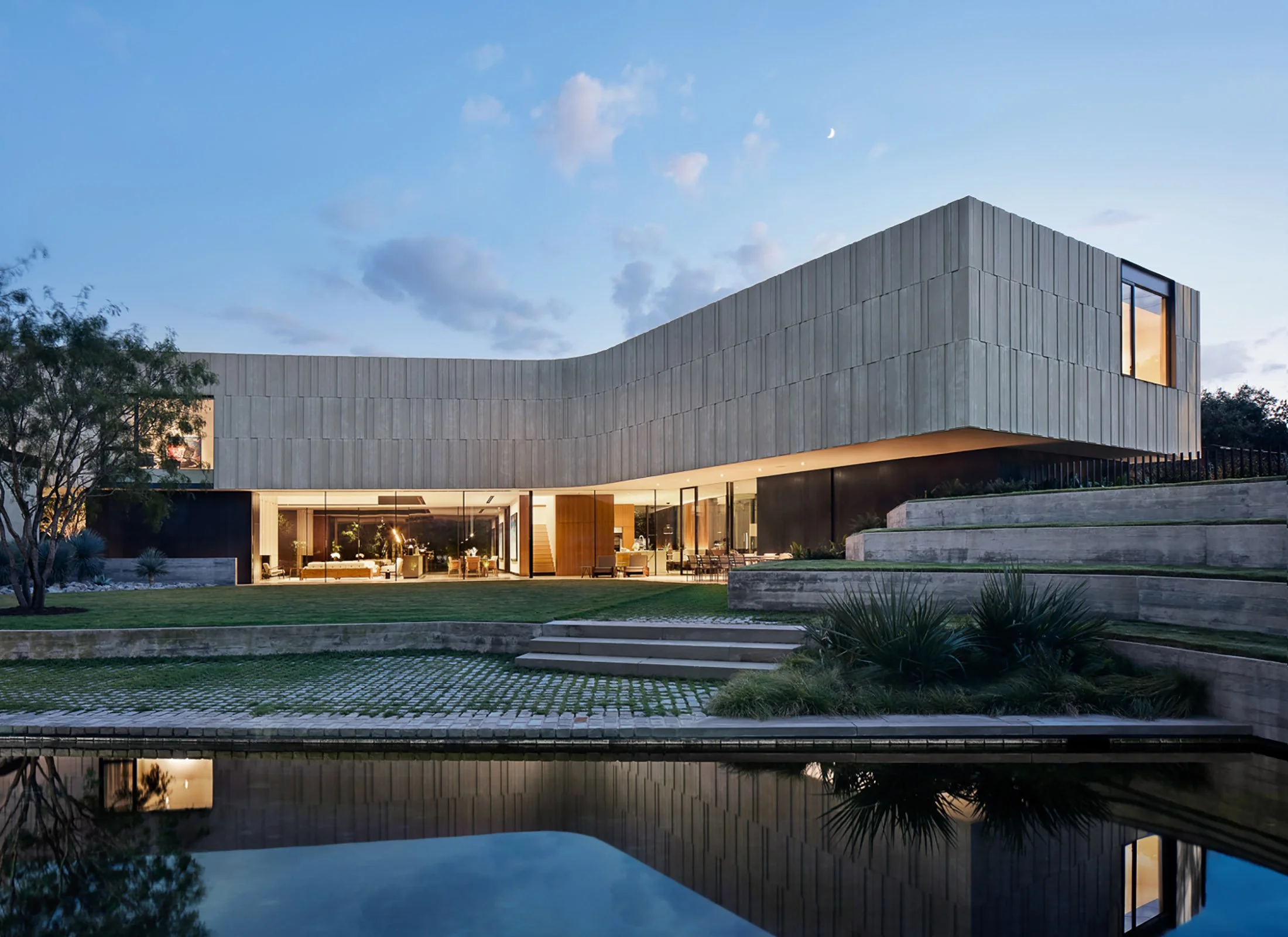
The Highland Park Residence stands as a testament to architectural ingenuity, establishing an "extraordinary interior environment" on a property initially "devoid of significant natural features or mature trees" and closely flanked by neighboring structures. Its striking features include a "continuous stone bar [that] hovers precariously at the building line, bends to define a private courtyard, and dramatically cantilevers 35 feet at the entry". The interior boasts "surprising verticality" in the living room, with "curved glass panels and expansive retracting doors" that skillfully blur the boundary between inside and out.
Photography: Casey Dunn
The ambitious architectural elements, particularly the "dramatically cantilevers 35 feet" and the extensive use of "curved glass panels and expansive retracting doors," inherently pose significant challenges for maintaining thermal performance, managing solar heat gain, and ensuring structural integrity. For an architect who knows that execution will require precision, such features raise immediate questions about how they can be made comfortable, energy-efficient, and durable. This project is a prime example of how ambitious architectural forms necessitate sophisticated MEP and building science integration. Positive Energy's MEP engineering was paramount in addressing these complexities. This project involved precise HVAC system design to account for large glass surfaces, meticulous coordination of high-performance glazing, and sophisticated air sealing and insulation strategies to mitigate thermal bridging and prevent air leakage. These measures were crucial in ensuring consistent indoor comfort and energy efficiency within such an open and vertically dynamic space, transforming potential performance liabilities into architectural triumphs.
The Highland Park Residence has received numerous accolades, including the 2022 AIA Housing Awards, 2021 Residential Architect Design Awards, and 2020 Builder's Choice / Custom Homes Magazine Merit Award. It has been published in prestigious outlets such as YinjiSpace, Residential Design Magazine, and Interior Design Homes.
West Campus Residence
The West Campus Residence was thoughtfully designed by architect-owners seeking a more suitable space for their growing family. Their deep knowledge of the neighborhood allowed them to acquire and subdivide an "unusually wide lot" into two narrow parcels. The presence of mature Live Oaks, coupled with zoning setbacks and parking requirements, dictated a compact building footprint. The resulting home features a vertically clad wood volume housing four bedrooms above a more agile, open-plan ground floor wrapped in mill-finished steel panels, reflecting a commitment to "compact, efficient living" deeply attuned to its natural surroundings.

Photography: Casey Dunn
The "compact building footprint" and commitment to "efficient living" are direct architectural responses to specific site constraints and programmatic needs. These design choices inherently create a requirement for highly efficient and precisely controlled MEP systems to ensure comfort and optimal indoor air quality within a smaller, potentially more densely occupied volume. The vertical organization of spaces creates challenges for effective air distribution and maintaining consistent temperatures across different levels, especially considering the natural tendency for heat to rise. Positive Energy's role was critical in ensuring efficient HVAC zoning to address thermal stratification, providing proper ventilation for a compact space to maintain healthy indoor air quality, and detailing the building envelope to prevent moisture issues and thermal discomfort, particularly given the chosen material palette. This project clearly illustrates how site-driven architectural decisions directly influence the complexity and necessity of sophisticated MEP and building science solutions.
The West Campus Residence has been recognized with the 2023 AIA Small Project Awards, 2022 AIA National Housing Awards, and 2021 Residential Architect Design Awards. It was also featured in Dwell+.
Falcon Ledge Residence
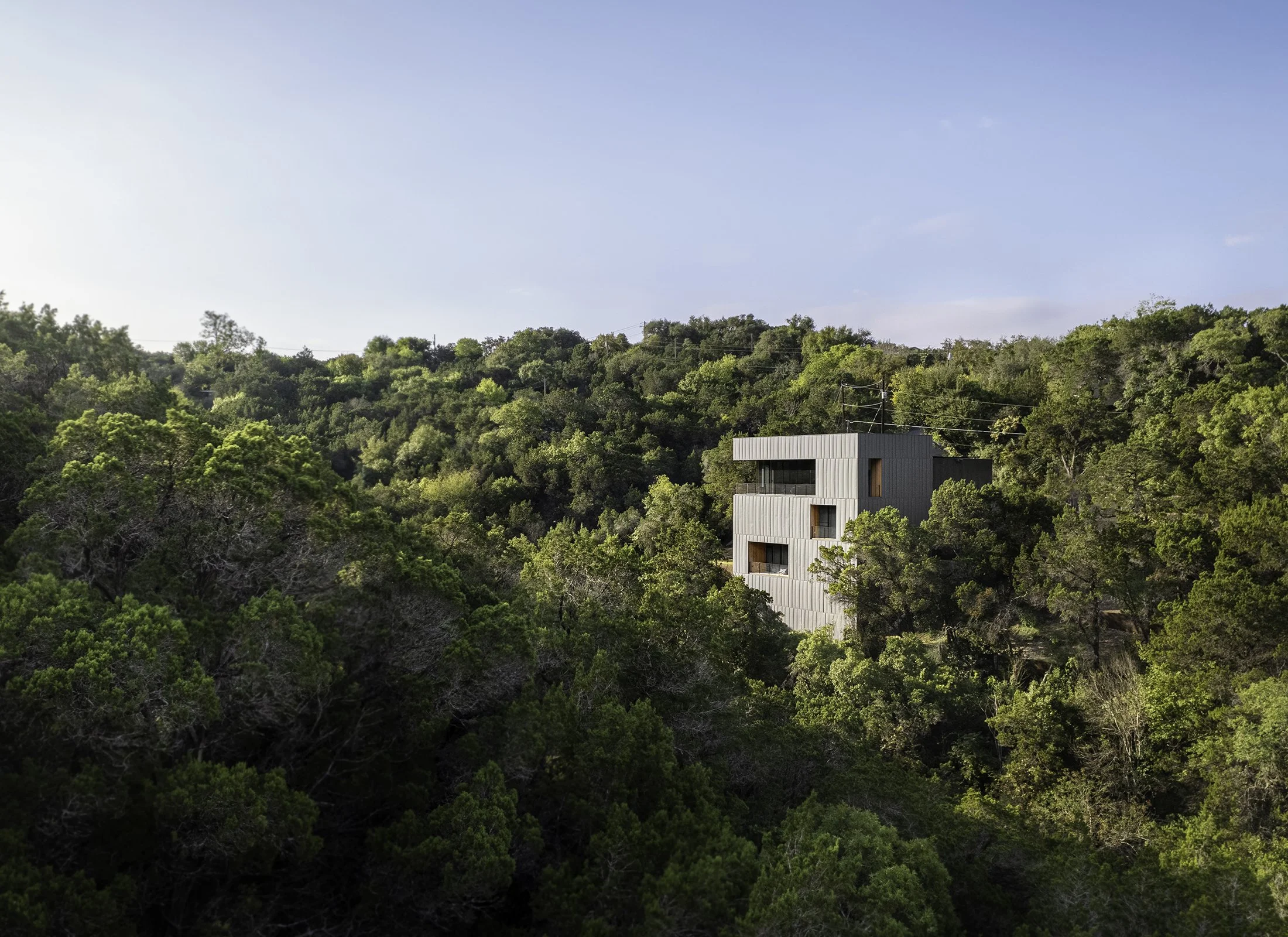
The Falcon Ledge Residence is a remarkable testament to overcoming an "impossible site" – a property that falls off "precipitously directly from the street’s curb". The innovative solution involved first erecting a "platform" adjacent to the street, which later became the garage and a bridge connecting to the main house. The home itself is uniquely organized "upside down," with the main living spaces on the top floor and private spaces below. This "unexpected tower" form was largely "determined by the logic of its construction and sequencing".
Photography: Casey Dunn
The Falcon Ledge Residence is a beautiful example of how deep building science knowledge and innovative MEP engineering enable architectural breakthroughs in the face of extreme site limitations. The "upside-down" organization and the exposed "tower" form presented unconventional challenges for HVAC design. Managing heat gain and loss at the highly exposed upper living levels, while ensuring efficient and consistent air distribution throughout the entire vertical structure, required a customized and thoughtful approach. Positive Energy's expertise was vital in designing systems that effectively condition such a tall, exposed structure, potentially incorporating strategies to mitigate stack effect and ensure thermal comfort across multiple, uniquely arranged levels. Our approach to HVAC design was performance-driven with a sympathetic understanding of the building envelope, essential to make an unconventional structure not just habitable, but comfortable, and durable.
This innovative project has garnered significant recognition, including the 2025 AIA Austin Design Awards, 2023 Residential Architect Design Awards, 2023 Texas Society of Architecture Design Awards, and 2023 American Architecture Awards. It has been featured in prominent publications such as Dezeen, Texas Architect, and Architectural Record.
Constant Springs Residence
Set on a typical suburban lot that backs unexpectedly onto a wooded escarpment and creek, the Constant Springs Residence masterfully balances urban proximity with the sense of an isolated retreat. Designed for a family of four, it features a one-story structure oriented horizontally beneath the canopy of preserved mature Live Oaks. A defining characteristic is the "continuous Western Red Cedar ceiling that extends inside and out, complemented by strategic roof openings that embrace both the trees and sky themselves. The home utilizes a restrained material palette of cedar, marble, limestone, white oak, and steel, along with custom glazing, to intimately connect interior spaces with both a front courtyard and the dramatic natural landscape.

Photography: Casey Dunn
The architectural aspiration for a continuous indoor-outdoor ceiling and large, framing openings created building science complexities, particularly concerning moisture management and thermal bridging. Positive Energy's MEP expertise was critical in designing systems that precisely manage humidity levels and ensuring consistent thermal comfort. This involved advanced humidity control systems and careful consideration of thermal bridges to maintain the integrity of the building envelope. Positive Energy's MEP solutions for this project helped enable bold aesthetic choices to be realized without compromising the building's long-term performance, durability, or occupant health. It demonstrates that the highly desirable architectural feature of seamless indoor-outdoor living is only truly successful and sustainable when underpinned by robust building science to expertly manage the environmental conditions.
This residence has earned accolades such as the 2022 Residential Design Architecture Awards, 2018 Texas Society of Architects Design Awards, 2018 IIDA Excellence in Design Award, 2018 AIA Austin Design Awards, and 2017 Architecture MasterPrize. It has been featured in Dwell and Austin Monthly.
Tumbleweed Residence
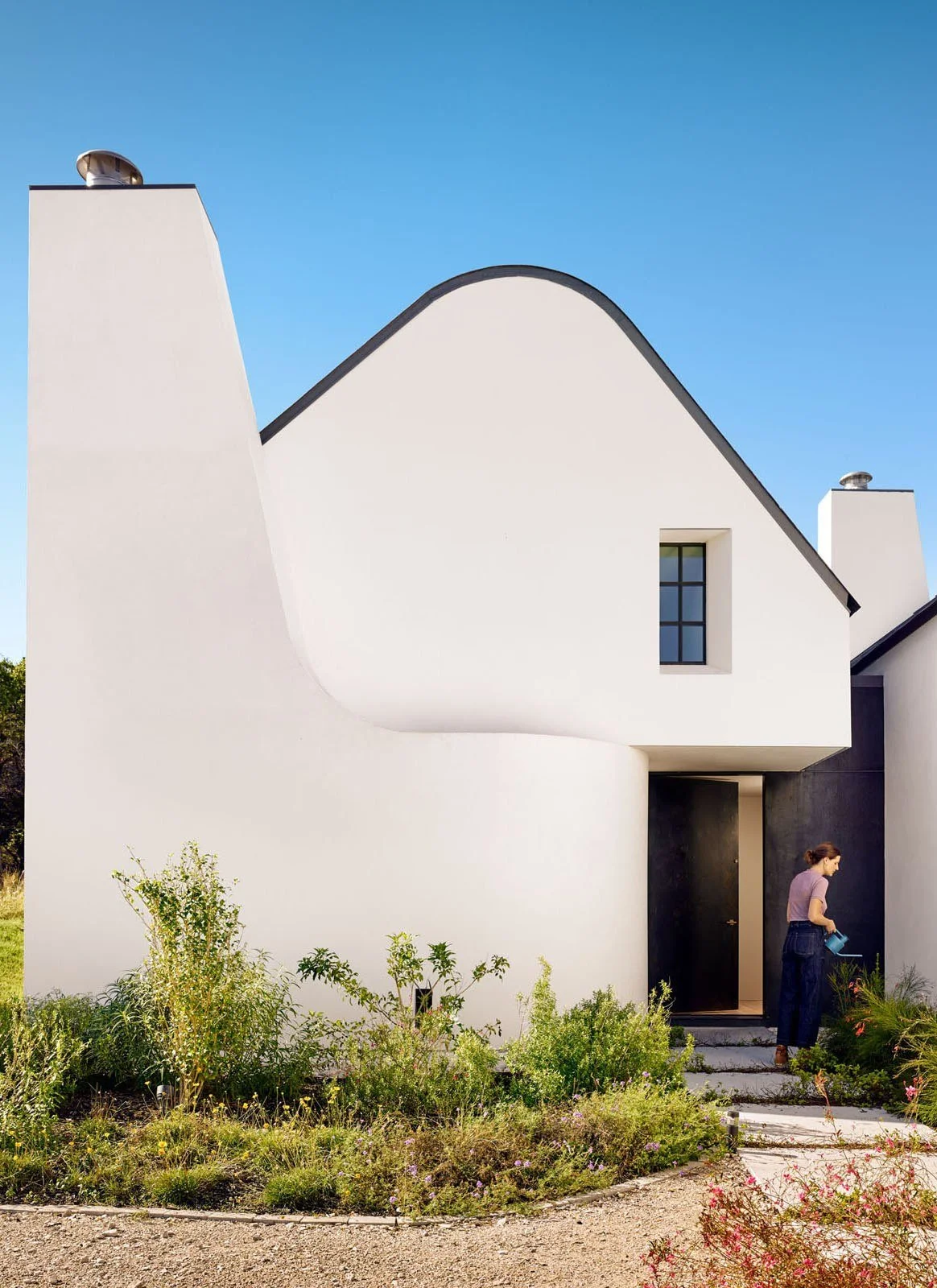
The Tumbleweed Residence embodies the owners' desire to embrace their surroundings through "simple materials -steel, concrete block, wood-" and a deep "celebration of craft and evidence of the hand in the construction". The design comprises "three volumes assembled to create a composition integral with the landscape," abstracted with "clean, white stucco, adopting curves to ease the edges of a sharper modernism".1 This abstraction of the stucco volumes intentionally contrasts with the "tactile, bold materials" that define the interior, where meticulous craftsmanship is evident in details like custom steel window welds and hand-turned walnut bar stools.
Photography: Casey Dunn
The project's explicit focus on "simple materials" and a "celebration of craft" might, at first glance, suggest a less technically complex building. However, for these seemingly straightforward materials to perform optimally and for the building to achieve long-term durability and occupant comfort, the underlying building science and MEP integration must be even more rigorous and precise. Exposed materials often mean less tolerance for error in the hidden layers of the wall assembly. Positive Energy’s work supports aesthetically driven material choices such that they can be seamlessly integrated into a high-performance building envelope, preventing thermal bridging and ensuring airtightness, so that the thermal loads are reduced. This project highlights a crucial fact that even a "simple" aesthetic requires sophisticated technical integration to ensure the building's performance and resilience.
This project received the 2018 Texas Society of Architects Design Award and was published in Texas Architect.
Tarrytown Residence
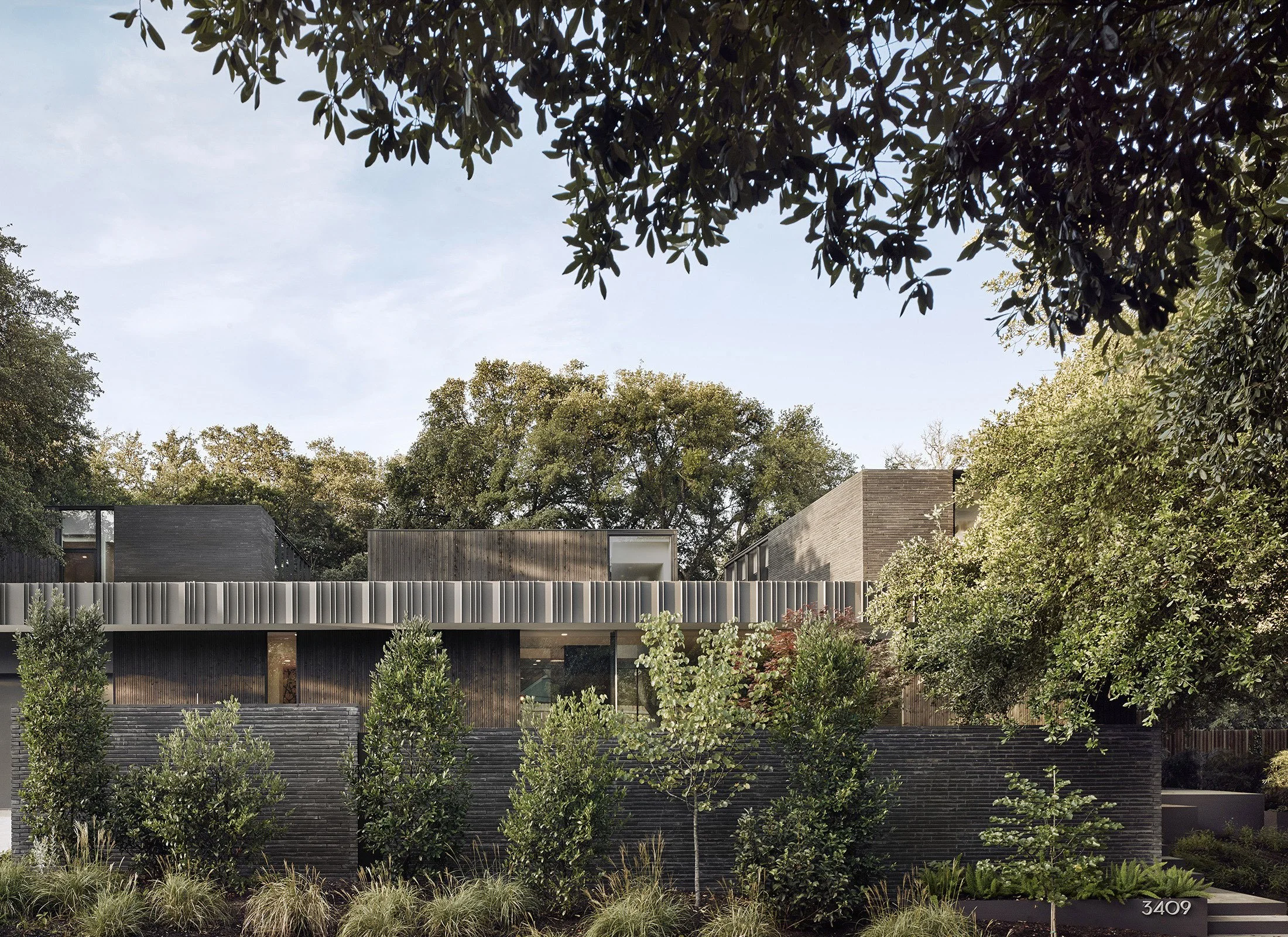
The Tarrytown Residence is designed to "unfold around the articulated, private landscape at its center". Its interiors "open fully to the outdoors beneath a continuous ceiling plane, delicately held in place by expansive, custom site-glazed window walls". The composition is anchored by "two abstract volumes—clad in elongated black brick and black-stained cedar", which serve to shield the home and provide a defense against future neighboring development. The interior showcases a rich contrast between dark masonry and finely crafted millwork, raw steel, and a vibrant palette of fabric, wallpaper, and tile. The architecture masterfully balances "intimacy and openness" throughout its carefully choreographed spaces.
Photography: Casey Dunn
This project strongly reinforces a recurring theme in Alterstudio's work: the architectural ambition to create seamless and beautiful indoor-outdoor connections through glass and continuous ceiling planes. The "expansive, custom site-glazed window walls" are a signature of modern design but inherently pose challenges for energy performance and occupant comfort. Similar to the Constant Springs Residence, these elements demand meticulous attention to thermal performance, air sealing, and condensation prevention. The use of dark exterior materials like "black brick and black-stained cedar" can also increase solar heat absorption, potentially leading to higher cooling loads. Positive Energy's MEP expertise was crucial in designing HVAC systems capable of carefully and efficiently managing these substantial thermal loads. This project underscores the critical necessity of a strong MEP engineering firm to ensure that architectural aspirations do not lead to uncomfortable, inefficient, or unhealthy spaces.
This project has received numerous prestigious awards, including the 2023 Texas Society of Architects Design Awards, 2022 Residential Architecture Design Awards, 2020 Builder's Choice / Custom Homes Magazine Grand Award, 2020 Architecture Masterprize Honorable Mention, 2019 AIA Austin Design Awards, and 2019 Society of Registered Architects National Design Awards.1 It has been published in Architectural Record and Arch Daily.
Elevating Architecture Through Collaboration
The long-standing collaboration between Alterstudio Architects and Positive Energy serves as a compelling testament to the fact that truly exceptional architecture, particularly in the custom residential sector, is increasingly a product of deep, integrated design. Positive Energy's specialized expertise in MEP engineering and building science has not merely supported, but fundamentally enabled Alterstudio's ability to produce award-winning, distinctive designs, consistently pushing the boundaries of what is aesthetically and functionally possible within Austin's architectural landscape.
This partnership highlights a critical paradigm shift in architectural practice: building science is not an afterthought or a reactive fix, but a foundational element that must be integrated and considered from the earliest conceptual design phases. A meticulously designed building envelope, acting as the building's protective skin, and sophisticated MEP systems are absolutely essential for achieving long-term durability, optimal indoor air quality, superior thermal comfort, and exemplary energy efficiency in modern residential projects.8 The profound success and recognition garnered by Alterstudio and Positive Energy's projects strongly suggest that the traditional, linear design process—where architects design and engineers then add systems—is increasingly insufficient for creating high-performance, award-winning residential architecture. The collaboration showcased throughout this report points to a necessary paradigm shift towards a concurrent, integrated design process.
This integrated approach unlocks greater creative freedom for architects, allowing them to pursue ambitious designs with confidence, knowing that the technical complexities will be expertly managed. It ensures that innovative architectural forms are not only beautiful but also perform optimally, providing comfortable, healthy, and durable environments for occupants. The consistent delivery of exceptional occupant experiences that genuinely allow the human spirit to soar is the ultimate outcome of such a partnership. Architects are encouraged to actively seek out MEP and building science partners who not only share their design vision but can also provide the "next level of resolution" for their projects, transforming challenges into opportunities for architectural excellence.

Rethinking Moisture Control: The Primacy of Air Tightness Over an Outdated Fixation on Vapor Barriers in Building Envelope Design
For decades, the architecture and construction community has engaged in a persistent debate surrounding the role and necessity of vapor barriers in building envelope design. This discussion, while touching on critical aspects of moisture control, has often been characterized by an overemphasis on the ability of specific materials to resist vapor diffusion, sometimes to the detriment of addressing more significant moisture transport mechanisms. Within the building science community, however, the principles governing moisture movement are largely considered settled science. It is well-established that air leakage, rather than vapor diffusion, is the predominant pathway for moisture transport through most wall assemblies.
By Positive Energy staff
The Misplaced Emphasis in The Moisture Management Puzzle
For decades, the architecture and construction community has engaged in a persistent debate surrounding the role and necessity of vapor barriers in building envelope design. This discussion, while touching on critical aspects of moisture control, has often been characterized by an overemphasis on the ability of specific materials to resist vapor diffusion, sometimes to the detriment of addressing more significant moisture transport mechanisms. Within the building science community, however, the principles governing moisture movement are largely considered settled science. It is well-established that air leakage, rather than vapor diffusion, is the predominant pathway for moisture transport through most wall assemblies.[1]
We’d like to put forth a compelling case for a fundamental shift in focus within the design and construction industries, from an often-misplaced obsession with vapor barriers, to a prioritized emphasis on achieving comprehensive air tightness. This is not a new idea and unfortunately not the only time it will have to be re-asserted. But by examining the historical context, the fundamental mechanisms of moisture transport, the distinct roles of air and vapor control layers, and the extensive benefits of air tightness, this blog post will demonstrate why a continuous air barrier system is a much more appropriate system of focus for creating durable, energy-efficient, and healthy buildings. We will also clearly delineate the necessary caveats where specific vapor diffusion control strategies remain essential, as in extreme climate zones or when dealing with reservoir claddings like stucco, brick, etc.
Historical Context and the Evolution of "Vapor Barrier Science"
The concept and application of vapor barriers in construction have undergone a significant evolution, shaped by early research, practical experience, and an advancing understanding of building physics. Historically, vapor barriers were largely a cold climate artifact, introduced with the primary intention of preventing moisture from indoor sources from migrating into wall cavities and condensing on cold exterior components during winter.[9] This initial focus was driven by observations of condensation-related damage in insulated wood-frame buildings in northern climates. This dynamic has been true of a number of early building science lessons and, while the research and literature has advanced, the public understanding of the current state of the literature requires repeated emphasis in order to properly affect practices in design and in the field.
To this very day, there is still considerable confusion between controlling vapor diffusion and controlling airflow. Much of that confusion lies in a misunderstanding of the principles of moisture transportation. Early building science informed attempts to manage moisture often involved using materials like sheet polyethylene, which, while an effective vapor retarder, was also tasked with acting as an air barrier, leading to the term "air-vapor barrier".[11] This dual-function approach, notably employed in programs like Canada's R-2000, aimed to create a sealed interior plane. However, achieving effective air tightness with polyethylene sheets proved daunting in practice. It required meticulous, painstaking effort to seal all laps and penetrations, often using acoustical sealants that were messy and difficult to work with.[11] This method was not great for typical production building speeds and its long-term robustness was questionable, as the thin plastic sheets were susceptible to damage during construction and over the building's service life.[11] This interior "air-vapor barrier" approach was also inherently climate-sensitive; in air-conditioned buildings, it placed a vapor-impermeable layer on the wrong side of the assembly during cooling seasons, potentially trapping moisture.[11]
Throughout the post-war years, practitioners were often taught, incorrectly, that interior vapor barriers were universally necessary in cold climates to protect assemblies, leading to the widespread adoption of kraft-faced and foil-faced batt insulation.[11] These facings, however, were inherently discontinuous and proved largely ineffective in preventing moisture problems, primarily because the dominant transport mechanism – air leakage carrying vapor – was not adequately addressed.[11]
As building science matured, a more nuanced understanding emerged. It became clear that vapor diffusion, the slow movement of water molecules through materials, was often a minor contributor to moisture accumulation compared to the substantial quantities of moisture that could be transported by air leaking through gaps and cracks in the building envelope.[3] This realization led to a refinement in terminology, with "vapor retarder" becoming the preferred term over "vapor barrier," acknowledging that most materials slow down diffusion rather than completely stopping it.[13] The term "vapor barrier" is now generally reserved for Class I vapor retarders, which are highly impermeable.[9]
Our understanding of vapor retarders today, and whether or not they are appropriate in a given building’s assemblies, involves a sophisticated, climate-specific approach. This is a significant departure from the initial, often misapplied, concept of a universal interior vapor barrier or even the notion of having a vapor barrier in the assembly at all. This evolution itself highlights that the early fixation on impermeable interior barriers was based on an incomplete understanding of moisture dynamics. Modern building codes, such as the International Residential Code (IRC) and International Building Code (IBC), now reflect this more mature understanding by mandating vapor retarders based on climate zone, often not requiring them at all in warmer climates, or allowing for more permeable options when certain conditions like exterior continuous insulation are met.[16] While codes aren’t perfect, the codification of climate-dependent strategies is still important because it is a clear indicator of the general consensus within the building science community.
Understanding Moisture Transport Mechanisms in Wall Assemblies
To effectively manage moisture in building envelopes, it is essential to understand the primary ways in which water, in its various phases, can move into and through wall assemblies. Building science identifies four principal mechanisms of moisture transport [5]:
Bulk Water Intrusion: This refers to the movement of liquid water—primarily from rain, snowmelt, or groundwater—through openings, cracks, or defects in the building envelope.[5] Examples include leaks at roof-wall intersections, poorly sealed window and door penetrations, or inadequate foundation drainage. Bulk water has the potential to introduce the largest quantities of moisture in the shortest time and is often the most damaging mechanism, leading to rapid saturation of materials, structural decay, and mold growth.5 Controlling bulk water through proper design of drainage planes, flashing, and water-shedding surfaces is the first line of defense in any moisture management strategy.[23]
Capillary Action: Capillarity is the ability of liquid water to be drawn into and move through the fine pores of materials, even against the force of gravity.[5] This "wicking" effect is common in porous materials like concrete, masonry, wood, and soil. Examples include moisture rising from damp ground into a concrete foundation wall or water being drawn into the end grain of wood siding.[13] While often less dramatic than bulk leaks, capillary action can lead to persistent dampness and significant hidden damage over time if capillary breaks (non-porous materials or air gaps) are not incorporated into the assembly.[13]
Air-Transported Moisture: Air can carry significant amounts of water in vapor form. When air moves through unintended openings in the building envelope (air leakage), it transports this moisture with it.[5] If warm, moist air leaks into a cooler part of the wall assembly, or contacts a surface below its dew point temperature, the water vapor can condense into liquid water.[12] This mechanism is driven by air pressure differences across the envelope, caused by wind, stack effect, or mechanical ventilation imbalances.[12]
Vapor Diffusion: This is the movement of water vapor at a molecular level through a material, driven by a difference in vapor pressure (concentration) or temperature.[5] Water vapor naturally moves from an area of higher concentration to an area of lower concentration, and from warmer to colder regions. The rate of diffusion depends on the vapor pressure gradient and the permeability of the material to water vapor.[13]
Of these four mechanisms, air-transported moisture is quantitatively the most significant pathway for water vapor entry into typical building cavities, far exceeding the amount transported by vapor diffusion alone. Numerous sources confirm that air leakage can transport 50 to 100 times more water vapor than diffusion through the same area of building material over the same period.[1] For instance, one study illustrates that while about 0.3 liters (1/3 quart) of water might diffuse through an intact 4×8-foot sheet of gypsum board during a heating season, a mere 1-square-inch hole in that same sheet could allow approximately 28.4 to 30 quarts of water to be carried into the wall by air leakage under typical pressure differences.[6] Renowned building scientist Joe Lstiburek similarly quantifies this difference, stating that moisture transport via air leaks is typically two orders of magnitude (a factor of 100) greater than through diffusion, even through a compromised vapor retarder.[7]
This disproportionate impact of air leakage is a fundamental concept that underpins the argument for prioritizing air tightness. Even if a "perfect" vapor retarder is installed to address diffusion, its overall effectiveness in controlling moisture will be severely compromised if pathways for air leakage remain. The persistent debate or overemphasis on vapor barriers within some segments of the construction industry often appears to overlook or insufficiently appreciate this crucial quantitative distinction—a distinction that has been well-established in building science for many years.[3] An effective moisture control strategy must, therefore, primarily focus on eliminating or drastically reducing air leakage.
Defining the Layers: Air Barriers vs. Vapor Retarders
A clear understanding of the distinct functions, materials, and performance metrics of air barriers and vapor retarders is crucial to dispel confusion and correctly prioritize moisture control strategies. While both contribute to managing the building envelope, they address different physical phenomena and moisture transport mechanisms.
Air Barriers:
The primary function of an air barrier system is to control the unintended movement of air into and out of a building and through its assemblies.[1] By controlling airflow, an air barrier inherently helps to manage air-transported moisture, which, as established, is a dominant vector for moisture problems.[1] An effective air barrier must be continuous over the entire building envelope, encompassing walls, roofs, and foundations, and meticulously sealed at all joints, penetrations (windows, doors, pipes, wiring), and transitions between different building components.[1]
Typical materials used for air barriers include specially designed membranes (house wraps), sheathing materials (like plywood or OSB with sealed joints), fluid-applied membranes, spray foam insulation (specifically closed-cell, when applied continuously), and even meticulously detailed gypsum board (though this approach has limitations).[2]
The performance of an air barrier material is quantified by its air permeance, typically measured in liters per second per square meter at a pressure differential of 75 Pascals (L/(s⋅m2) @ 75 Pa). A common benchmark for an air barrier material is an air permeance not greater than 0.02L/(s⋅m2) @ 75 Pa, as per ASTM E2178.[1] Whole building air tightness is often measured in air changes per hour at 50 Pascals (ACH50) using a blower door test.[28]
Vapor Retarders:
The primary function of a vapor retarder is to reduce the rate at which water vapor moves through a material via diffusion.[1] It does not, by its primary definition, control airflow. Again, the term "vapor retarder" is more accurate than the older term "vapor barrier" because most materials only slow down the process of diffusion rather than stopping it completely.[3] The term "vapor barrier" is often colloquially used to refer to Class I vapor retarders, which are very impermeable.[9]
The performance of a vapor retarder is measured by its water vapor permeance, commonly expressed in "perms." Materials are classified by their perm rating according to standards like ASTM E96:
Class I Vapor Retarder: ≤0.1 perm (vapor impermeable). Examples include polyethylene sheeting, non-perforated aluminum foil, glass, and sheet metal.1
Class II Vapor Retarder: > 0.1 perm to ≤1.0 perm (vapor semi-impermeable). Examples include kraft-faced fiberglass batt insulation, unfaced expanded or extruded polystyrene, some plywoods, and bitumen-coated paper.1
Class III Vapor Retarder: > 1.0 perm to ≤10 perms (vapor semi-permeable). Examples include gypsum board, latex or enamel paint (some paints), unfaced fiberglass insulation, cellulose insulation, and many house wraps.1 Materials with a perm rating greater than 10 are generally considered vapor permeable.2 The placement of vapor retarders is highly dependent on climate and the specific wall assembly design, generally positioned on the warm-in-winter side in cold climates to control outward diffusion, or sometimes on the exterior in very hot-humid climates if used, though often omitted in such climates to promote inward drying.4
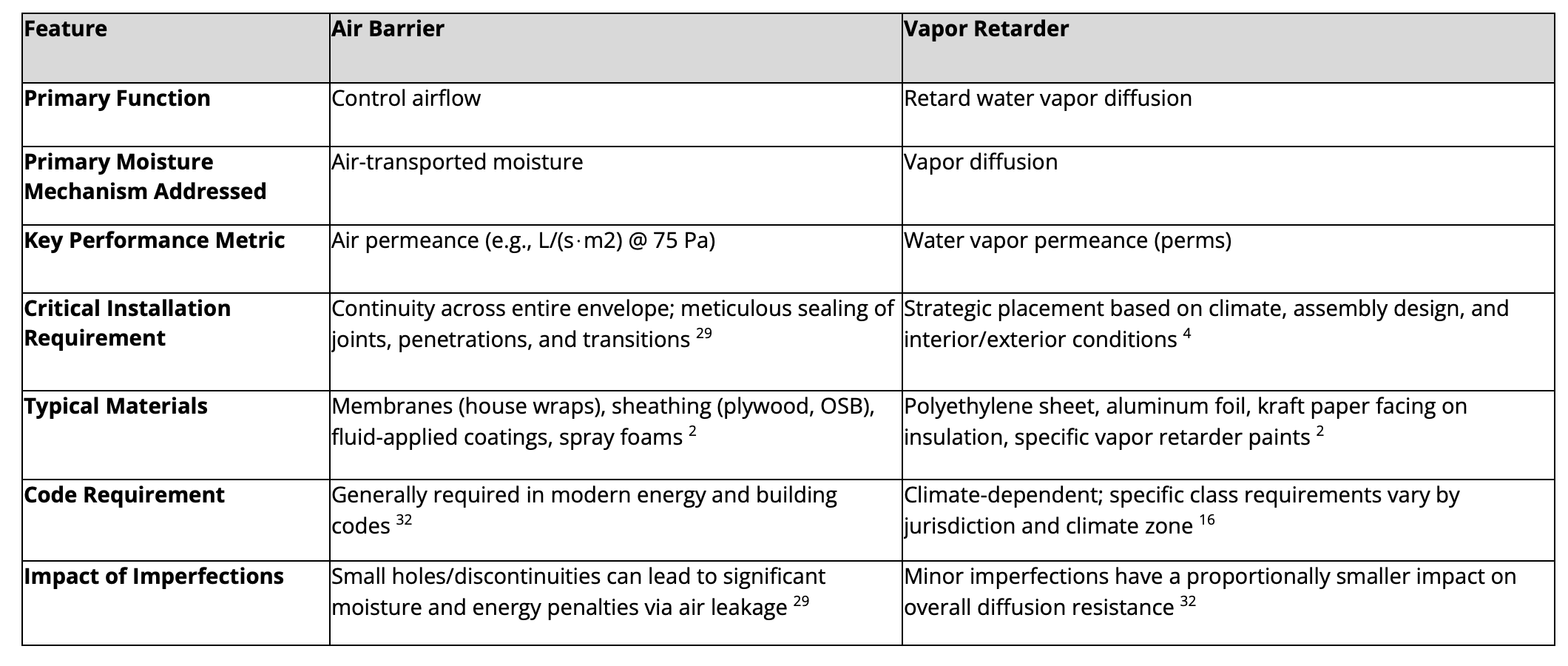
Table 1: Air Barrier vs. Vapor Retarder – A Functional Comparison
A critical source of ongoing confusion is the terminology itself. The term "vapor barrier," with its definitive "barrier" connotation, implies a more absolute and critical role in stopping all vapor movement than the more accurate term "vapor retarder," which reflects the function of managing diffusion rates.[13] This linguistic legacy subtly reinforces the notion that achieving a near-zero perm rating is a primary goal, overshadowing the more pressing need to stop air movement, which carries far more moisture.
The fact that some materials can function as both an air barrier and a vapor retarder (e.g., a meticulously sealed polyethylene sheet or continuous closed-cell spray foam) further blurs the functional distinctions in practice.[11] This can lead to the erroneous assumption that specifying a material for its vapor retarding properties automatically ensures adequate air barrier performance, or vice versa. However, the level of detailing and continuity required for an effective air barrier system is far more rigorous and unforgiving than what might be considered adequate for a vapor retarder whose primary role is to manage diffusion across its surface area.[29] A 10% discontinuity in a vapor retarder might mean it's 90% effective at retarding diffusion, but a 10% discontinuity in an air barrier system can lead to catastrophic failures in moisture and energy control.[32]
It is imperative for the design and construction industry to clearly separate the specification and performance targets for air control from those for vapor control. While integrated products and materials exist, the distinct functional requirements and, most importantly, the detailing for continuity of the air control layer, must be independently understood, specified, and meticulously executed to achieve desired building performance. Simply calling for a "vapor barrier" and hoping it also serves as an adequate air barrier is an approach fraught with risk.
The Primacy of Air Tightness: A Holistic Approach to Building Performance
Given that air leakage is overwhelmingly the dominant mechanism for moisture transport into and through building assemblies [1], the establishment of a continuous and robust air barrier system emerges as the single most critical strategy for effective moisture control. As building scientist Joseph Lstiburek succinctly states, "air barriers are a good idea everywhere, vapor barriers are not".[4] An effective air barrier minimizes the potential for condensation within the building envelope by preventing warm, moist air from reaching cold condensing surfaces.[12]
However, the importance of air tightness extends far beyond just moisture management. Achieving a high level of air tightness offers a multitude of interconnected benefits that contribute to overall building performance, occupant well-being, and long-term durability:
Energy Efficiency: This is perhaps the most widely recognized benefit. By minimizing uncontrolled air exchange (infiltration of outside air and exfiltration of conditioned inside air), air barriers significantly reduce heating and cooling loads. This translates directly to lower energy consumption, with potential reductions ranging from 10% to 40% in general buildings [29] and around 15% in homes designed to Zero Net Energy (ZNE) standards.31 Consequently, operational costs are lowered as HVAC systems do not have to work as hard to maintain desired indoor temperatures.[28]
Improved Comfort: Airtight buildings provide a more comfortable indoor environment by eliminating drafts and cold spots often associated with leaky envelopes.[31] This leads to more consistent and stable indoor temperatures throughout the conditioned space.
Enhanced Indoor Air Quality (IAQ): A continuous air barrier plays a crucial role in protecting IAQ by controlling the entry of outdoor pollutants such as dust, pollen, smoke, and soil gases like radon (which is primarily transported by air, not diffusion[7]).[29] Research indicates that airtight homes can reduce indoor concentrations of harmful PM2.5 particles by approximately 70% compared to conventional, leakier homes.[31] Furthermore, air tightness enables mechanical ventilation systems to operate much more effectively and predictably. Instead of relying on uncontrolled and often polluted air leakage paths, ventilation systems in tight buildings can provide the correct amount of fresh, filtered air from a known source, precisely managing indoor humidity and diluting internally generated pollutants.[31]
Building Durability: By significantly reducing the amount of moisture entering and moving through building assemblies via air leakage, air barriers mitigate the risk of moisture-related damage to building components. This includes preventing rot in wood framing, corrosion of metal components, and degradation of insulation materials, thereby extending the structure's lifespan and preventing premature failure of components.[28]
Acoustic Control: Well-sealed building envelopes can also contribute to improved sound isolation, reducing the transmission of exterior noise.[29]
The realization of these benefits hinges on one critical factor: the continuity and quality of workmanship of the air barrier system. Unlike vapor retarders, where minor imperfections might lead to a proportional decrease in diffusion resistance, the performance of an air barrier is fundamentally compromised by discontinuities.[32] As stated in one industry report, "The success of an air barrier system is highly dependent on skilled installation and adherence to detailed specifications. Because it is a barrier, any failure point can compromise the entire performance".[29] Many of you likely recognize the common failure points for air barriers, such as joints between materials, transitions between different assemblies (e.g., wall-to-roof, wall-to-foundation), and penetrations for windows, doors, pipes, and wiring.[29] Meticulous sealing of these areas using appropriate tapes, sealants, and gaskets is paramount, as is testing your results.[13] Achieving this level of continuity requires careful planning, coordination among trades, and a commitment to quality construction practices.[30]
The multiple, significant co-benefits derived from achieving superior air tightness—spanning energy savings, enhanced IAQ, improved durability, and greater occupant comfort—make it a far more impactful and cost-effective strategy to prioritize in building design and construction than a narrow focus on controlling vapor diffusion. Investing in a high-quality, continuous air barrier system yields substantial returns across a wide spectrum of building performance metrics. In contrast, an overemphasis on a specific class of vapor retarder primarily targets vapor diffusion, which is often a secondary moisture transport mechanism. When viewed through the broader lens of holistic building performance and lifecycle costs, the return on investment for achieving superior air tightness is demonstrably higher, making the historical "obsession" with vapor barriers appear even more disproportionate.
Interestingly, the very act of meticulously creating a continuous air barrier can often incidentally improve control over vapor diffusion, even if the primary air barrier material itself is vapor permeable (like many house wraps). Many pathways for air leakage, such as gaps at joints or around penetrations, also represent potential pathways for vapor diffusion if a vapor pressure differential exists across them. By diligently sealing these openings to achieve air control [29], one inherently reduces the surface area available for diffusion at these critical junctures. While the primary air barrier material might be designed to allow vapor to pass through it, the act of sealing its edges and integrating it continuously into the building envelope makes the overall assembly more resistant to all forms of gaseous transport through those specific, sealed leakage points. This implies that a dedicated focus on achieving comprehensive air tightness can indirectly bolster vapor control, whereas focusing solely on the perm rating of a vapor retarder does little to address the far more significant issue of air leakage.
This underscores the need for a shift in industry quality control and verification processes. While whole-building air leakage testing (e.g., blower door tests) is becoming more common and is mandated by some codes 28, the broader mindset shift towards viewing and executing "airtightness as a system" rather than merely installing an "air barrier product" is still developing. The emphasis on "construction quality and workmanship" 29 is far more critical for the successful performance of an air barrier system than it is for a vapor retarder.
The Importance of Dedicated Dehumidification
A core principle of durable building design is maintaining a moisture balance where the rate of moisture removal from an assembly consistently exceeds the rate of moisture entry. If wetting outpaces drying, moisture accumulation occurs, leading to degradation of materials, structural damage, and potential health issues from mold growth. While the strategies discussed previously—prioritizing air tightness and strategically using vapor retarders—are crucial for minimizing wetting, actively promoting drying is equally important, particularly in challenging conditions like a hot/humid climate.
In many modern, airtight homes, and especially in humid climates or buildings with high internal moisture loads (e.g., from occupants, cooking, construction moisture, etc.), relying solely on passive drying mechanisms (like vapor diffusion through permeable materials) or the incidental dehumidification provided by standard air conditioning systems may not be sufficient to ensure net drying. Air conditioning systems are primarily designed for sensible cooling (temperature control) and may not operate long enough or at optimal conditions to adequately remove latent moisture (humidity), especially during shoulder seasons or under partial load conditions.
This is where dedicated dehumidification systems play a critical role. These systems are designed specifically to remove excess moisture from the indoor air, thereby lowering the indoor relative humidity (RH). By maintaining a lower indoor RH (ideally between 30-60%, or even below 50%), a greater vapor pressure differential is established between the moist building materials and the drier indoor air. This enhanced differential significantly increases the drying potential of the assemblies towards the interior.
Benefits of Dedicated Dehumidification:
Enhanced Drying Capacity: Actively reduces indoor humidity, creating a more favorable gradient for moisture to move out of damp materials. This is crucial for drying incidental wetting from leaks, construction moisture, or even inward vapor drives that might bypass other defenses.
Improved Indoor Air Quality (IAQ) and Health: By maintaining lower RH, dedicated dehumidifiers help prevent conditions conducive to mold growth, dust mites, and other biological contaminants, which thrive in damp environments.
Occupant Comfort: Lower humidity levels are generally perceived as more comfortable, especially in warm weather.
Protection of Building Materials and Furnishings: Prevents moisture damage to structural components, insulation, finishes, and contents.
Complements Airtight Construction and Mechanical Ventilation: In highly airtight homes, where natural air exchange is minimal, mechanical ventilation (often with Energy Recovery Ventilators - ERVs) is essential for fresh air. While ERVs can help manage some moisture from incoming ventilation air, they do not actively dehumidify the interior space. Supplemental dehumidification works in tandem with these systems to ensure comprehensive moisture control.
Dedicated dehumidification systems can be whole-house units integrated with the HVAC system or standalone units. Their importance has become increasingly recognized, especially in high-performance building standards. Ensuring that the building can reliably dry out any moisture it encounters is a cornerstone of long-term durability (not to mention ensuring indoor air quality), and dedicated dehumidification provides a powerful tool to achieve this goal.
Strategic Use of Vapor Retarders: Necessary Caveats and Considerations
While air tightness is paramount, vapor retarders remain a necessary component of moisture control strategies in specific situations. Their use, however, must be guided by building science principles, particularly the critical need to facilitate drying. A fundamental principle of durable building envelope design is that assemblies should be designed to dry if they become wet, whether from incidental moisture intrusion or construction moisture.9 This necessitates the avoidance of "double vapor barriers"—impermeable layers on both the interior and exterior sides of an assembly—which can trap moisture and prevent drying in either direction.9 The building science consensus encourages "drying mechanisms over wetting prevention mechanisms" wherever feasible.[9]
The appropriate strategy for vapor control is highly dependent on climate and the type of cladding used.
Climate-Specific Needs for Vapor Control:
Extreme Cold Climates (e.g., ASHRAE/IECC Climate Zones 6, 7, 8, and Marine 4 in some instances):
Concern: Significant outward vapor drive from the warm, humidified interior to the cold exterior during winter, risking condensation on or within the cold exterior sheathing or other components of the wall assembly.[20]
Strategy: Typically, building codes mandate a Class I (e.g., polyethylene sheet, ≤0.1 perm) or Class II (e.g., kraft-faced insulation, > 0.1 to ≤1.0 perm) vapor retarder on the interior (warm-in-winter) side of framed walls.[10]
Nuances: Building scientist Joseph Lstiburek suggests that polyethylene (Class I) should generally be reserved for very cold hygro-thermal regions.[40] The addition of sufficient continuous exterior insulation can keep the wall cavity's condensing surfaces (like sheathing) warm enough to prevent condensation, potentially reducing or eliminating the need for a highly impermeable interior vapor retarder.[39] The IRC, for example, allows the use of Class III vapor retarders (e.g., latex paint, > 1.0 to ≤10 perms) in these cold zones if specific R-values of continuous exterior insulation are installed, or in some cases, with vented claddings.[17]
Hot-Humid Climates (e.g., ASHRAE/IECC Climate Zones 1A, 2A, parts of 3A):
Concern: Predominant vapor drive is from the hot, humid exterior to the cooler, air-conditioned interior during much of the year.[20]
Strategy: Interior vapor barriers (Class I or II) should generally be avoided to allow the wall assembly to dry towards the interior.[20] Some even emphatically claim that an interior polyethylene vapor barrier should "NEVER be installed" in these conditions if an exterior air/vapor barrier is present.[41] If an air/vapor barrier is used on the exterior (which can be beneficial for controlling bulk water and the strong inward vapor drive from outside), the wall assembly must be able to dry inwards. Lstiburek advocates for vapor-open assemblies in these climates, potentially with a vapor-permeable air control layer on the interior if masonry is part of the assembly.[44]
Mixed-Humid Climates (e.g., ASHRAE/IECC Climate Zones 3A, 4A, 4C):
Concern: Significant bi-directional vapor drive—outward in winter, inward in summer—makes the placement of a fixed, impermeable vapor barrier problematic.[4] A vapor barrier on the "wrong" side for part of the year can trap moisture.
Strategies:
"Smart" Vapor Retarders: These materials, such as CertainTeed MemBrain or ProClima Intello, have variable vapor permeance. They become more resistant to vapor diffusion (low perm) in dry conditions (typically winter interior) and more permeable (high perm) in humid conditions (typically summer, or if the cavity becomes wet).[45] For example, MemBrain is rated at ≤1 perm (dry cup) and > 10 perms (wet cup) [46], while Intello can range from < 0.13-0.23 perms to > 13 perms.[47] This adaptability allows drying in whichever direction is favored by the prevailing conditions.
Vapor-Open Assemblies: Designing walls to be generally vapor permeable on both sides of the insulation, often incorporating exterior continuous insulation. The primary moisture defense relies on the air barrier and bulk water management (flashing, drainage plane).[34]
Class II or Class III vapor retarders may be appropriate, as they allow a greater degree of drying than Class I materials.
Reservoir Claddings (e.g., Stucco, Brick, Stone, some Fiber Cement):
These claddings present a unique and critical challenge that demands specific attention beyond general climate-based rules.
The Challenge: Reservoir claddings absorb and store significant amounts of rainwater.24 When solar radiation subsequently warms the wet cladding, this stored moisture can be driven inward as a powerful vapor drive ("solar-driven inward vapor drive").[4] This inward pressure can overwhelm wall cavities, leading to condensation on interior layers, particularly if an impermeable interior vapor barrier like polyethylene is present and the building is air-conditioned.[55] This is a major caveat where focusing solely on controlling wintertime outward vapor drive from occupants is insufficient and potentially harmful.
Control Strategies for Inward Drive with Reservoir Claddings:
Ventilated Rainscreen/Cavity: A well-ventilated air space behind the cladding is a critical defense.[56] This gap (e.g., minimum 3/8 inch for many claddings, up to 1 inch or more for brick [56]) decouples the wet cladding from the rest of the wall assembly. It allows the inwardly driven moisture vapor to be carried away by airflow before it can penetrate the wall's weather-resistive barrier (WRB) and sheathing. Effective ventilation requires clear openings (vents) at both the top and bottom of the wall section.[56]
Appropriate WRB/Sheathing Permeance: The selection of the WRB and sheathing behind the ventilated cavity is crucial. In some designs, a WRB or sheathing with lower vapor permeance (acting as an exterior vapor control layer) might be used to "throttle" or resist the inward vapor drive.[56] However, this must be carefully balanced with the need for outward drying capability, especially in colder climates, to avoid creating a double vapor barrier situation.
Avoid Interior Impermeable Layers: In climates with significant air conditioning use, a Class I interior vapor retarder (like polyethylene) is generally contraindicated when reservoir claddings are present.[9] Such an interior barrier traps the solar-driven inward moisture, leading to condensation and potential damage. Lstiburek pointedly noted that the interior polyethylene sheets in many Vancouver condos in the 1980s and 1990s prevented the inward drying of rain-wetted stucco during the summer, contributing to widespread moisture problems.[40]
Additional Strategies: Reducing the reservoir capacity of the cladding itself by using paints or additives can lessen the inward drive potential.[58] Lstiburek advises that for reservoir claddings, one must either ventilate the airspace very effectively or use an exterior vapor throttle (like a dimple sheet behind the cladding) to intercept the inward drive; the key is that the air gap effectively uncouples the cladding from the wall assembly.[59]

Table 2: Vapor Retarder Strategies – Key Caveats and Considerations
The caveats for vapor retarder use are not minor exceptions. They represent common and critical construction scenarios, such as buildings with brick or stucco exteriors, or those located in the diverse climates across North America. In these situations, a simplistic "vapor barrier on the warm side" rule, often learned as a fundamental, can fail dramatically and cause significant harm if not critically assessed against the actual moisture physics at play.[14] The historical borderline obsession with vapor barriers may, in part, stem from an oversimplification of these complex interactions. When reservoir claddings are introduced, for example, solar-driven inward vapor drive becomes a powerful force that can overwhelm an assembly designed only to resist wintertime outward diffusion from occupant activities.[55] If the "warm side" rule is still rigidly applied with an interior polyethylene sheet in an air-conditioned building with a brick exterior, it inadvertently creates a moisture trap.[55] This demonstrates that the simple rule is insufficient for many common building types and that the borderline obsession might be with an incomplete rule itself, rather than a deep understanding of the building science that sometimes invalidates or modifies it.
The development and market presence of "smart" vapor retarders are a direct technological response to the documented failures of fixed-permeance vapor barriers in mixed climates or complex assemblies involving bi-directional vapor flow.[45] Their existence and promotion for challenging situations like mixed climates or unvented roof assemblies underscore that the "settled science" of moisture control includes acknowledging these complexities and providing advanced tools to address them. If traditional polyethylene (Class I) or kraft-facing (Class II) worked perfectly in all situations, there would be little impetus for materials that actively change their permeance in response to ambient humidity.[46] This reinforces that "settled science" does not equate to "simple science" in all applications of vapor control.
Ultimately, effective vapor control is less about finding a single perfect barrier material and more about understanding and managing vapor flow dynamics and drying potential within the entire building assembly, specific to its climate, materials, and operational conditions. This requires a significant shift from a product-centric thinking (i.e., "which vapor barrier product should I use?") to a system-centric, performance-based thinking (i.e., "how will this entire assembly manage all forms of moisture, including vapor, and ensure it can dry if it gets wet?").
Moving Forward: Prioritizing Air Tightness in Design and Construction
To align construction practices with established building science, the architecture and construction community must consciously shift its focus towards prioritizing air tightness. This requires changes in design philosophy, specification practices, on-site execution, and industry education.
Recommendations for the Architecture and Construction Community:
Prioritize Air Barrier System Design from Concept: The air barrier system should not be an afterthought or a layer simply added to the drawings. It must be a primary design consideration from the earliest conceptual stages. Designers need to clearly define the location of the continuous air control layer(s) and ensure this continuity is meticulously planned across all building assemblies and critical interfaces (e.g., wall-to-roof, wall-to-foundation, around penetrations).[29]
Specify for Air Tightness Performance, Not Just Products: Specifications should move beyond merely naming an air barrier material. They should include measurable air tightness targets for the whole building (e.g., a specific ACH50 value) and potentially for assemblies or components. Crucially, specifications must mandate verification through quantitative testing, such as whole-building blower door tests.[28] This shifts the focus from simply installing a product to achieving a verifiable performance outcome. Consider using the Phius performance standard for high levels of quality assurance and quality control.
Invest in Education and Training: Continuous education for design professionals, project managers, and construction crews is essential. This training should cover current building science principles related to air leakage, moisture transport mechanisms, the appropriate and strategic use of vapor retarders, and importantly, how to correctly detail and install air barrier systems.[30] Efforts should be made to actively address and debunk persistent misconceptions surrounding vapor barriers and air barriers.[40]
Develop and Implement Robust Detailing for Continuity: The success of an air barrier system lies in its continuity. Architects and designers must develop robust, practical, and buildable details for all penetrations, joints, and transitions between different air barrier materials or building assemblies. These details are where systems most commonly fail.[29]
Shift Mindset from "Vapor Barrier" to "Vapor Management": The industry needs to internalize that vapor control is about managing diffusion rates appropriate to the specific climate and assembly, not just about stopping all vapor movement with an impermeable layer. This involves embracing strategies like vapor-open assemblies or the use of smart vapor retarders where these approaches enhance the overall drying potential and resilience of the building envelope.[9]
Critically Evaluate "Rules of Thumb" and Historical Practices: Long-standing practices and simplified rules regarding vapor barrier placement should be critically examined against current building science. Decisions must be based on climate-specific, assembly-specific hygrothermal analysis rather than outdated or overly generalized guidelines.
The Role of Building Codes and Standards:
Building codes and industry standards play a vital role in driving practice. Continued advocacy for and support of code advancements that emphasize verifiable air tightness performance are necessary. Codes should also provide clear, science-based, and nuanced guidance on vapor retarder selection and placement, moving away from potentially problematic or overly simplistic blanket requirements. The evolution of codes to include mandatory air barrier requirements and air leakage testing is a positive development.[32] Standards like ASHRAE 90.1, which already mandate continuous air barriers with specific maximum air leakage rates for materials, assemblies, and whole buildings, provide a robust framework that can be more broadly adopted and rigorously enforced.[35]
Achieving a genuine shift in industry focus towards air tightness requires more than just better products; it demands better processes. From the initial design integration and clarity of specifications to the crucial inter-trade coordination and robust quality assurance/quality control (QA/QC) measures on the construction site, air tightness is a systems challenge.[29] It is not about a single product's performance in isolation but about how multiple components and materials are meticulously assembled by various trades to form a continuous, unbroken plane of air control. Therefore, simply specifying an "air barrier material" is insufficient. The design must explicitly show how this material connects and remains continuous across the entire envelope; trades must be trained in the specific techniques required for its correct installation; and site inspections, coupled with diagnostic testing, must verify that the intended performance is achieved.
This process-oriented approach is inherently more demanding than the simpler, often less critical, task of specifying and installing a sheet of polyethylene as a "vapor barrier."
The historical lack of widespread, rigorous air barrier verification (though this is improving with more stringent code requirements for testing [32]) has arguably allowed suboptimal air sealing practices to persist. Without consistent measurement and accountability for air tightness performance, the perceived urgency to perfect it may remain lower than its actual importance warrants. If air tightness is not consistently tested and failures are not identified and rectified [28], then the often severe consequences of poor air barrier detailing (e.g., hidden moisture damage, high energy bills, poor IAQ) are less immediately visible than, for instance, a bulk water leak from a poorly flashed window. This lack of immediate, obvious feedback can foster complacency or lead to a continued underestimation of air leakage's multifaceted impact, thereby allowing the "vapor barrier obsession" to continue as a more visible, albeit often less critical, focal point of moisture control discussions.
Ultimately, shifting the industry's predominant focus from vapor barriers to air tightness is a cultural transformation as much as a technical one. It will require a concerted and sustained effort involving designers (who must prioritize and detail for air continuity), builders and contractors (who must ensure meticulous execution and implement effective QA/QC), code officials (who must understand and enforce air tightness standards more rigorously), and even manufacturers (who should provide clearer guidance on system integration rather than focusing solely on individual product features).
A Call for a Science-Based Shift in Focus
The evidence from decades of building science research and field experience is unequivocal: air tightness is the most critical factor in controlling moisture transport through building assemblies in the majority of construction scenarios. The quantity of moisture carried by air leakage far surpasses that transported by vapor diffusion.[1] This fundamental understanding necessitates a paradigm shift in the architecture and construction community—a move away from an often disproportionate and historically rooted fixation on vapor barriers towards the primacy of designing and constructing robust, continuous air barrier systems.
This is not to say that vapor retarders have no role. They are indeed necessary tools, but their application must be strategic, nuanced, and firmly grounded in current building science. The "settled science" provides clear, climate-specific and assembly-specific guidance for their appropriate use, particularly in extreme cold climates and when dealing with the complexities of reservoir claddings and solar-driven inward vapor drive.[14] This modern understanding moves far beyond outdated, overly simplistic blanket rules that can, in many common situations, lead to moisture-related building failures by trapping moisture or impeding necessary drying.
Adopting a holistic, science-informed approach that prioritizes a continuous air barrier system, coupled with intelligent and context-appropriate vapor management strategies, offers profound benefits. Such an approach leads to buildings that are significantly more durable, energy-efficient, and provide healthier indoor environments for their occupants.[28] This shift not only reduces the risk of costly moisture-related failures and repairs but also improves occupant comfort and optimizes the allocation of resources in both design and construction phases.
The near obsession with vapor barriers is not merely an academic debate; it has tangible real-world consequences, contributing to building failures, energy waste, and compromised occupant health when it distracts from the more pressing need for air tightness.[28] Therefore, the advocated shift in focus is not just a technical correction but a matter of professional responsibility for those involved in creating the built environment.
It is time for the architecture and construction community to collectively move beyond the prolonged and often misdirected preoccupation with vapor barriers. Instead, the industry must embrace the well-established primacy of air tightness as the cornerstone of effective moisture control and overall building performance. Successfully making this transition will not only prevent common building problems but will also enhance the reputation and value proposition of the AEC industry by consistently delivering buildings that perform better, last longer, and truly align with the robust body of knowledge developed by the building science community. This alignment is crucial for creating a more sustainable, resilient, and healthy built future.
Works cited
Air Barrier vs Vapor Barrier: What are The Differences, accessed May 12, 2025, https://barricadebp.com/news/air-barriers-vs-vapor-barriers
Air Barrier vs Vapor Barrier- What You NEED to Know - Healthy Building Science, accessed May 12, 2025, https://healthybuildingscience.com/2024/02/01/air-barrier-vs-vapor-barrier-what-you-need-to-know/
Vapor barrier - Wikipedia, accessed May 12, 2025, https://en.wikipedia.org/wiki/Vapor_barrier
buildingscience.com, accessed May 12, 2025, https://buildingscience.com/sites/default/files/migrate/pdf/RR-0004_Air_Barrier_Vapor_Barrier.pdf
ENERGY SERIES: What about Moisture? | VCE Publications ..., accessed May 12, 2025, https://www.pubs.ext.vt.edu/2908/2908-9020/2908-9020.html
Understanding Moisture Flow | CertainTeed, accessed May 12, 2025, https://www.certainteed.com/inspiration/case-studies/understanding-moisture-flow
Air Barrier or Vapor Barrier? - Building Science Podcast ..., accessed May 12, 2025, https://www.greenbuildingadvisor.com/article/air-barrier-or-vapor-barrier-building-science-podcast
Controlling condensation from air leakage and vapour diffusion ..., accessed May 12, 2025, https://www.constructioncanada.net/controlling-condensation-from-air-leakage-and-vapour-diffusion/
BSD-106: Understanding Vapor Barriers | buildingscience.com, accessed May 12, 2025, https://buildingscience.com/documents/digests/bsd-106-understanding-vapor-barriers
Understanding Vapor Barriers - VaproShield, accessed May 12, 2025, https://vaproshield.com/images/stories/pdf/joe%20lstiburek%20understanding%20vapor%20barriers%20ashrae%202004%2008.pdf
BSI-084: Forty Years of Air Barriers\*—The Evolution of the ..., accessed May 12, 2025, https://buildingscience.com/documents/insights/bsi-084-forty-years-of-air-barriers
Moisture Transfer through Walls, accessed May 12, 2025, https://web.ornl.gov/sci/buildings/conf-archive/1989%20B4%20papers/044.pdf
www.southface.org, accessed May 12, 2025, https://www.southface.org/wp-content/uploads/2019/08/N082-Building-Science-101.pdf
Vapor Barriers or Vapor Retarders - Department of Energy, accessed May 12, 2025, https://www.energy.gov/energysaver/vapor-barriers-or-vapor-retarders
Building Science Digest 106 Understanding Vapor Barriers - andrew.cmu.ed, accessed May 12, 2025, https://www.andrew.cmu.edu/course/48-400/pdfs/Understanding%20Vapor%20Barriers.pdf
Vapor Barrier Code Requirements: Crawl Space & Building… | Polyguard, accessed May 12, 2025, https://polyguard.com/blog/vapor-barrier-code-requirements
2021 International Building Code (IBC) - CHAPTER 14 EXTERIOR WALLS - 1404.3 Vapor retarders., accessed May 12, 2025, https://codes.iccsafe.org/s/IBC2021P1/chapter-14-exterior-walls/IBC2021P1-Ch14-Sec1404.3
2021 International Residential Code (IRC) - CHAPTER 7 WALL ..., accessed May 12, 2025, https://codes.iccsafe.org/s/IRC2021P3/chapter-7-wall-covering/IRC2021P3-Pt03-Ch07-SecR702.7
Moisture Control | Vapor Retarders, Residential, Installing - Insulation Institute, accessed May 12, 2025, https://insulationinstitute.org/im-a-building-or-facility-professional/residential/installation-guidance-2/moisture-management/vapor-retarders/
www.iccsafe.org, accessed May 12, 2025, https://www.iccsafe.org/wp-content/uploads/proclamations/TN06-Vapor-Retarders_pdf.pdf
i LABORATORY Moisture Control Handbook - UNT Digital Library, accessed May 12, 2025, https://digital.library.unt.edu/ark:/67531/metadc696747/m2/1/high_res_d/586594.pdf
Moisture Ingress in Building Envelope Materials: (II) Transport Mechanisms and Practical Mitigation Approaches - MDPI, accessed May 12, 2025, https://www.mdpi.com/2075-5309/15/5/762
buildingscience.com, accessed May 12, 2025, https://buildingscience.com/sites/default/files/migrate/pdf/BSD-106_Understanding%20Vapor%20Barriers_2013.pdf
Vapor Barriers and Wall Design - Building Science, accessed May 12, 2025, https://buildingscience.com/sites/default/files/migrate/pdf/RR-0410_Vapor_Barriers_Wall_Design.pdf
Building Science Digest 106 Understanding Vapor Barriers - revfoam insulation, accessed May 12, 2025, https://revfoam.com/wp-content/uploads/2015/01/BSD-106_Understanding-Vapor-Barriers_2013.pdf
Controlling Moisture Movement in Buildings - W. R. Meadows, accessed May 12, 2025, https://www.wrmeadows.com/data/cat-mm03.pdf
Moisture accumulation in walls due to air leakage, accessed May 12, 2025, https://publications-cnrc.canada.ca/eng/view/ft/?id=aebbca87-8deb-4f03-9ca9-ba27712f9297
The Role of Air Barriers in Modern Construction - Intertek, accessed May 12, 2025, https://www.intertek.com/blog/2025/02-25-air-barriers-in-modern-construction/
The impact of air barriers in meeting new energy codes - Salas O'Brien, accessed May 12, 2025, https://salasobrien.com/news/energy-code-air-barrier/
Common Air Barrier Failures and How to Avoid Them, accessed May 12, 2025, https://475.supply/blogs/design-construction-resources/common-air-barrier-failures-and-how-to-avoid-them
Benefits of Superior Airtightness - SVACH, accessed May 12, 2025, https://svach.lbl.gov/benefits-superior-airtightness/
The Last Word (We Hope) on Vapor Barriers | JLC Online, accessed May 12, 2025, https://www.jlconline.com/how-to/insulation/the-last-word-we-hope-on-vapor-barriers_o
Air Barrier vs Vapor Barrier: Key Differences, Benefits - METALCON 2025, accessed May 12, 2025, https://metalcon.com/blog/air-barrier-vs-vapor-barrier-how-do-they-differ/
BSC Information Sheet 311 Vapor Open Assemblies - Building Science, accessed May 12, 2025, https://buildingscience.com/sites/default/files/migrate/pdf/BSCInfo_311_Vapor_Open_Assemblies.pdf
ANSI/ASHRAE/IES Standard 90.1-2019: Envelope - Oregon.gov, accessed May 12, 2025, https://www.oregon.gov/bcd/codes-stand/Documents/90.1-2019-Envelope-training.pdf
Tight Air-Sealed Homes | Building Science Education, accessed May 12, 2025, https://bsesc.energy.gov/energy-basics/tight-air-sealed-homes
BSC Information Sheet 311 - Vapor Open Assemblies, accessed May 12, 2025, https://www1.eere.energy.gov/buildings/publications/pdfs/building_america/vapor_open_assemblies.pdf
PA-0401: Built Wrong from the Start | buildingscience.com, accessed May 12, 2025, https://buildingscience.com/documents/published-articles/pa-built-wrong-from-start/view
Is vapour barrier a bad idea for a house that has cold winters and hot humid summers?, accessed May 12, 2025, https://www.reddit.com/r/Homebuilding/comments/1gr4l4a/is_vapour_barrier_a_bad_idea_for_a_house_that_has/
Vapor Barrier Confusion : r/buildingscience - Reddit, accessed May 12, 2025, https://www.reddit.com/r/buildingscience/comments/1jhgu31/vapor_barrier_confusion/
www.carlisleccw.com, accessed May 12, 2025, https://www.carlisleccw.com/download.aspx?id=797&fileID=37
Vapor Barrier and humidity : r/buildingscience - Reddit, accessed May 12, 2025, https://www.reddit.com/r/buildingscience/comments/1784d5b/vapor_barrier_and_humidity/
The Truth About Vapor Permeability in High Humidity Environments - DuPont, accessed May 12, 2025, https://www.dupont.com/content/dam/dupont/amer/us/en/performance-building-solutions/public/documents/en/bsb-the-truth-about-vapor-permeability-43-d100849-enna.pdf
Building America Webinar: Stump the Building Science Chump — Joe Lstiburek (Text Version) | Department of Energy, accessed May 12, 2025, https://www.energy.gov/eere/buildings/building-america-webinar-stump-building-science-chump-joe-lstiburek-text-version
Vapour Barrier or Vapour Retarder? (Exposing important myths and ..., accessed May 12, 2025, https://litebox.ca/vapour-barrier-or-vapour-retarder-exposing-important-myths-and-misconceptions/
MemBrain™ | CertainTeed, accessed May 12, 2025, https://www.certainteed.com/products/building-insulation-products/membrain
Smart Vapor Retarders for Walls and Roofs - Fine Homebuilding, accessed May 12, 2025, https://www.finehomebuilding.com/project-guides/insulation/smart-vapor-retarders-for-walls-and-roofs
Understanding Air Barriers and Vapor Retarders: Why and Where to Place Them - Hypo Air, accessed May 12, 2025, https://hypoair.com/blogs/news/understanding-air-barriers-and-vapor-retarders-why-and-where-to-place-them
Reinforced all-round hydrosafe® high-performance vapour check - INTELLO X PLUS | pro clima international, accessed May 12, 2025, https://proclima.com/products/internal-sealing/intello-x-plus/technical-specs
Technical specs - INTELLO | pro clima international, accessed May 12, 2025, https://proclima.com/products/internal-sealing/intello/technical-specs
MemBrain™, The SMART Vapor Retarder - IDI: Insulation, accessed May 12, 2025, https://www.idi-insulation.com/wp-content/uploads/2020/06/MemBrain-SMART-Vapor-Retarder.pdf
Cetainteed MemBrain Vapor Retarder (All Sizes) - Shop Online - Insulation4US, accessed May 12, 2025, https://insulation4us.com/products/cetainteed-membrain-vapor-retarder-all-sizes
Pros and cons of a "vapor open" exterior wall assembly with/without rigid sheathing?, accessed May 12, 2025, https://www.greenbuildingadvisor.com/question/pros-cons-of-a-vapor-open-exterior-wall-assembly-with-without-rigid-sheathing
Joe Lstiburek Discusses Basement Insulation and Vapor Retarders - GreenBuildingAdvisor, accessed May 12, 2025, https://www.greenbuildingadvisor.com/article/joe-lstiburek-discusses-basement-insulation-and-vapor-retarders
RR-0104: Solar Driven Moisture in Brick Veneer | buildingscience.com, accessed May 12, 2025, https://buildingscience.com/documents/reports/rr-0104-solar-driven-moisture-in-brick-veneer/view
www1.eere.energy.gov, accessed May 12, 2025, https://www1.eere.energy.gov/buildings/publications/pdfs/building_america/reservoir_cladding.pdf
Brick, Stucco, Housewrap and Building Paper, accessed May 12, 2025, https://buildingscience.com/sites/default/files/migrate/pdf/RR-0105_Brick_Stucco_Housewrap_Paper.pdf
BSI-091: Flow-Through Assemblies | buildingscience.com, accessed May 12, 2025, https://buildingscience.com/documents/building-science-insights-newsletters/bsi-091-flow-through-assemblies
How to Protect Stucco Buildings from Moisture | Dr. Joe Lstiburek - YouTube, accessed May 12, 2025, https://www.youtube.com/watch?v=fBj4l3pzmss
Vapor Barrier Myths and Facts - Basement Waterproofing by Al, accessed May 12, 2025, https://basementwaterproofingbyal.com/waterproofing/vapor-barrier-myths-facts/

The Campsite at Shield Ranch
The Campsite at Shield Ranch was designed by our friends at Andersson / Wise. It is a 100% off-grid community designed to engage and celebrate the natural context of the ecologically diverse 6800-acre hill country sanctuary where it sits. The camp features an open-air pavilion, screened shelters, and miles of hiking trails just 22 miles from downtown Austin. Positive Energy was hired to perform MEP engineering, solar design and engineering, and Resilient Systems consulting. The Resilient Systems we master planned for the program include a 64kW architecturally integrated solar array, a 200kWh (100kW peak power capacity) backup battery array, a 60kW emergency propane genset, and we consulted with another rainwater system engineer a couple of 60k gallon rainwater collection tanks for occupancy use with TECQ compliant filtration for public consumption (as well as necessary rainwater storage for fire suppression).


By Positive Energy staff. Photos by Leonid Furmansky, M. Walker, & The Build Show Productions.
The Campsite at Shield Ranch stands as a pioneering example of fully off-grid, sustainable development, nestled within a 6,400-acre protected wildland outside Austin, TX. It serves not only as a nature immersion camp but also as a living laboratory for conservation and a blueprint for resilient infrastructure in a rapidly urbanizing region. The facility achieves 100% self-sufficiency through an integrated microgrid (solar PV, battery energy storage, minimal generator backup for life-safety) and an advanced rainwater harvesting system that functions as a Texas Commission on Environmental Quality (TCEQ)-approved public water supply. Waste is managed via innovative evaporative toilets, representing a significant regulatory breakthrough. The Campsite's commitment to low environmental impact is underscored by its SITES Gold certification, extensive site protection zones, and design principles that prioritize minimal disturbance and integration with the natural landscape. As the designated M/P On-Site Power Engineer, Positive Energy played a critical role in the design and integration of the Campsite's complex energy and mechanical systems, contributing their expertise in building science and human-centered design to ensure the project's robust off-grid functionality and long-term resilience.

A Vision for Sustainable Immersion
The Campsite at Shield Ranch is strategically located approximately 22 miles west of downtown Austin, Texas, within the expansive 6,600-acre Shield Ranch.[1] This vast expanse is recognized as a nationally designated historic district and a protected wildland, playing a crucial role in the ecological health of the Barton Creek watershed. A remarkable 98% of the ranch is permanently protected through a series of conservation easements held by The Nature Conservancy and the City of Austin, a profound commitment to preserving this natural heritage.[2]
The fundamental purpose of The Campsite extends beyond providing recreational opportunities. It serves as the new home for Camp El Ranchito, a scholarship-based nature overnight camp, offering immersive experiences for youth and various community groups.[6] At its core, the Campsite's mission is to educate, transform, and inspire visitors by demonstrating practical lessons in sustainability and conservation, effectively functioning as a living laboratory for these principles.[1]
A defining characteristic of The Campsite is its unwavering commitment to 100% off-grid operation for both energy and water, a testament to its ambitious sustainability objectives.[1]This dedication has earned it the prestigious SITES Gold certification under the Sustainable SITES Initiative rating system, which is an adherence to the highest standards for sustainable land development in the United States.[6] Further reinforcing its environmental ethos, the larger Shield Ranch has been designated an Urban Night Sky Place by DarkSky International and a "Quiet Place" by Quiet Parks International, highlighting a holistic approach to preserving natural environments and minimizing human impact.[4]
The realization of The Campsite was a collaborative endeavor involving a diverse team of experts. Key contributors included Andersson / Wise as Architects, Ten Eyck Landscape Architects, Hill & Wilkinson General Contractors, Benz Resource Group as Project Manager, Regenerative Environmental Design as Landscape Sustainability & SITES Consultant, and Asterisk* for Signage and Wayfinding.[6] Positive Energy served as the M/P and On-Site Power Engineer.

The integration of conservation and education at The Campsite is a profound aspect of its design and operation. The extensive conservation efforts of Shield Ranch, with nearly all its vast acreage protected by easements and its vital role as the "lungs of Barton Creek" [2], are directly mirrored and amplified by the Campsite's explicit function as a learning laboratory.[1] The Campsite's design actively involves campers in conservation through features like timed rainwater showers and monitored energy and water usage.[7] This approach means the physical infrastructure of the Campsite is not merely a sustainable building; it is an active pedagogical instrument. It demonstrates that living in harmony with nature is achievable and empowering, thereby enhancing the long-term impact of the ranch beyond mere preservation. This fosters a new generation of environmental stewards who have directly experienced and participated in sustainable practices.
Off-Grid Energy Systems
The Campsite at Shield Ranch operates entirely independently of the conventional power grid, relying on a meticulously designed and robust microgrid system to ensure self-sufficiency and resilience. This sophisticated microgrid is comprised of three primary components: a Battery Energy Storage System (BESS), a Solar Photovoltaic (PV) system, and a Propane Generator for backup power.[1] This integrated architecture guarantees a continuous and reliable power supply, essential for the Campsite's operations in its remote setting.[1]
Solar Photovoltaic (PV) System
The Campsite's energy generation is exclusively sourced from solar panels, establishing solar power as its primary energy backbone.[6] The system boasts a substantial capacity, featuring a 46.4 kW AC Solar System.[1] This capacity is achieved through the installation of 198 solar panels, designed to provide 100% of the Campsite's off-grid power requirements.[17] A notable aspect of the design is the thoughtful integration of these panels directly into the architecture, with the sleeping shelters incorporating solar-paneled roofs.[18] This approach exemplifies a seamless blend of renewable energy technology with the aesthetic and functional coherence of the structures, moving beyond simple rooftop installations to a more integrated design expression.

Battery Energy Storage System (BESS)
Central to the Campsite's microgrid is the Battery Energy Storage System, provided by Current Energy Storage, and explicitly recognized as the "backbone of the microgrid power system".[1] Its dependability is paramount, especially given the complete absence of grid power.[1] The BESS is specified as an MG 100 kW 276 kWh unit.[1] This system performs critical functions by supplying power to the main facility, which includes the dining hall and learning center. Furthermore, it energizes essential site infrastructure such as lighting, fire suppression systems, refrigeration units, and the crucial pumps required for rainwater collection and sanitation.[1] This comprehensive power delivery ensures that not only comfort amenities but also vital health and safety systems remain operational without interruption.
Propane Generator Backup
A 60 kW Propane Generator is incorporated into the system to serve as a backup power source, particularly for life-safety issues in the event that the battery system is not sufficiently charged.[1] However, the generator's operational footprint is remarkably small. Thanks to the robust and efficient design of the primary solar and battery systems, the generator's annual run time is typically less than 75 hours.[1] This minimal usage significantly contributes to Shield Ranch's overarching sustainable goals by drastically reducing fossil fuel consumption and, consequently, lowering annual fuel costs.[1] This approach was intentional and demonstrates a deep commitment to minimizing the carbon footprint of the facility.
The design of the microgrid system at Shield Ranch, characterized by its solar PV, Battery Energy Storage System (BESS), and propane generator, demonstrates a high degree of energy resilience. The fact that the propane generator operates for less than 75 hours per year means that the solar and battery components had to be exceptionally efficient and precisely sized to meet the vast majority of the Campsite's energy demands.[1] This setup is not merely about being off-grid; it is about being reliably off-grid with minimal reliance on fossil fuels. The robust design, evidenced by the low generator run-time, points to sophisticated load management and precise sizing of the solar and battery systems. This ensures continuous operation, even during extended periods of low solar insolation or peak demand, which is a critical design achievement for essential infrastructure such as water pumps and fire suppression systems that cannot fail in an off-grid environment.[1]
While the initial capital expenditure for a comprehensive off-grid system, including a substantial solar PV system (46.4 kW AC, 198 panels) and a large Battery Energy Storage System (MG 100 kW 276 kWh), is considerable [1], the direct operational outcome of a propane generator run-time of less than 75 hours per year signifies a significant long-term economic and environmental return.[1] The minimal generator usage directly translates into dramatically reduced annual fuel costs and lower maintenance requirements for the generator. Environmentally, this results in a substantial reduction in greenhouse gas emissions compared to a system more reliant on fossil fuel backup. This provides a compelling business case for similar off-grid, sustainable developments: while the upfront investment may be higher, the operational savings and profound environmental benefits can justify and even accelerate the return on investment over the project's lifespan, particularly in remote locations where grid extension costs would be prohibitive.
MEP Engineering Innovations for Self-Sufficiency
The Campsite at Shield Ranch showcases pioneering Mechanical, Electrical, and Plumbing (MEP) engineering solutions that are fundamental to its complete self-sufficiency and minimal environmental footprint. These innovations extend beyond mere functionality, setting new benchmarks for sustainable infrastructure.
Electrical Systems Integration
The electrical systems at The Campsite are meticulously engineered to achieve seamless integration among the solar PV array, the battery energy storage system, and the propane generator. This sophisticated integration is paramount for maintaining a stable and reliable power supply in a 100% off-grid environment.[1] As the M/P and On-Site Power Engineer, Positive Energy played a direct and instrumental role in the design and coordination of these complex electrical interconnections and control mechanisms. A critical aspect of this design is the strategic prioritization of electrical loads, where the Battery Energy Storage System (BESS) is configured to power essential functions such as fire suppression, refrigeration, and the vital water and sanitation pumps.[1] This demonstrates a robust load management strategy, which is indispensable for ensuring reliability in an off-grid setting where continuous operation of critical infrastructure is non-negotiable.
Advanced Water Management
The Campsite achieves 100% of its water needs through an advanced rainwater harvesting system.[9] This system boasts a substantial storage capacity, incorporating three 63,400-gallon cisterns, accumulating a total of 190,200 gallons.[17] This capacity is notably higher than some earlier reported figures, reflecting the comprehensive scale of the installed system.[9] A groundbreaking achievement of this project is that its rainwater harvesting system is the first Texas Commission on Environmental Quality (TCEQ)-approved public water system that relies entirely on rainwater to serve its guests.[6] This accomplishment establishes a significant regulatory precedent, paving the way for similar sustainable developments across Texas.[9] Beyond collection, the Campsite actively champions water conservation through operational measures. Rainwater showers are equipped with timers, and energy and water usage are diligently monitored and shared with campers, guests, and staff. This practice serves to emphasize the importance of conservation and integrates user behavior directly into the sustainability model.[7]

Sustainable Wastewater Solutions
The Campsite implements innovative wastewater management through the use of evaporative toilets. These systems operate by collecting waste underground and stabilizing it with airflow facilitated by a sun-heated chimney, thereby eliminating the need for conventional plumbing.[17] This represents another significant regulatory milestone, as it is the first onsite septic facility permitted by Travis County and TCEQ in Texas to utilize evaporative toilets.[6] All on-site wastewater is further processed through separate septic fields, ensuring comprehensive and environmentally sound waste management.[17] Similar to the water system, this breakthrough sets a new standard for off-grid wastewater solutions.
Passive and Hybrid Climate Control
The design of The Campsite incorporates sophisticated passive and hybrid climate control strategies to ensure occupant comfort while minimizing energy consumption. The 11 screened sleeping shelters, constructed as prefabricated kits, were assembled on-site with minimal environmental disturbance.[7] These structures are strategically perched above grade to prevent disruption of natural water patterns and the sensitive soils supporting the native woodland plant community.[7] Designed to be cooler and more durable than traditional tents, they facilitate natural airflow.[8] For enhanced comfort and protection, especially during adverse weather, the shelters are equipped with solar-powered ceiling fans and movable wooden panels that can be closed.[8] The open-air pavilion further exemplifies this approach, featuring large openings and fans for effective cooling during warmer months. For cooler periods, it integrates sliding wall panels, a fireplace, and a wood-burning stove.[6] This thoughtful blend of passive and active climate control elements significantly reduces energy demand while maintaining a comfortable environment across seasons, reflecting a design ethos that is "subservient to the environment".[18]
The Campsite's rainwater harvesting system is the first TCEQ-approved public water system that relies entirely on rainwater [6], and its septic facility using evaporative toilets is the first onsite septic facility permitted by Travis County and TCEQ in the state of Texas [6], a process that transcended mere compliance with existing regulations. This project actively engaged with regulatory bodies to establish precedents and create new permitting pathways for innovative sustainable technologies. This makes the Campsite not just a successful off-grid facility, but a policy influencer and a blueprint for regulatory change. Its success provides a practical guide and a validated model for future projects in Texas and potentially beyond, reducing the regulatory hurdles for the adoption of similar advanced sustainable solutions. This broader implication for policy and market transformation represents a significant outcome of the project.
The Campsite's design incorporates specific features such as timed rainwater showers and the monitoring and sharing of energy and water usage data with campers and staff.[7] This is an active measure to involve the users in resource conservation. This approach indicates that the Campsite's sustainability strategy extends beyond purely technological solutions to actively incorporate and shape user behavior. By making resource consumption visible and encouraging conscious use, the project fosters a culture of conservation and environmental awareness among its occupants. This human-centered design approach that Positive Energy champions [19], amplifies the environmental benefits of the infrastructure and reinforces the educational mission of the Campsite, creating a more impactful and enduring model of sustainability that relies on both technological innovation and human engagement.

Table 1: Key MEP System Features and Certifications
Low Environmental Impact Design Principles and Conservation
The Campsite at Shield Ranch exemplifies a profound commitment to low environmental impact, integrating comprehensive design principles and leveraging the broader conservation efforts of its surrounding landscape.
SITES Gold Certification
A cornerstone of the Campsite's environmental credentials is its achievement of SITES Gold certification.[6] This rigorous standard for sustainable land development validates the project's adherence to a holistic set of sustainability principles, encompassing every stage from initial site design and construction to ongoing operations. This certification signifies a commitment to environmental performance that extends well beyond the structures themselves, embracing the entire site ecosystem.
Minimal Site Disturbance and Ecological Protection
The project demonstrates an exceptional dedication to ecological preservation through meticulous planning and execution. A significant 92% of the 14-acre project area was designated as Vegetation and Soil Protection Zones.[7] This proactive measure was crucial in minimizing the construction impact on sensitive ecosystems and preserving existing biodiversity. Furthermore, topsoil from building areas was carefully harvested and stored for reuse on-site.[7] This practice not only reduced the environmental impact associated with external transportation but also mitigated the risk of introducing invasive species from imported soil. Crucially, the salvaged topsoil contained a valuable seed bank of native species, directly aiding in the ecological restoration of disturbed areas.[7] Following construction, these disturbed areas were meticulously restored with diverse native plant species, ensuring they blend seamlessly into the surrounding landscape and actively support local ecosystems.[7]
The architectural approach, characterized by "light-on-the-land" structures, further minimizes physical footprint. The sleeping shelters were designed as prefabricated kits, allowing for assembly in the field with minimal site disturbance.7 These structures are strategically perched above grade, a design choice specifically implemented to avoid disturbing natural water patterns and the sensitive soils that support the native woodland plant community.[7] The selection of materials also reflects this commitment: a galvanized steel superstructure for the cabins, fabricated off-site, eliminates the need for painting for decades, thereby reducing long-term environmental impact and maintenance.18 The use of locally-sourced cedar further reduced embodied energy and transportation impacts.[20]
Broader Conservation Context of Shield Ranch
The Campsite is not an isolated sustainable building project; it is an integral part of the larger Shield Ranch, a 6,600-acre protected wildland.[1] Approximately 98% of this vast land is permanently protected by three conservation easements held by The Nature Conservancy and the City of Austin.[2] These easements legally prohibit large-scale commercial development, serving as a critical safeguard for water quality, hydrologic function, and biodiversity within the region.[2]
Shield Ranch encompasses a significant portion of the Barton Creek watershed, including 10% of its total area and over 6 miles of the creek itself.[2] This makes the ranch's conservation efforts profoundly vital for maintaining Austin's water quality and protecting the Edwards Aquifer recharge zone. Consequently, the ranch is famously referred to by conservationists as the "lungs of Barton Creek".[2]
The ranch's commitment to minimizing environmental impact extends beyond land and water to include light and sound pollution. It has been designated an Urban Night Sky Place by DarkSky International, with all lighting designed to be dark-sky friendly.[5] Additionally, it is recognized as a "Quiet Place" by Quiet Parks International [4], a holistic approach to preserving natural sensory environments and critical wildlife habitats.
The Campsite, a 14-acre project [7], is situated within the much larger Shield Ranch.[1] The ranch has a long history of conservation, with 98% of its land protected by easements [2] and a critical role in the Barton Creek watershed. The Campsite's specific design principles—SITES Gold certification, 92% Vegetation and Soil Protection Zones, on-site topsoil reuse, native plant restoration, and elevated, prefabricated structures [7]—directly mirror and operationalize the broader land stewardship goals of the entire ranch. This demonstrates that the Campsite is not an isolated sustainable building project but rather a microcosm and a direct physical expression of the Shield Ranch's multi-generational, deep-seated commitment to conservation. Its design and operation reinforce and exemplify the overarching land ethic of the ranch, making it a powerful, tangible demonstration of how human activity can be integrated with large-scale ecological protection. This deep alignment creates a real model for sustainability [9], showcasing how architectural interventions can serve as extensions of broader conservation strategies.
Shield Ranch is located in a region identified as a "danger zone" for climate change impacts, characterized by extreme weather events such as droughts and large storms.[16] The Campsite's design incorporates specific features that directly address these anticipated challenges. These include movable panels on shelters and the pavilion for storm protection and climate adaptation 6, a robust steel superstructure for enhanced durability [18], and a fully off-grid system for both energy and water.[6] These design choices are not merely about reducing the Campsite's current environmental footprint but also about building inherent resilience against anticipated future climate volatility. Its self-sufficiency in energy and water provides independence from potentially vulnerable municipal grids and water supplies during extreme weather events. Coupled with robust structural design and adaptive architectural elements, this positions the Campsite as a forward-thinking model for climate-adaptive architecture and infrastructure, particularly relevant for regions facing increasing environmental volatility and resource scarcity. This foresight makes the project even more impactful as a blueprint for future resilient development.
Positive Energy's Contributions
Positive Energy's involvement was pivotal in the successful realization of The Campsite at Shield Ranch's ambitious off-grid and low-impact objectives. Their specialized expertise was instrumental in translating a visionary concept into a functional, resilient, and highly efficient reality.
Role as M/P On-Site Power Engineer
Positive Energy was the "M/P On-Site Power Engineer" for The Campsite at Shield Ranch project.[15] Our primary responsibility for the mechanical (M), plumbing (P), and on-site power systems, which are foundational to the Campsite's complete off-grid functionality and minimal environmental impact. This role was distinct from other consultants on the project, such as the general Electrical Engineer (EEA Consulting Engineering) and the Water Specialist (Venhuizen Water Works).[15] We had a specialized focus on the intricate integration and performance of the core MEP systems that enable the Campsite's self-sufficiency, particularly where they interface with on-site power generation and distribution.
Application of Building Science and Human-Centered Design
Positive Energy is an MEP engineering firm specializing in high-end residential architecture, emphasizing building science and human-centered design to engineer healthy, comfortable, and resilient spaces. This core philosophy aligned directly with the Campsite's ambitious objectives:
Building Science: Our expertise in building science was critical in optimizing the performance of the solar PV system, accurately sizing the battery array, seamlessly integrating the generator, and designing the overall electrical load management for a 100% off-grid operation. This includes ensuring the energy efficiency of mechanical loads such as fans in the pavilion and shelters [13], ensuring that the systems were not only functional but also optimized for minimal energy draw in a self-sufficient context.
Human-Centered Design: This approach is clearly reflected in the Campsite's design elements that enhance occupant experience and reinforce its educational mission. Examples include the provision of solar-powered ceiling fans in shelters for occupant comfort [8], the integration of movable panels for adaptability to varying weather conditions [6], and the educational component of monitoring and sharing energy and water usage data with campers.[7] Positive Energy's involvement ensured that the technical systems were not only robust but also contributed directly to an enhanced user experience and reinforced the educational mission of the Campsite.
Consulting on Energy and MEP Systems
Given our role as "M/P On-Site Power Engineer" 15, Positive Energy's contributions encompassed comprehensive consultation and engineering oversight across several key areas:
Energy Systems Consulting: This involved detailed load calculations, precise system sizing, and intricate integration strategies for the 46.4 kW AC Solar System, the MG 100 kW 276 kWh Battery Energy Storage System, and the 60 kW Propane Generator.1 Our expertise ensured these disparate components work harmoniously as a cohesive, resilient microgrid, prioritizing renewable energy use and minimizing reliance on fossil fuels.
Solar Design: Positive Energy provided consultation on the optimal placement, orientation, and angling of the 198 solar panels to maximize energy harvesting throughout the year.[17] This considered the architectural design, such as the solar-paneled roofs on shelters [18], and site-specific conditions to ensure peak performance.
Battery Array Design and Integration: We specified the battery chemistry, capacity (276 kWh), and the sophisticated control systems necessary for efficient charging, discharging, and reliable power distribution to critical loads like site lighting, fire suppression, refrigeration, and water pumps.[1] This ensures continuous operation even during periods of low solar generation or high demand.
Generator Integration: Consulting on the generator's precise role as a minimal backup system was crucial. This included ensuring seamless and automated transition when needed and optimizing its operation to contribute to the remarkably low annual run-time of less than 75 hours.[1] This design choice significantly minimized fossil fuel consumption and operating costs.
MEP Systems Integration (Mechanical & Plumbing): While other consultants handled specific aspects of water and electrical engineering, Positive Energy's expertise in the mechanical and plumbing aspects that directly interface with the on-site power generation and distribution and rainwater storage systems. We ensured that the power systems adequately support the water pumps for the advanced rainwater harvesting system [1] and that the overall energy consumption of mechanical systems (such as fans in the pavilion and shelters) is optimized for the off-grid environment.[13] Our focus on resilient spaces [19] came from a holistic approach to MEP that directly supports the overall off-grid goal and occupant comfort.
The design team for Shield Ranch Campsite included multiple engineering firms that we collaborated with: EEA Consulting Engineering as "Electrical Engineer," and Venhuizen Water Works as "Water Specialist". Positive Energy's approach emphasizes building science and human-centered design to engineer healthy, comfortable, and resilient spaces , bringing a broader, more holistic approach than a single component design. Positive Energy's role extended beyond merely designing individual mechanical or plumbing components. We acted as an integrator and coordinator for the complex interplay between the mechanical, plumbing, and on-site power systems. Our building science approach ensured that these disparate systems were optimized to work together efficiently within the unique off-grid context, contributing to the overall resilience, energy efficiency, and low environmental impact of the Campsite. Holistic performance and synergy of these interconnected systems are vital for a truly self-sufficient facility.
The Campsite's status as a 100% off-grid facility [6] that achieved significant regulatory breakthroughs for its rainwater harvesting public water system and evaporative toilets 6, coupled with its extremely efficient microgrid operation evidenced by the generator's minimal run-time [1], underscores the critical need for highly specialized MEP engineering expertise. Traditional commercial MEP often might lack the specific expertise required for seamlessly integrating solar, battery, and generator systems for complete grid independence, or for navigating the unique regulatory hurdles associated with innovative water and wastewater solutions in an off-grid context. We are proud of our involvement in the project's success in achieving such ambitious levels of self-sufficiency, regulatory compliance, and operational efficiency, demonstrating the premium value of niche expertise in advanced sustainable development.
A Blueprint for Future Sustainable Development
The Campsite at Shield Ranch stands as a remarkable achievement in sustainable design and engineering, offering a profound model for future developments. Its 100% off-grid operation, powered by an efficient solar-battery microgrid with minimal reliance on a backup generator, combined with innovative rainwater harvesting and advanced wastewater treatment, positions it as a leading example of environmental stewardship. The SITES Gold certification and the pioneering regulatory breakthroughs achieved in Texas for its water and wastewater systems underscore its status as a trailblazer, demonstrating that complete off-grid living can be both functional and compliant with stringent environmental standards.
The project's success is a testament to the power of integrated design and engineering. The meticulous collaboration between architects, landscape architects, general contractors, and specialized engineers, including Positive Energy, ensured that every system—from energy generation to water management and climate control—was meticulously planned and executed to achieve a holistic, low-impact, and resilient facility. The "light-on-the-land" philosophy and human-centered design principles are deeply embedded in its functionality and educational mission, proving that sustainability is a multi-faceted endeavor requiring interdisciplinary expertise and a coordinated approach.
The Campsite at Shield Ranch offers invaluable lessons and a practical blueprint for future sustainable developments, particularly those aiming for off-grid self-sufficiency. Its experience in navigating complex regulatory pathways for innovative water and waste systems, coupled with its demonstration of a highly efficient and reliable microgrid, provides a compelling case study for overcoming common barriers to sustainable infrastructure. It highlights that true sustainability requires not only technological innovation but also a deep commitment to ecological integration, proactive engagement with regulatory bodies, and a holistic, collaborative engineering approach that prioritizes long-term resilience and minimal environmental footprint. The project serves as an inspiration for creating spaces that educate, transform, and inspire a deeper connection with the natural world, even within a rapidly developing region.
Works cited
Shield Ranch - Current ESS, accessed May 27, 2025, https://www.currentess.com/our-work/shield-ranch/
Conservation easement between Shield Ranch and City of Austin ensures water quality protection including Barton Creek, accessed May 27, 2025, https://www.shieldranch.com/conservation-easement-between-shield-ranch-and-city-of-austin-ensures-water-quality-protection-including-barton-creek/
Barton Creek gets conservation protection with city of Austin, Shield Ranch agreement, accessed May 27, 2025, https://communityimpact.com/austin/lake-travis-westlake/government/2025/02/19/barton-creek-gets-conservation-protection-with-city-of-austin-shield-ranch-agreement/
Forever Wild: Shield Ranch | The Nature Conservancy, accessed May 27, 2025, https://www.nature.org/en-us/about-us/where-we-work/united-states/texas/stories-in-texas/shield-ranch/
Shield Ranch Barton Creek - DarkSky.org, accessed May 27, 2025, https://darksky.org/places/shield-ranch-barton-creek/
Shield Ranch Celebrates Grand Opening of New Sustainably ..., accessed May 27, 2025, https://www.shieldranch.com/shield-ranch-celebrates-grand-opening-for-the-campsite-at-shield-ranch/
The Campsite at Shield Ranch - SITES | Developing Sustainable Landscapes, accessed May 27, 2025, https://www.sustainablesites.org/node/8507
Register Early for the Creative Nature Retreat - Oct. 24-26, 2025 - Shield Ranch, accessed May 27, 2025, https://www.shieldranch.com/creative-nature-retreat-2025/
2023 Texas Rain Catcher Award - Baker Equestrian Center | Texas ..., accessed May 27, 2025, https://www.twdb.texas.gov/innovativewater/rainwater/raincatcher/2024/CampsiteShieldRanch.asp
Shield Ranch Campsite: Trailblazing Sustainability with Help from the Sky, accessed May 27, 2025, https://www.meadowscenter.txst.edu/research/one-water/shield-ranch.html
The Campsite at Shield Ranch - SITES | Developing Sustainable Landscapes, accessed May 27, 2025, https://sustainablesites.org/node/8507
The Campsite at Shield Ranch - Hill & Wilkinson, accessed May 27, 2025, https://hwgc.com/projects/the-campsite-at-shield-ranch
The Campsite at Shield Ranch, accessed May 27, 2025, https://www.shieldranch.com/campsite/
The Campsite at Shield Ranch - Asterisk* Design, accessed May 27, 2025, https://asteriskdesign.com/news/the-campsite-at-shield-ranch/
Campsite at Shield Ranch - Andersson / Wise, accessed May 27, 2025, https://www.anderssonwise.com/projects/shield-ranch
From Pixels to Stewardship: Advancing Conservation Through Digital Innovation | 2018 ASLA Professional Awards, accessed May 27, 2025, https://www.asla.org/2018awards/453745-From_Pixels_To_Stewardship.html
Campsite at Shield Ranch in Austin, Texas - Hill & Wilkinson, accessed May 27, 2025, https://hwgc.com/news/project-feature-shield-ranch
Groundbreaking sustainable campsite breaks ground at 6,400-acre Barton Creek ranch - CultureMap Austin, accessed May 27, 2025, https://austin.culturemap.com/news/travel/10-28-21-hill-country-ranch-sustainable-campsite/
Positive Energy | Building Science Focused MEP Engineering, accessed May 27, 2025, https://positiveenergy.pro/
Austin, October 31, 2024 - Agenda - Facades+, Premier Conference on High-Performance Building Enclosures., accessed May 27, 2025, https://facadesplus.com/austin/agenda/

CHANGING THE CONVERSATION: PASSIVE HOUSE IN HUMID CLIMATES (MAY 2-3)
Originally published on the Passive House Accelerator March 11, 2022
By M. Walker, originally published on the Passive House Accelerator March 11, 2022
If you work in the Passive House space in the Southern US, you know how heavy a lift it can be to hold conversations with other industry professionals about basic building performance, much less the nuances of Passive House. Add to this challenging cultural zeitgeist the learning curve that the Passive House organizations have been up against (nailing down heating targets, energy allotments for dehumidification, etc.) and it’s not difficult to see why humid climates, particularly hot and humid climates, have not seen much uptake.
In the early 2010s, when Passive House was introduced to the Austin design and construction community, it was overwhelmingly rejected as “unnecessary” and “unrealistic.” Ideas before their time often encounter resistance, regardless of merit. It is the way of history (just ask Nikola Tesla). PHIUS took that feedback in stride and substantially revamped their certification program to better account for climate zone differences. But in many ways, the well had been poisoned in Austin. The irony was palpable; the very same design and construction community long praised for its role in the “green building” movement in previous decades suddenly found itself in nearly wholesale rejection of the most progressive building standard around.
To paraphrase the ever-quotable Kristof Irwin, “The AEC industry is filled with intelligent, hardworking people who are rowing their boats with skill, expertise, and exertion, but ultimately facing backward.”
In 2016, the PHIUS Alliance Austin group decided it was time to change the conversation. We needed a Trojan horse of sorts to illustrate to the local design and construction community that Passive House is really just about building performance. We needed to communicate that building performance is logical, important, and doable. We needed to show that, once we can figure out how to make sure buildings are air tight, well insulated, and have efficient mechanicals serving energy and indoor-air-quality needs, the next step to Passive House is well within striking range.
So we began organizing a conference to do exactly that. We called it The Humid Climate Conference, invited world class and inspiring building science speakers (thanks to the good Dr. Joe Lstiburek), introduced the PHIUS+ 2015 standard, and sold out the conference in our first year. It was a smashing success, planting the Passive House seed in previously doubtful minds. At that point, the momentum in the community was evident and the embodiment of our organization’s mission was clear. The Humid Climate Conference was to become a biennial conference focused on bringing the PHIUS standard to life in humid climates.
We did it again in 2018, with another sold out event. It was a powerful confluence of empowerment and education for architects, builders, engineers, and trades to bring Passive House projects to life in places where they’ve never existed before. And then, only two months before our fully planned 2020 conference was set to kick off, the entire world came to a standstill as the SARS-CoV-2 pandemic created one of the biggest health challenges we’ve ever seen. As so many did at the time, we canceled the event, but found ourselves overwhelmed when we offered refunds to sponsors and ticket holders only for many to respond, “just keep it and I’ll see you when it happens again.”
Despite all the hurdles the last two years, we’re back and ready to host one of the most progressive and integrative, science-based architecture, construction, and building science conferences in the United States. Passive House Austin is thrilled to invite you back to Texas May 2-3, 2022 to listen, learn and network with industry thought leaders, boots-on-the-ground overachievers, and a fantastic mix of manufacturer sponsors.
This year’s conference theme is Barriers To Better Buildings. The rockstar list of speakers includes Dr. John Straube (RDH Labs), Zack Semke (Passive House Accelerator), Stacy Smedley (Skanska), Bruce King (author of New Carbon Architecture), Dan Cohan (author of Confronting Climate Gridlock), Nikki Krueger (Madison Ind.), Kimberly Llewellyn (Mitsubishi Electric Trane HVAC US), Bryan Orr (HVAC School) and a special media event with Matt Risinger (The Build Show) and Passive House Accelerator. Dr. Jonathan Bean (The University of Arizona) will once again be our host and Master of Ceremonies. We’ll also have an Austin-style after-party that only this city could play host to.
The conference will be held at the incredible Austin Central Library this spring as we explore the issues and causes that prevent us from designing and creating better buildings, as well as solutions and next actions to bring a new high performance paradigm to life. While we’re anticipating attendees from Houston, Austin, Dallas, New Orleans, Florida, Atlanta, Japan, we hope you’ll also join us for the experience, whether in-person or via our streaming option.
In the age of COVID-19, the prospect of traveling can feel intimidating. Fortunately, we’re entering a moment when vaccines/boosters, combined with precipitously falling case counts as the Omicron wave subsides, have given us a great window of opportunity. Given the climate challenges we already face, we believe that it’s important to have science-focused professionals in the industry get together and cross-pollinate networks, ideas, and strategies. Of course, we are in close communication with the local public health authority and venue to ensure that our safety precautions are top-notch and timely (we’re even going to have a Comparetto Cube (or Corsi-Rosenthal Box, depending on your affiliation) building station at registration). If a new variant arises and the conference needs to adapt to a fully online format, we’re ready for that as well.
We look forward to seeing you in our beautiful city this May. Don’t hesitate to reach out with questions.
A Beautiful January Day In Austin
We love what we do. Our work is aimed at achieving the best performance from indoor environments and guess who benefits from better indoor comfort?
Yep. That's right. You do.
Each and every day we're thankful to come into the office and tackle the challenges of building science. Positive Energy takes pride in our work and we're passionate about the great results we provide for so many great clients.
At the end of the day, we're all people. People need a quality space to occupy when at work or home. This is the fundamental reason we do what we do. Making the world a better place through building science.
